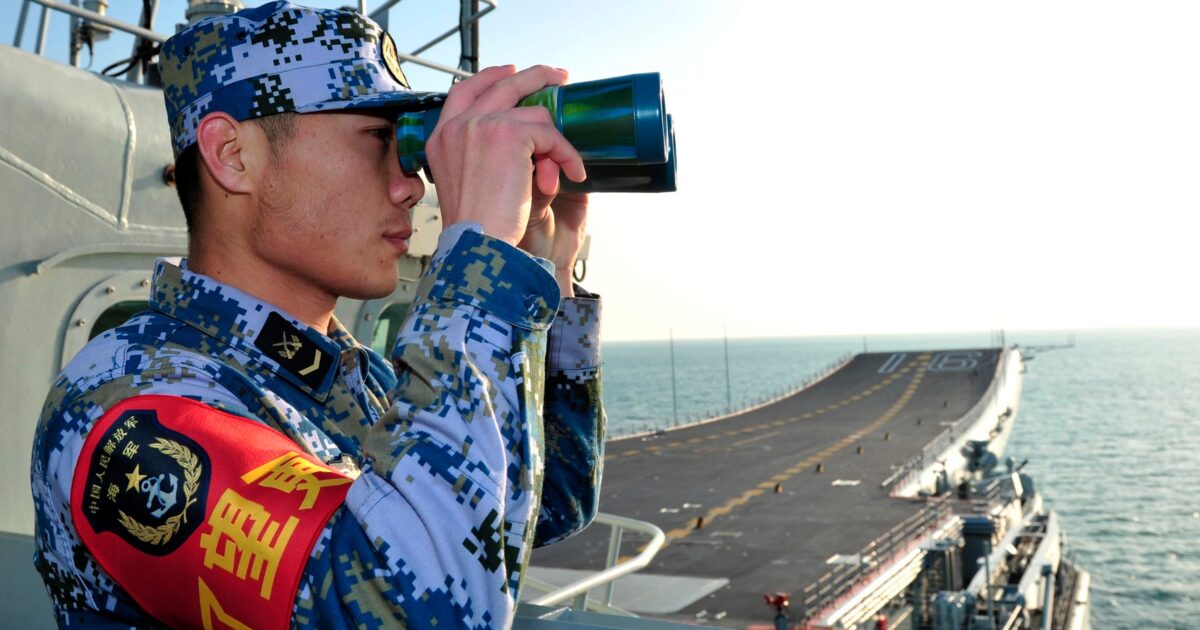
A naval soldier of the Chinese People’s Liberation Army views through binoculars aboard China’s first aircraft carrier, Liaoning, as it visits a military harbor in the South China Sea. Xinhua photo.
It is small, poor, and far away, so most Americans probably don’t know or care about it. However, the Federated States of Micronesia (FSM) is one of the most crucial strategic battlegrounds in the U.S.–China struggle for influence and power projection in the Pacific.
China wants the FSM because its islands sit inside the second island chain and give any power that controls them a direct hold over U.S. military movement, surveillance routes, and supply lines across the Pacific. A foothold there would let Beijing break America’s defensive perimeter and project power deep into territory that has been exclusively U.S.-controlled since World War II.
The Federated States of Micronesia (FSM) is a small Pacific nation composed of four island states, Yap, Chuuk, Pohnpei, and Kosrae, spread across a vast stretch of ocean between Guam and the Philippines. Despite its small population, the FSM occupies territory that is central to America’s Pacific defense architecture.
Under the Compact of Free Association, the FSM grants the United States exclusive military access and strategic-denial rights, which prevent any foreign power from building bases, stationing forces, or entering security agreements without Washington’s approval. In return, the United States provides economic support, immigration privileges, and defense guarantees. This arrangement effectively extends the U.S. homeland defense perimeter deep into the Western Pacific.
Micronesia, including the FSM, sits inside the second island chain and directly along the air and sea routes connecting Hawaii, Guam, and Australia. These routes form the core arteries of U.S. logistics, deterrence, and rapid-response capability. Any erosion of American influence in these islands threatens the stability of this entire network.
Chinese influence efforts across Micronesia combine economic incentives, infrastructure projects, and educational exchanges aimed at pulling these states away from Washington and undermining U.S. access to airfields, ports, and surveillance sites. Beijing uses infrastructure loans, fishing deals, and dual-use port or airfield construction as entry points to cultivate political leverage, gather intelligence, and weaken America’s exclusive military rights under the Compact.
China has already made inroads in Palau, Yap, and Kiribati, often under the guise of tourism or development projects. In Palau, Chinese entities have purchased strategic land near the site of the planned U.S. missile-defense radar on Angaur. In Yap, Beijing has shown interest in refurbishing an airfield; in Kiribati, it is eyeing a defunct U.S. airstrip; and in East Timor and the Solomon Islands, it is exploring additional airfields suitable for military dual use.
This regional push is supported by a steady campaign of political engagement and subnational outreach. On May 14, 2025, Chinese Ambassador Wu Wei met with leaders from the Federated States of Micronesia, including officials from Kosrae and Chuuk, to discuss expanding China-FSM cooperation. He reviewed the outcomes of FSM Vice President Palik’s recent visit to China and reaffirmed Beijing’s commitment to implementing the consensus reached between Chinese leader Xi Jinping and FSM President Wesley Simina.
Ambassador Wu highlighted continued support for road projects in Kosrae and Chuuk, framed within the one-China policy. Local leaders—including Kosrae Lt. Governor Arthy G. Nena and mayors from Tonoas and Uman—thanked China for its assistance, pledged to uphold the one-China policy, and signaled their intent to deepen cooperation across multiple sectors.
Two weeks later, these ties were showcased again when FSM President Simina inaugurated a new China-funded convention center in Palikir, describing it as a symbol of the “strong partnership” between FSM and the PRC. Funded under the Belt and Road Initiative with support from the Guangdong Provincial Government, the center was praised by Simina as both a practical facility and a landmark of growing bilateral ties.
He thanked the Chinese government and people for what he called their “selfless support,” commended Guangdong and the China Construction Science and Industry Corporation for completing the project, and said the building would help position FSM as a regional hub for diplomacy.
The project, initiated under former President David Panuelo, was opened in the presence of Ambassador Wu Wei and Guangdong Deputy Director-General He Rusheng. Both sides expressed a desire to expand cooperation in economic development, infrastructure, agriculture, transportation, and sustainability. Last year, Xi Jinping pledged $13.8 million in aid to FSM, and Ambassador Wu described the convention center as a “landmark” of China-FSM cooperation in the new era.
FSM Speaker Esmond Moses also called it the “most precious gift from the Chinese people,” underscoring its importance for the country’s development. Chinese state media, along with FSM’s Public Information Office, now linked through a memorandum with Chinese outlets, amplified the event, highlighting President Simina’s optimism about future China-FSM collaboration.
These moves are part of a broader toolkit of economic coercion, elite capture, and gray-zone influence operations aimed at co-opting Pacific Island governments. Chinese-linked casinos with intelligence capabilities have appeared on Tinian and previously on Saipan, shaping local politics and regulatory systems in ways that complicate U.S. basing efforts.
The Pentagon’s report on Chinese military activity warns that Beijing views engagement with Pacific Island nations, often through corruption and financial inducements, as a vehicle for expanding regional influence, pressuring them to drop ties with Taiwan, and cultivating access to local security forces.
Control of mid-ocean staging points determines whether a great power can reinforce or resupply in wartime. In a Taiwan war, China will try to prevent U.S. intervention by targeting the ability to move forces across the central Pacific. Micronesian islands, acting as logistics hubs or surveillance outposts, will be prime targets for influence campaigns, sabotage, or military action.
The post US–China Competition in Micronesia – Far Away From American Minds, but Crucial for Defense appeared first on The Gateway Pundit.