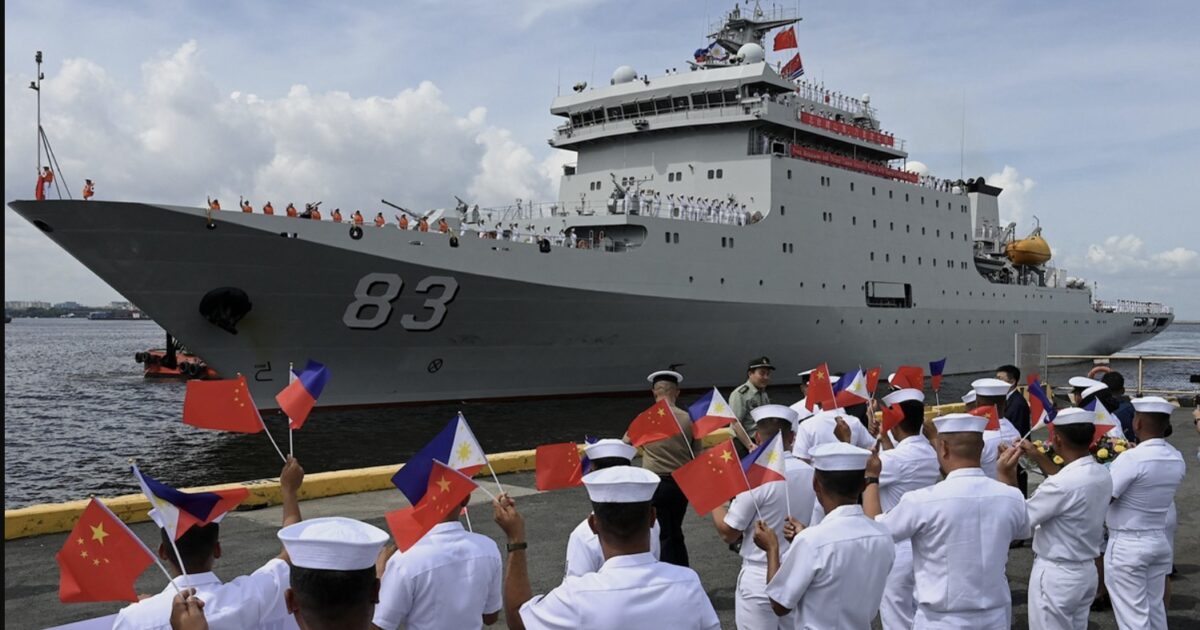
Philippine Navy personnel wave flags as they welcome the Chinese naval training ship Qi Jiguang in Manila on June 14, 2023. Photo courtesy of VCG/Global Times.
In early December 2025, China surged more than 100 naval and coast guard vessels across East Asian waters, pushing through the Yellow Sea and East China Sea and into the Pacific, according to regional intelligence reports. This unprecedented deployment is not limited to the First Island Chain.
By operating in the Philippine Sea and western Pacific, China is rehearsing the very movements needed to challenge U.S. positions on Guam, Tinian, Palau, and the rest of the Second Island Chain. The timing underscores Beijing’s intent to break out from its coastal defenses and project power deep into territory long dominated by the United States.
China has been aggressively expanding its military and is building naval vessels at a pace no nation has matched in recent history. Currently, China has 234 warships while the United States has 219. Although China has more ships, the United States still maintains a clear firepower advantage. Beyond the differences in ship capabilities, one of the factors holding China back from becoming a world-class navy is its inability to operate and resupply far from its shores. China has no ports in the Atlantic and only limited overseas capacity in the Pacific.
This is why the Second Island Chain, made up of Guam, Midway, the Marianas, Palau, the Marshall Islands, and nearby archipelagos, is so important to China’s blue-water navy strategy.
The Second Island Chain is imperative to the United States because the First Island Chain, spanning Japan, Taiwan, and the Philippines, is increasingly within range of Chinese long-range bombers and missile systems. These areas may no longer be survivable in the opening stages of a war with China. That makes the Second Island Chain essential to U.S. force posture.
China’s revival of Woleai’s airfield represents a concrete challenge to U.S. influence in the central Pacific and exemplifies Beijing’s pattern of building infrastructure under the guise of development while laying the groundwork for potential military use. The reconstruction is being carried out by the Chinese state-owned firm Shandong Hengyue Municipal Engineering in cooperation with the FSM government, following a May 26, 2025 groundbreaking ceremony attended by President Wesley Simina.
Officially, the project is a civilian initiative, the Woleai Airstrip Rehabilitation Project, intended to restore a deteriorated World War II–era airfield for transportation, emergency evacuation, and local development. But China rarely builds civilian infrastructure without strategic intent, and across the Indo-Pacific similar projects have evolved into dual-use assets supporting PLA operations, from Sri Lanka’s Hambantota port to Cambodia’s Ream Naval Base, the Solomon Islands airstrip upgrades, and multiple research outposts in the South China Sea that ultimately became militarized.
Woleai’s location makes the project even more significant. The atoll sits within the Second Island Chain. Any expanded Chinese access to an airfield here would erode the U.S. defensive perimeter. The involvement of Shandong Hengyue is particularly concerning, as major Chinese SOEs abroad operate within the CCP’s civil-military fusion framework and often serve long-term strategic objectives. For now, Woleai is not a Chinese military bas.
There are no public agreements permitting PLA operations, no status-of-forces arrangements, and no formal basing rights. But the pattern mirrors China’s pre-basing strategy, building dual-use facilities in key locations, establishing political or financial leverage, and quietly expanding access over time.
The geopolitical context underscores this dynamic. Woleai lies in a chain of islands the United States considers vital to containing China, yet American presence on these outer islands remains minimal. President Simina even traveled to the ceremony aboard an Australian patrol vessel, while construction materials arrived through Chinese aid, and no U.S. officials attended the event.
This stood in sharp contrast to events just days earlier at Camp Blaz in Guam, where FSM leaders joined a U.S. Joint Task Force Micronesia change-of-command ceremony. Rear Adm. Joshua Lasky reaffirmed America’s enduring ties with FSM under the Compacts of Free Association, describing them as “deep bonds built on trust,” while outgoing commander Rear Adm. Gregory Huffman called Micronesia a “bulwark against coercion.” These parallel scenes, U.S. assurances in Guam and Chinese construction on Woleai, capture the strategic contest now unfolding across the Second Island Chain.
In response to China’s growing regional influence, the U.S. Congress approved a $7.1 billion aid package in March 2024, renewing the Compacts of Free Association with Micronesia, Palau, and the Marshall Islands. This agreement secures continued American military access to FSM territory and underscores Washington’s strategic interests in the Pacific.
The Pentagon has earmarked $2 billion for Pacific infrastructure, including $400 million for upgrades to Yap International Airport. The U.S. Air Force has identified the site as a vital contingency location because of the region’s shortage of available divert airfields. Critics, however, point out that outer islands like Woleai remain neglected by Washington, creating space for Chinese influence to grow.
A similar pattern is emerging in Papua New Guinea, where the United States signed a 15-year Defense Cooperation Agreement in 2023 that granted American forces unimpeded access to six major ports and airfields, including the Lombrum Naval Base. Although details were initially vague, PNG later revealed the partnership included more than $864 million in infrastructure, training, and military support. By early 2025, the agreement had already produced visible results: U.S.-funded runways, wharfs, and fuel depots were under construction; joint exercises with PNG forces had increased; and additional deployments of U.S. personnel were underway.
While Washington stopped short of establishing a permanent base, the expanding U.S. presence, now coordinated directly rather than relying solely on Australia, marks a decisive step in America’s long-term positioning against China’s advance in the Pacific. The Trump administration has moved quickly to operationalize this framework, accelerating construction, increasing deployments, and integrating PNG into a larger military arc stretching across the Second Island Chain.
At the same time, the United States is reviving legacy bases across the region. It is reclaiming a World War II–era airfield on Tinian in the Northern Mariana Islands as part of a broader effort to reinforce the Second Island Chain and close the strategic gap with China. Similar restoration work is underway on Peleliu in Palau, with plans for Yap in Micronesia to follow. Once completed, the facilities on Peleliu and Yap will complement those on Tinian and Guam, creating a more resilient network capable of surviving a Chinese strike and reinforcing America’s defensive posture in the Pacific.
Local leaders in the CNMI, Palau, and other island states have shown increasing willingness to host U.S. facilities as China’s footprint and economic inducements grow. The dual-use nature of Chinese investments, casinos, tourism projects, and infrastructure that can quickly be adapted for military use, has raised widespread concern, strengthening support for an expanded American presence. What once may have seemed intrusive is now viewed as essential deterrence.
Though the headlines focus on tariffs, the real long game is unfolding across the waters and islands of the Indo-Pacific. By reinforcing the Second Island Chain, strengthening alliances, and deploying forces at strategic flashpoints, President Trump is executing a form of containment through forward positioning, one designed to encircle China without firing a shot. The combination of trade pressure and military posturing signals that the United States intends not only to remain a Pacific power but to shape the region’s future balance of power on its own terms.
The post Countering China’s Second Island Chain Strategy and Their Quest for a Blue Water Navy appeared first on The Gateway Pundit.