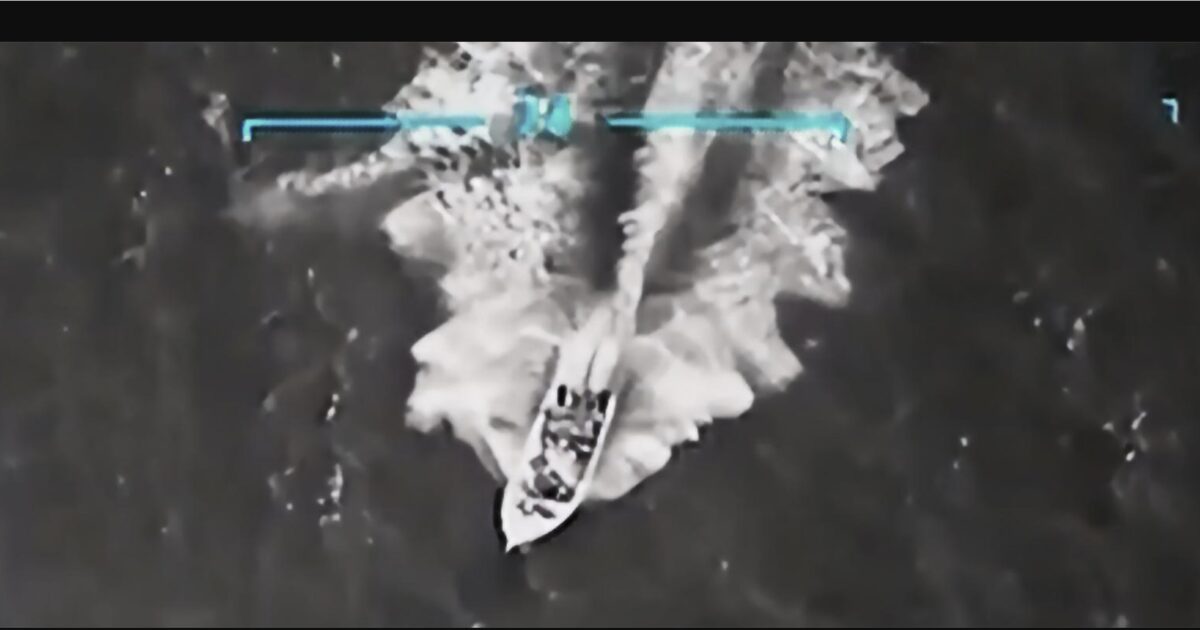
Photo courtesy of the U.S. Naval Institute
Pete Hegseth delivered a defiant speech at the Reagan library defending the Pentagon’s lethal strikes on suspected drug-smuggling boats in the Caribbean, insisting that President Trump has the authority to use military force “as he sees fit.”
He argued that the operations, which have killed more than 80 people since September, are justified because the traffickers work with designated terrorist organizations. Hegseth compared them to al-Qaida operatives and warned that any group bringing drugs into the United States would be targeted and sunk.
His defense comes as legal and political scrutiny intensifies. The administration claims the strikes fall under the laws of armed conflict because groups like Venezuela’s Tren de Aragua and Colombia’s ELN are terrorists. Legal experts reject that argument, noting the United States is not at war in the Caribbean, and the traffickers have not attacked Americans.
However, under U.S. domestic law there is no requirement for a formal declaration of war before the United States can use lethal force against terrorists; Congress can authorize force by statute, and the president also has self-defense authority.
Critics also point out that the suspects were never convicted of any crimes, that evidence behind the terrorist designations has not been made public, and that fentanyl typically enters the United States through Mexico, not via Caribbean smuggling routes. The rebuttal here, however, is that no conviction is necessary to counter terrorist operations. The 9/11 terrorists, for example, had no prior conviction, but lethal force would have been justified in stopping them.
There is also no requirement for the evidence of a terrorism designation to be made public. Furthermore, the administration has never claimed that these boats were carrying fentanyl. The claim is that they are carrying cocaine, which is consistent with the facts.
Tensions escalated after reports that a 2 September strike was followed by a second attack that killed two survivors clinging to debris, allegedly under Hegseth’s directive to ‘kill everybody.’ Hegseth denies issuing such an order. Furthermore, there is no evidence that he gave that order; the claim comes solely from media reports based on anonymous sources.
In closed-door briefings to lawmakers, Frank Bradley, the admiral who oversaw the operation, reportedly told Congress there was no ‘kill them all’ order from Hegseth.
Adm. Bradley told members of Congress that all 11 people aboard the suspected drug-smuggling boat struck on Sept. 2 were on an internal U.S. military target list, meaning they had been pre-approved for lethal action. According to several officials familiar with the briefings, Bradley said intelligence had identified each individual and validated them as authorized targets under President Trump’s campaign against narco-terrorist vessels.
This previously undisclosed detail adds new weight to the controversy surrounding the operation, especially the second strike that killed two survivors in the water.
Bradley said Defense Secretary Pete Hegseth ordered him to kill everyone on the approved target list, destroy the drugs, and sink the boat. He emphasized that military lawyers reviewed each step and that he acted within U.S. and international law.
Administration officials have similarly defended the strikes, saying the boat carried cocaine and was linked to a cartel designated by President Trump as a terrorist organization, though no evidence has been publicly released. However, there is no requirement for the government to release such evidence to the public for the strikes to be legally justified.
Bradley described firing a precision airburst munition that killed nine people and capsized the vessel, leaving two survivors who climbed onto the overturned hull. He observed the survivors for more than 30 minutes, determining they were not injured and had not surrendered.
He also said cocaine bundles appeared to still be strapped inside the capsized boat, raising concern the drugs could be recovered. A larger vessel suspected of being the intended rendezvous point was spotted nearby, but it was not on the authorized target list, preventing any action against it.
Bradley told lawmakers he ordered additional strikes because the survivors remained lawful targets, the drugs remained intact, and the vessel might still float or drift. Although U.S. intelligence later assessed that the cocaine was heading toward Europe or Africa, not the United States, Bradley said the drugs themselves constituted the threat. He denied receiving or issuing any illegal “no quarter” order and insisted the operation complied fully with the law.
The post Secretary of War Hegseth on Drug-Boat Strike: No Public Evidence of an Illegal Order appeared first on The Gateway Pundit.