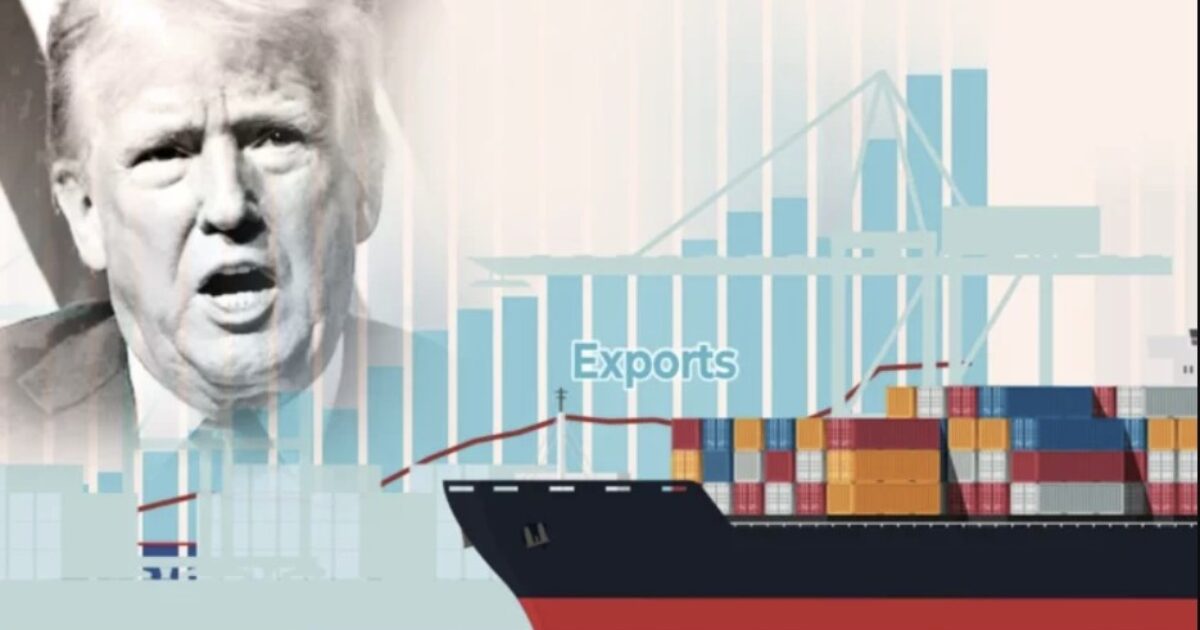
Though legacy media prefers to fixate on looming questions of affordability, one of the most neglected stories of the year has been just how much industry President Trump and his team have commandeered back into the United States.
Whether through the wide-ranging tariffs on goods coming from countries as varied as China, Canada, Mexico, Brazil, and the European Union, or by way of simply cutting deals with individual companies, like the $150 billion the President recently got IBM to commit in quantum computing and manufacturing over the next half-decade, the flurry of deals – both reported and sometimes not – unleashed over these last eleven odd months has positioned the United States to once again be the dominant industrial power on the planet.
The President long campaigned on a pledge of reviving American business, a plan that was defined by increased tariffs on foreign goods – particularly from countries like China and trading blocs like the European Union – as well as reindustrialization. Our previous trade agreements became a flashpoint on all three of the President’s campaigns, given how badly foreign competitors for years have taken advantage of lax trade rules, devised by American policymakers, to our national detriment.
This second term offered the President a unique chance to finally do a hard reset on the decades-old trading regime. Since April’s Liberation Day, the rules were once again rewritten to prioritize American businesses and reestablish this country’s economic dominance, bar none.
The long overdue changes in policy (simple, commonsense fixes to a problem that had been percolating for nearly half a century) had an immediate boon on American business. From Japanese commitments to steel and artificial intelligence, to Middle Eastern investments in energy, aircraft, real estate and biotech, America once again signaled to the world that it was open for business, and global markets responded in kind. As a result, hundreds of billions of dollars have poured into our shores, between external revenue and FDI inflows, directly replenishing America’s coffers.
In total, the US is on pace to bring in close to a trillion dollars this year alone, a number that Commerce Secretary Howard Lutnick has discussed with great pride, for it is indicative of a tectonic shift in America’s economic trajectory, a defiant course correction from what the prophets of doom had long forecasted about this country’s standing in the world for the twenty first century. America had long been written off by the self-proclaimed intellectuals of the Biden and Obama years. This class predicted that the United States was damned to go down the paths of Great Britain and Rome, an empire saddled by too much debt and too little growth. And that it was far too late to expurgate the virus, which would in short order swallow this once great power whole as other powers on the ascent, like China and India, pined to overtake it.
As gloomy a prognosis as that was, up until this year, one could not be faulted for believing it as a matter of dogma. Indeed, even with the muscle memory of the previous Trump administration nestled in the rearview mirror, it was a challenge to conceive – particularly after four disastrous years of Biden – that the downward economic spiral of the United States could really be reversed, and that the orthodoxy which governed its prior trade arrangements could be dispensed with outright.
And yet, the results speak for themselves. A trillion dollars of new economic opportunities is not merely a symbolic victory but is the sort of policy shift that will continue to echo for years to come. Not only will such a maneuver have a significant impact on spurring other businesses – representing the full gauntlet of industries, from AI to robotics to energy to real-estate development – to shift gears and reorient themselves to an American frame of reference. But furthermore, it will lay a strong foundation, one backed by tangible goods, that will make it a serious challenge for any Democratic politician (no matter how petulant) to undo the roaring success of the last year, try as they might. This latter opinion is supported by the countless meetings the President has taken with titans of industry, chief executives, and financial barons over just the last couple of weeks alone. They are flocking to this White House and this President because for the first time in at least a generation the entrepreneurial spirit of the country is truly at top of mind in driving questions of policy.
In the recent past, presidents – evidently none of whom were business-minded – would wax critically at American industry, sounding more like a sneering European technocrat instead of the de facto spokesperson of the American Dream by declaring that dream dead and gone, a fantastical figment of an age which would never return. It was undeniable that our history provided countless roadmaps of how to unleash American industry through tariffs and strategic trade dealmaking. Yet, latter-day policymakers, academics, and trade officials all maintained a dismissive, indeed derisive, posture to that glorious period in American history which encapsulated the last few decades of the nineteenth century and the first three of the twentieth – that golden age of unparalleled growth animated by robust tariffs and hardly any income tax (the Sixteenth Amendment was not ratified until 1913), a victory lap for economic nationalism that for globalists offer a historical bugaboo they prefer be ignored.
Fast forward to the current year, and we can observe that same tariff-focused model’s untapped potential in action with the return on interest already reigniting the American economy just over the previous eleven months. The aforementioned IBM has devoted $150 billion over five years for U.S.-based growth in AI and quantum computing, an allocation that includes a $30 billion investment specifically for research and development facilities in states like New York and California. Micron Technology, another tech behemoth, committed an additional $200 billion for semiconductor manufacturing as well as more research and development to repatriate memory chip production. Part of that deal included new factories to be set up in Idaho and New York, commitments that have been accelerated by CHIPS Act funding and tariff protections against Chinese imports.
Pivoting from AI to pharmaceuticals, Bristol Myers Squibb, a biopharmaceutical company headquartered in Princeton, New Jersey, also joined the ranks of industrial powerhouses recommitting to the homeland in their pledge of $40 billion for pharmaceuticals and biotech expansions, a deal that incorporates building new plants in New Jersey and California. Other pharmaceutical juggernauts, like Pfizer and Moderna, followed suit: committing nearly $400 billion in projects across the industry for the next five years, which are being driven by onshoring incentives.
This is just a smattering of what has been promised over the last year in corporate promises – and virtually no sector has been left untouched, from pharmaceuticals to technology to traditional manufacturing – cars, aircraft, steel, mining, the list goes on and on. Even that is just scratching the surface. The groundwork being laid today is poised to have a multiplier effect on trade – and American enterprise – for years to come. Like markets, the agreements themselves have a compounding effect: as more deals come in, other companies will follow their leads.
Deal by deal, the global market will slowly recalibrate around American business once again. And this time, it will have staying power that will ignite not just financial markets, but also include profound national security repercussions, as China and India finally lose ground to a renascent United States.
The Supreme Court recently took up the so-called “tariff question” in this year’s docket, where the High Court is set to rule on a landmark decision about whether the president has the statutory authority, under IEEPA – the International Emergency Economic Powers Act – to impose tariffs on foreign goods. The core question is yet another presidential authority/separation of powers issue, tracing the scope of such power on matters with far-reaching implications for business, global trade, and national security. In recent years, the Supreme Court has been increasingly deferential to a broad – or “energetic” in the words of our Founders – construction of presidential authority. In part this is attributed to the constitution’s explicit textual prerogative (and originally intended meaning), elucidated in the historical record by statesmen like Alexander Hamilton and James Madison – and realized in the acts of George Washington and his immediate successors, who, as president used their perch to unilaterally impose tariffs as they saw fit, justified by reasons as varied as to raise revenue for the fledgling Republic (as with the Tariff of 1789 under Washington) to protecting infant industries that risked being overtaken by foreign competitors (as with James Madison’s protective tariff of 1816, which helped build up domestic industries after being razed in the War of 1812).
There is also an interesting separation of powers angle to this analysis: the President is arguing that he, not Congress, has primary authority to impose tariffs because of the interests to national security – including remedying trade deficits and even curbing fentanyl imports – and America’s general welfare. This argument, which is supported by history, draws from at least two major rationales: the first, because of the national security interests at stake, the President as Commander-in-Chief may use the tariff power proactively as an extension of his diplomatic capabilities. This helps protect American business from foreign competitors like China, while also reorienting the global landscape to draw influence away from would-be adversaries, who if left to their own devices, might pose a threat to our way of life.
The second rationale is a question of expediency, and the reason why, after all, Congress has set a precedent of traditionally remaining “hands-off” or subordinate to the executive branch in the arena of worldly affairs. Congress, as the lawmaking body, is by nature slow and deliberative: these constrictions are woven into its very fabric; the President, by contrast, being unitary in complexion is much nimbler on its feet. Tariffs can be an instrument for raising money, sure, but unlike conventional taxes, also serve a national security function: they can be used as a powerful “stick” in foreign negotiations, or as leverage to counteract a foe rapidly in the process of arming themselves up (or any number of uses). This multifaceted function prefigures a much more nuanced legal analysis than mere taxing powers would warrant – since, the latter, unlike the former, tariff-question, rests squarely in the domain of Congress, to which the Constitution exclusively vests revenue-raising authority.
But the imposition of tariffs serves both revenue-raising and national security functions, and so the Commander-in-Chief must have primary discretion in its use. Thus, a proper, constitutionally-sound decision by the High Court would recognize this fundamental distinction and delegate this authority to the President, and not Congress in turn, justifying their decision based on the various reasons already explained.
Historically, tariffs were one of the main ways for the government to raise revenue, protect American industry, and shield us from foreign competition – and the attendant risks that come with it. Under President Trump, we are finally, after many years, rediscovering that grand history and unlocking Almighty Tariff’s prosperity-boosting potential: let us pray that the judiciary follows the President’s lead and similarly recognizes this incontrovertible history. Or else as a nation we risk backsliding into the economic malaise epitomized by the Biden era’s trade policies, which could set the United States back decades and surrender whatever advantages we may have gained back over the past year to our adversaries. That is a danger that hopefully the Supreme Court, in its infinite wisdom, will recognize, and put a stop to in its tracks.
Featured image by India shipping news
The post Trump’s Tariff Triumph: Billions in FDI Revive America’s Industrial Dominance appeared first on The Gateway Pundit.