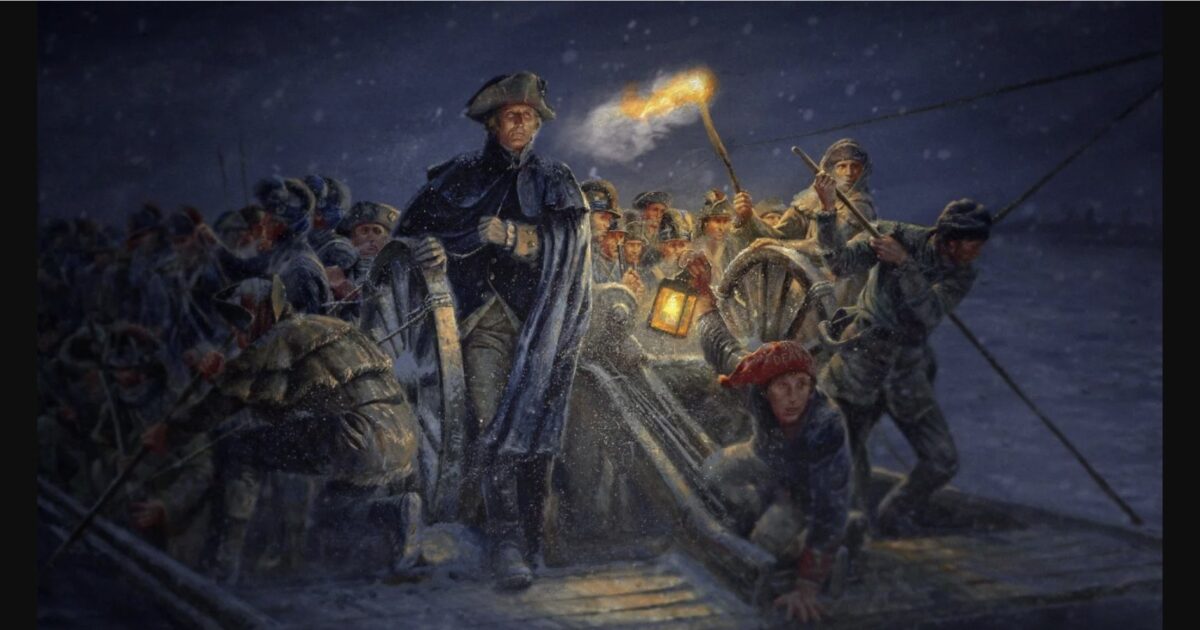
The story of George Washington crossing the Delaware on Christmas Day reminds us that American freedom was born in sacrifice, courage, and unwavering belief in the cause of liberty, and that Washington’s victory was a miracle granted by God.
On the night of December 25–26, 1776, during the American Revolutionary War, George Washington led a desperate and audacious crossing of the ice-choked Delaware River in an effort to surprise Hessian troops stationed in Trenton, New Jersey.
It was a gamble taken at the lowest point of the Revolution, after months of crushing defeats that had cost the Continental Army New York City and left morale on the brink of collapse. Many believed the cause of independence was lost.
Washington’s army began crossing the river around 11 p.m. on Christmas night amid freezing temperatures, high winds, and sheets of snow and sleet. Ice floes clogged the river, threatening to crush the boats ferrying men, horses, and artillery across the water. Of the roughly 5,400 troops originally planned for the operation, only about 2,400 successfully reached the New Jersey side before dawn. Even then, Washington pressed forward. His password for the night was simple and stark: “Victory or Death.”
After completing the crossing, Washington’s exhausted men marched nine miles through the storm toward Trenton. Many were poorly clothed, some barefoot, leaving bloody footprints in the snow. At dawn on December 26, the Continental Army advanced in two columns and descended on the town.
The roughly 1,400 Hessian defenders, weary from Christmas celebrations and confident after a series of British victories, were caught completely off guard. Within hours, American forces overwhelmed the garrison. By 9:30 a.m., Trenton was surrounded, nearly 1,000 Hessian soldiers were captured, and the Americans had suffered only four fatalities.
Despite the success, Washington lacked sufficient men and artillery because much of his army had failed to cross the river. He withdrew from Trenton soon after the victory. Tactically, the battle was limited. Strategically, its impact was enormous. News of the victory electrified the colonies and shattered the belief that the Continental Army was incapable of defeating professional European troops.
The crossing and the victory at Trenton revived American morale at the moment it was needed most. Enlistments set to expire at the end of the year were renewed, and hope returned to a cause that had seemed doomed only days earlier. Washington repeatedly acknowledged divine providence in both the survival of his army and the success of the operation, a belief widely shared by the men who followed him into the storm.
In his surviving writings, Washington referred to God as “Providence” more than 270 times and expressed the conviction that the Revolution unfolded under divine guidance. In a letter to one of his generals, he wrote that “the hand of Providence has been so conspicuous in all this, that he must be worse than an infidel that lacks faith, and more than wicked, that has not gratitude enough to acknowledge his obligations.”
Washington believed the cause of independence was righteous and ordained, and that victory depended not solely on human strength, but on divine favor.
Washington’s sense of providence was grounded in a lifelong pattern of Christian formation and practice. At the age of thirteen, he copied verses on Christmas Day that read, “Assist me, Muse divine, to sing the Morn, on Which the Saviour of Mankind was born.”
He descended from a family with deep church ties, received Christian instruction at home, attended worship regularly, and spoke openly of Jesus Christ. During the war, he defined what it meant to be a “Christian soldier” in his general orders and required discipline, moral conduct, and respect for religious observance within the ranks.
Public expressions of faith were common throughout the Revolutionary era. The Continental Congress employed chaplains, as did Washington’s army, and political leaders frequently proclaimed days of prayer, fasting, and thanksgiving.
Many of the principles underlying the Revolution, including the belief that all men are created equal, were widely understood as grounded in Christian teaching. John Adams later wrote that the principles of independence had taken root in religious conviction long before the outbreak of war.
After the victories that followed Valley Forge, Washington ordered a day of fasting, humiliation, and prayer on April 22, 1778, directing all troops to suspend work and attend religious services. He required chaplains for each regiment and ordered soldiers to show them respect. In one directive, he stated that “the blessing and protection of Heaven are at all times necessary, but especially so in times of public distress and danger,” and elsewhere made clear that devotion to Christian character should never be eclipsed by patriotism.
For Washington, there was no contradiction between defending liberty and honoring faith. Christmas commemorated the coming of Christ to bring spiritual freedom, while the crossing of the Delaware preserved the possibility of political freedom. Both required faith, sacrifice, and trust in divine guidance. In that sense, Christmas of 1776 became inseparable from the survival of American independence.
Washington’s Christmas night gamble stands as one of the clearest examples of American resilience and faith under fire. The crossing of the Delaware did not end the war, but it saved the Revolution at its darkest hour. It remains a defining moment in America’s founding, when courage, conviction, and Christian faith converged to keep the cause of liberty alive.
The post America’s Christmas Miracle George Washington Crosses the Delaware, December 25, 1776 appeared first on The Gateway Pundit.