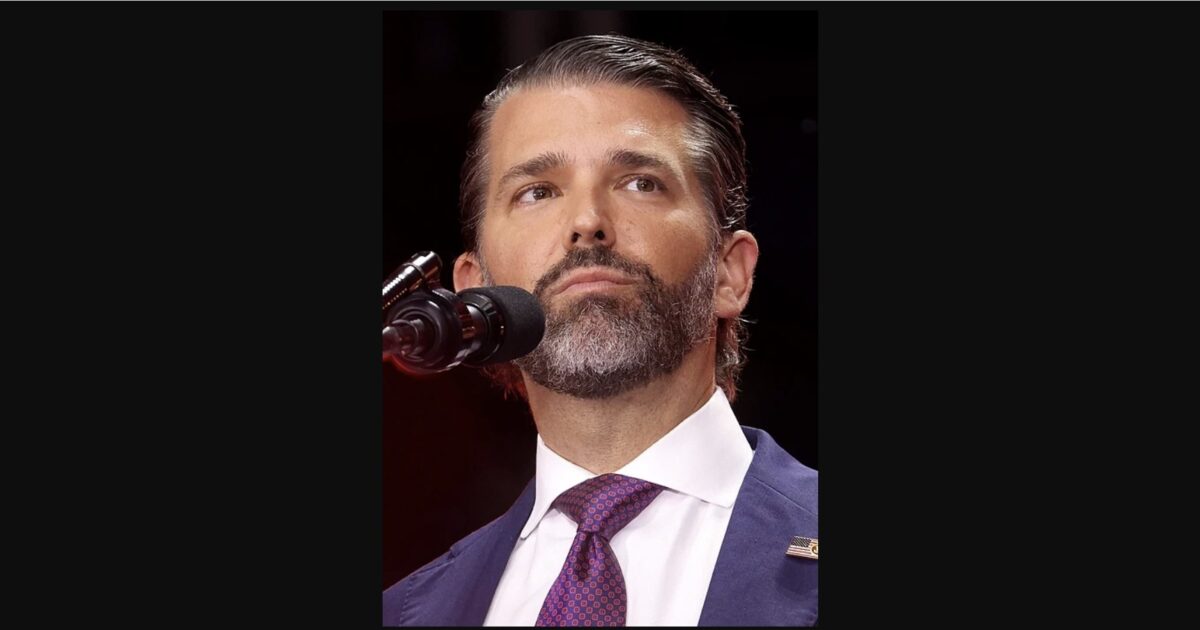
Donald Trump Jr. Photo courtesy of Gage Skidmore, CC BY-SA 4.0 (https://creativecommons.org/licenses/by-sa/4.0), via Wikimedia Commons
A conspiracy theory being perpetuated by Democrats claims that Donald Trump Jr. owns a rare earth mineral company that received a $620 million loan from the Department of Defense, supposedly representing corruption by the Trump administration. As is often the case with attacks on the current administration, this narrative is false. Here is the truth.
Vulcan Elements, a firm neither owned nor operated by Donald Trump Jr., received a $620 million loan from the Pentagon’s Office of Strategic Capital in November 2025. This is the largest loan ever issued by OSC, which was established in December 2022 under the Biden administration. The loan is part of a broader Pentagon initiative to expand domestic production of rare earth magnets. ReElement Technologies, another firm neither owned nor operated by Donald Trump Jr., received an $80 million loan from OSC as part of the same effort.
Donald Trump Jr.’s involvement is limited and indirect. He is a partner at 1789 Capital, a venture capital firm that made a minority equity investment in Vulcan Elements in August 2025, approximately three months before the Department of Defense loan was announced. That investment was part of Vulcan’s Series A funding round, which raised $65 million and was led by Altimeter Capital, a firm unrelated to Trump Jr. 1789 Capital was one of several investors participating in the round.
So, to recap, Trump Jr. does not own Vulcan Elements, does not run the company, has no direct equity stake in Vulcan Elements based on public records, and does not serve on Vulcan’s board or in any advisory capacity. He does work as a partner at 1789 Capital, participates in investment decisions at the firm, has indirect exposure through 1789’s portfolio, and would benefit financially if 1789’s investments appreciate.
The Pentagon explicitly stated Trump Jr. was not involved in any aspect of the conditional loan commitment discussions. Both Commerce Department and Vulcan officials denied Trump Jr. played any role in securing the loan.
Media reports have characterized Vulcan as being “backed by” Trump Jr.’s firm. This language is used to intentionally misrepresent the relationship by suggesting a primary financial supporter, controlling interest, or main sponsor role. In reality, 1789 Capital was one investor among several, was not the lead investor, holds a minority stake, and has no indication of board seats or operational control.
Breaking U.S. dependence on China for rare earth minerals is explicitly documented as a national security priority across multiple administrations and policy documents. The Biden-era 2024 National Defense Industrial Strategy set a DOD goal to develop a complete mine-to-magnet rare earth supply chain by 2027. Since 2020, DOD has committed over $439 million toward building domestic rare earth supply chains. The Biden Administration issued multiple executive orders and fact sheets identifying rare earth elements as critical for national security and economic prosperity.
China currently controls 60-70% of rare earth mining, 85-90% of processing capacity, and 90-93% of magnet manufacturing. The country also controls 77% of cobalt processing, 92% of rare earth elements processing, and 91% of graphite processing. Rare earths are essential for F-35 fighter jets, Virginia-class and Columbia-class submarines, Tomahawk missiles, radar systems, and smart bombs and guided munitions. Each gas-powered car contains 40 rare earth magnets. Electric vehicles require even more.
China has progressively restricted rare earth exports. In 2010, China restricted rare earth exports to Japan, leading to a WTO case. In July 2023, China imposed export controls on gallium and germanium. February 2024 brought tungsten and tellurium controls. In April 2025, China restricted seven rare earth elements in response to Trump tariffs.
August 2024 added bismuth, molybdenum, and indium controls. December 2024 banned germanium, gallium, and antimony sales to the U.S. October 2025 brought tighter restrictions including case-by-case review for advanced technology applications.
Other companies have received similar or larger government support for rare earth production with no Trump Jr. connection. MP Materials received a $400 million DOD equity investment for a 15% stake, a $150 million loan for heavy rare earth separation, a $110/kg price floor guarantee on neodymium-praseodymium (double current market price), and a 10-year guaranteed offtake agreement. This multi-billion-dollar commitment represents the first time DOD became a major shareholder in a critical minerals company.
Lynas Rare Earths received a $258 million contract for a heavy rare earth refinery in Texas, $30 million in 2021 for a light rare earth separation plant, and $120 million in 2022 for a heavy rare earth separation facility. OSC was created in December 2022 under the Biden administration. Initial OSC funding of $984 million was appropriated in March 2024. The 2024 goal is to complete a mine-to-magnet supply chain by 2027.
Reducing dependence on Chinese rare earths has been bipartisan U.S. policy since at least 2010, and multiple companies have received similar government support over the years. The national security rationale for expanding domestic rare earth production is well documented across administrations and policy frameworks. As a result, U.S. government investment in rare earths is logical and consistent with policies dating back through the Biden administration and earlier.
Most importantly, there is no indication that Donald Trump Jr. or any firm he controls received this money. The Donald Trump Jr. DoD loan conspiracy theory is therefore debunked.
The post No, Don Jr. Did Not Get a $620 Million Government Loan for Rare Earths appeared first on The Gateway Pundit.