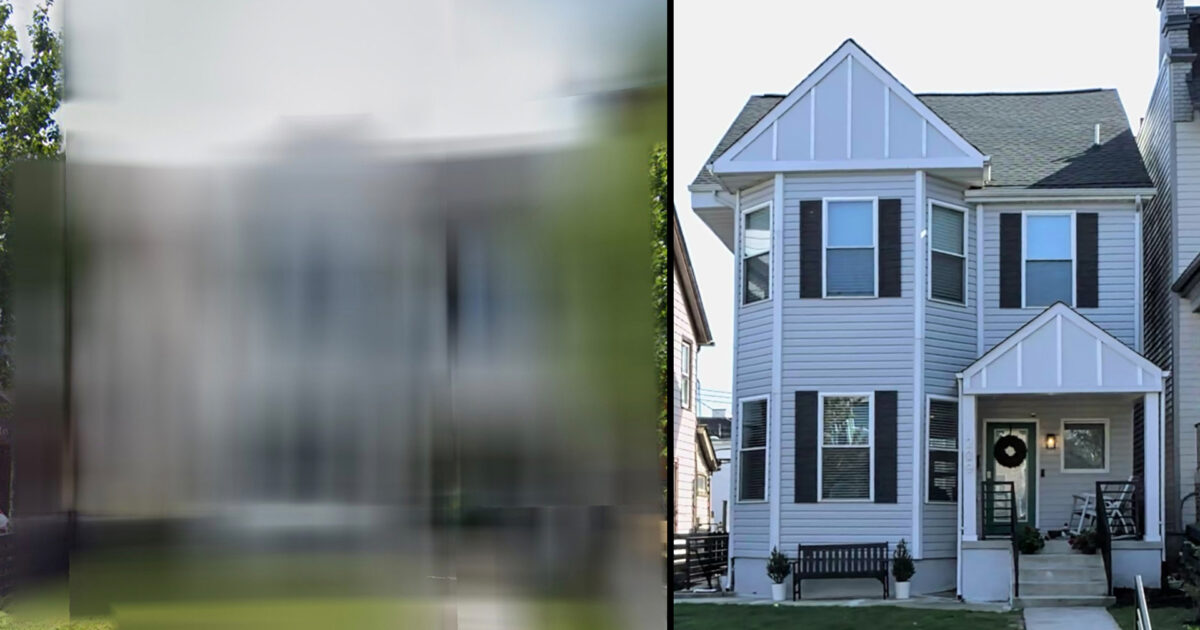
Does Eric Swalwell really think that blurring out his house on Google Maps can wipe out the facts?
Ironically, Swalwell had previously enjoyed showing off his home at 209 S Street NE in Washington, D.C. to the world. Variety Magazine featured Swalwell’s home when he purchased it in 2020.
On his Instagram account, Swalwell has repeatedly posted photos inside and outside of his home, his dog sleeping on the living room floor, looking out at his backyard, and even a birthday video with his children.
Screenshot: Swalwell/Instagram
Now, Eric Swalwell has blurred out his home on Google Maps so it cannot be viewed online.
Google Maps allows homeowners to blur their homes as part of Google’s broader privacy and safety policy. To request blurring, a homeowner uses the “Report a Problem” feature directly within Google Maps Street View.
The user just navigates to their address, clicks the reporting link, then selects the option to blur their home. Once a home is blurred, the blur is permanent for that location in Street View, even if ownership changes.
Screenshot
What exactly is Swalwell now trying to hide? In “Eric Swalwell is Constitutionally Disqualified from Running for Governor of California,” I explained that Swalwell is ineligible to run for governor because he legally declared his domicile to be Washington D.C., and he has no California address.
California’s eligibility rules to become governor derive from the California Constitution. Article V, Section 2 states a person is eligible to be Governor only if he is “a citizen of the United States and a resident of this State for 5 years immediately preceding the Governor’s election.”
The operative word is resident. But in California law, “resident” does not simply mean where one receives mail or even owns property. It means “domicile”, one’s true, fixed, permanent home.
California Elections Code §349 makes this point absolutely clear: “A domicile is the place where a person’s habitation is fixed and where they have the intention of remaining.” And, “At a given time, a person may have only one domicile.”
Swalwell’s mortgage document to purchase 209 9th St SE in Washington D.C. makes it clear. On the opening pages of the Deed of Trust, Swalwell and his wife are listed as the borrowers.
The document is a District of Columbia Deed of Trust, and it contains the standard federal Fannie Mae/Freddie Mac provisions for owner-occupant primary residence declarations.
Clause 8 of the document includes the line “Material representations include, but are not limited to, representations concerning Borrower’s occupancy of the Property as Borrower’s principal residence.”
The signature page shows Swalwell and his wife signing under seal, affirming every covenant in the document. The Swalwell’s signatures confirm he is bound by the principal residence owner-occupancy declaration.
On the Security Affidavit on page 20, Swalwell again signs under oath regarding his ownership and use of the D.C. property “subject to criminal penalties for making false statements”.
What about Mortgage fraud? Does blurring out your house erase that? Separately, Federal Housing Finance Agency Director Bill Pulte referred Swalwell to the Department of Justice for potential mortgage fraud violations in November 2025.
Facing political and legal disaster, Swalwell filed a civil lawsuit against the Federal Housing Finance Agency and Director Pulte built on two shaky allegations:
That referencing his public mortgage paperwork violated the Privacy Act and the First Amendment, claiming the publicly available document was “private”; and
That he had included a sworn affidavit with his mortgage stating his D.C. residence was “his wife’s” primary residence rather than his own.
Both claims immediately collapse under minimal scrutiny.
Every mortgage executed in Washington D.C., including Swalwell’s, appears on the public database mytax.dc.gov where I accessed the Deed of Trust for Swalwell’s 209 9th Street SE home.
This document is public by law and has been available online for years. Director Pulte merely referenced this publicly available file in his DOJ referral.
Next, Swalwell’s online Deed of Trust contains no language whatsoever in which Eric Swalwell disclaims that the property will be his principal residence, nor does it include any affidavit, rider, or statement indicating that the home will be used exclusively by his wife or that he will not live there.
Both Eric Michael Swalwell and Brittany Watts Swalwell are listed jointly as “Borrower,” they jointly sign the Deed of Trust, and the only affidavit they sign pertains solely to D.C. tax classification for a residential property.
If Swalwell insists he lives in California, he is guilty of mortgage fraud due to his sworn documents claiming a primary residence in Washington D.C to qualify for low interest rates he was not entitled to.
Blurring a house on Google Maps does not blur sworn signatures, recorded deeds, or federal mortgage covenants. It does not un-sign a Deed of Trust. It does not relocate a domicile. And it certainly does not convert Washington, D.C. back into California by wishful thinking.
At best, the Google Maps blur by Swalwell is a digital fig leaf, an attempt to hide a legal problem behind a privacy setting designed for stalkers, not for members of Congress with inconvenient paperwork.
Eric Swalwell wants voters to believe that what he solemnly affirmed under seal to a lender, a taxing authority, and the federal government somehow means something different when election season rolls around.
According to this logic, a “principal residence” is only principal when the bank asks, a domicile is flexible depending on the ballot, and public records are suddenly private once they become politically radioactive.
That may be creative lawyering, but it is not how contracts, mortgages, or constitutional eligibility work in the real world.
In the end, this is not about Google Maps, privacy, or safety. It is about credibility. When a politician attempts to dismiss his sworn financial disclosures, voters are entitled to ask a simple question: if he will blur his own house to avoid accountability, what else would he blur once he has more power?
The irony is rich. A man who cannot keep a straight story about where he lives wants to govern 39 million people. Swalwell cannot fix his legal problems with a blur tool.
He can only fix it by withdrawing his candidacy for governor before the state of California is forced to remove him from the ballot.
Joel Gilbert is a Los Angeles-based film producer and president of Highway 61 Entertainment. He is the producer of the new film Roseanne Barr Is America. He is also the producer of: Dreams from My Real Father, The Trayvon Hoax, Trump: The Art of the Insult, and many other films on American politics and music icons. Gilbert is on Twitter: @JoelSGilbert.
The post What’s He Got to Hide? — Eric Swalwell Blurs Out his ‘Mortgage Fraud’ Home in Washington D.C. on Google Maps appeared first on The Gateway Pundit.