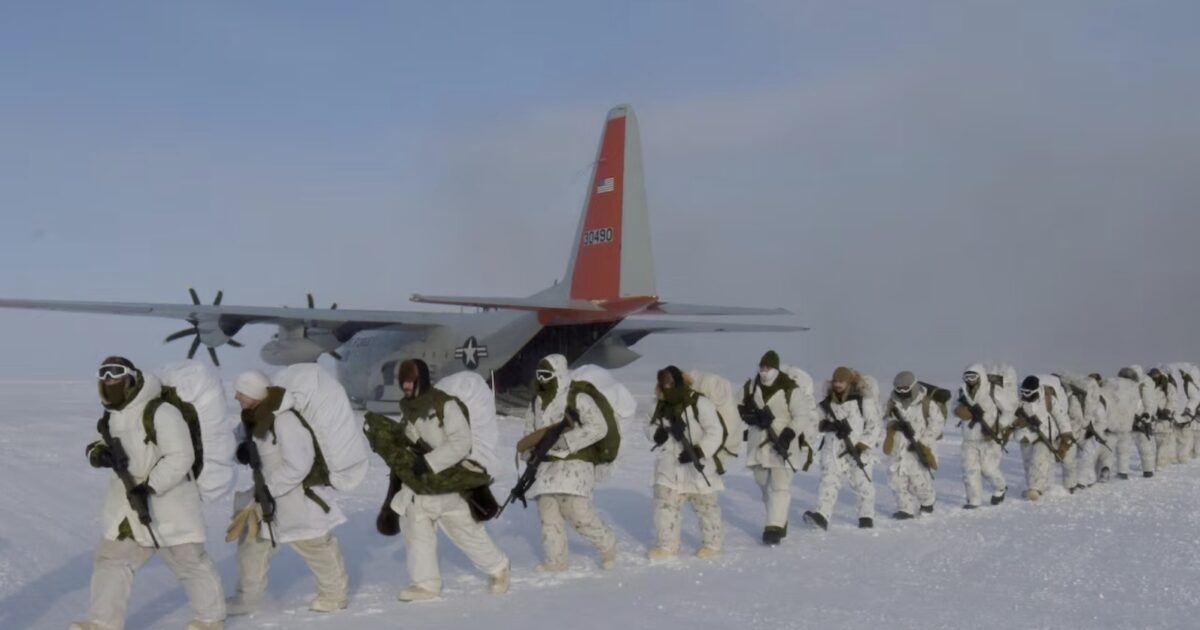
U.S. troops in Greenland. Photo courtesy of the U.S. Department of War.
Trump is right about Greenland. The United States defended the island during World War II, and it was forcibly annexed by the Kingdom of Denmark in 1951 without UN approval and without the consent of the island’s population. Today, Greenlanders would likely agree to a compact of free association with the United States, which would give them greater autonomy and independence from Denmark.
President Trump has expressed interest in Greenland for national security reasons, as Russia and China are increasingly sending naval vessels through Arctic waters north of Alaska. Positioned between North America and Europe, Greenland controls emerging Arctic sea lanes that are becoming more accessible as ice retreats.
The United States operates Pituffik Space Base, formerly Thule Air Base, on the island, which plays a critical role in missile warning and space surveillance. In 2019, Walter Berbrick of the Naval War College stated that whoever controls Greenland will control the Arctic, calling it the most important strategic location in the region and possibly the world.
Greenland is also rich in natural gas, oil, and minerals used in advanced technology and military applications, resources that sit at the center of the U.S.-China trade war. The United States has classified 50 minerals as critical to national security, and Greenland holds known reserves of 43 of them, including rare earth elements essential for modern weapons systems and advanced technologies.
Trump has repeatedly emphasized that the United States must secure Greenland to prevent Russia or China from gaining influence there. China currently dominates global rare earth processing, making access to alternative sources strategically urgent. These materials are indispensable for defense systems, electronics, and electric vehicles, and the ongoing retreat of Arctic ice is making large-scale extraction increasingly feasible.
The House China Committee asked the Secretaries of Defense and State to evaluate Chinese dual-purpose research and surveillance activities at research stations in Iceland and Norway’s Svalbard, demonstrating concerns about Chinese Arctic presence. Russia and China have both increased Arctic activity.
Trump administration officials are expected to meet privately with Danish officials on Wednesday to discuss Greenland, following statements from Secretary of State Marco Rubio confirming President Trump’s interest in acquiring the territory. The White House has said it is considering a range of options, including military force, though Rubio has attempted to downplay that possibility.
Senator Tim Kaine said Democrats and Republicans would unite to block any U.S. military action against Greenland, stressing that Denmark is a NATO ally and should not be treated as an adversary. Trump has also raised doubts about NATO’s reliability, questioning whether the alliance would defend the United States if needed and suggesting that withdrawing could save money.
European diplomats told CBS News that Trump’s rhetoric has further strained relations with European allies, some of whom now question the durability of America’s commitment to NATO. One diplomat described the Greenland issue as a potential breaking point, particularly after Danish Prime Minister Mette Frederiksen warned that a U.S. military seizure of Greenland would effectively end NATO. Under Article 5 of the alliance, an armed attack on Denmark would obligate all members to respond.
It seems extremely unlikely that President Trump would invade and capture Greenland. However, this entire line of reasoning by Europeans is preposterous. The United States represents about 80 percent of NATO’s firepower. The reason NATO depends on the U.S. is that the alliance is incapable of defending itself from Russia. NATO is certainly in no position to launch a war against the United States to defend Greenland.
It is almost as if, when doing firepower calculations, Europeans assume the U.S. would provide troops to NATO to help them fight the U.S. President Trump would never do that. Such a foolish course of action would, in addition to costing countless European lives, distract resources from Ukraine and likely result in the U.S. withdrawing not only from NATO but also from defending Ukraine, something Europe cannot do on its own.
Louisiana Governor Jeff Landry, appointed by President Trump as special envoy to Greenland, criticized Denmark’s postwar annexation of the island nation.
The United States defended Greenland during World War II while Denmark was under Nazi occupation and unable to do so. On April 9, 1940, Germany invaded and occupied Denmark. One year later, on April 9, 1941, Danish Ambassador Henrik Kauffmann, acting independently because Denmark was under Nazi control, signed an agreement with the United States authorizing the U.S. to defend Greenland.
From 1941 to 1945, the United States established an extensive military presence on the island. This included facilities for air and sea traffic, radio beacons and stations, weather stations, ports and depots, artillery posts, and search-and-rescue stations. The U.S. Coast Guard also provided civilian resupply along both coasts. The strategic purpose of this presence was to prevent German use of Greenland, protect critical North Atlantic shipping routes, maintain weather stations essential for Atlantic operations, and preserve Greenland as an air transit route between North America and Europe. The legal basis for U.S. involvement rested on the Monroe Doctrine, which was invoked to prevent a European power, in this case Nazi Germany, from controlling territory in the Western Hemisphere.
When Denmark was liberated from Nazi occupation in 1945, it immediately reasserted control over Greenland. The Greenland Administration surrendered its wartime emergency self-governing powers and returned authority to Copenhagen. The 1941 Kauffmann–U.S. agreement stated that it would remain in force “until agreement has been reached that current threats to the peace and security of the American continent have ended.”
Denmark later argued that those threats ended with World War II in 1945, while the U.S. position implied that threats continued into the Cold War with the Soviet Union. As a result, the U.S. military remained in Greenland, and by 1948 Denmark abandoned efforts to force a complete U.S. withdrawal. In 1951, the United States and Denmark signed a defense agreement formalizing the continued U.S. military presence, which continues today.
In 1953, Denmark removed Greenland from the United Nations list of non-self-governing territories by declaring it an integral part of the Kingdom of Denmark and granting Greenland representation in the Danish parliament.
Criticism of Denmark’s postwar actions centers on the lack of a referendum. Denmark integrated Greenland into the kingdom in 1953 without a vote by Greenlanders, despite United Nations Resolution 850 (IX), which emphasized that integration with a colonial power should be validated through an expression of the will of the people. After declaring Greenland fully integrated, Denmark removed it from the UN decolonization list.
Denmark’s ambassador to the United States countered that Greenland has been part of the Kingdom of Denmark for centuries and noted that all five parties in Greenland’s parliament oppose becoming part of the United States. The Danish ambassador is incorrect, however, and repeats the same error Denmark made when it annexed Greenland after World War II: he never asked Greenlanders what they want. According to Greenland’s prime minister and party leaders, they want to remain Greenlanders, not Americans or Danes.
A poll released by Patriot Polling found that 57.3 percent of surveyed respondents in Greenland support joining the United States, while 37.4 percent oppose the idea and 5.3 percent remain undecided. The survey questioned 416 people and was conducted during a visit by Donald Trump Jr.. The results of the poll are questionable because of the small sample size.
However, other research has found that Greenlanders desire greater autonomy and independence from Denmark but overwhelmingly reject becoming part of the United States. Some are open to a Compact of Free Association with Washington for economic and defense benefits, a model similar to arrangements used by Pacific island nations. Rasmus Leander Nielsen of the University of Greenland has said that Greenlanders have discussed since the 1980s the idea of creating a compact of free association with Denmark after independence, and that some have suggested a similar arrangement with the United States instead.
The winning Democrats party in the March 2025 election stated that a free association model with another country could be suitable for a sovereign Greenland, citing Denmark and the United States as the only two realistic options. Pele Broberg, leader of runner-up Naleraq party, suggested that Greenland could gain free association status similar to Micronesia or Palau’s association with the United States to deal with the lack of military protection from Denmark after independence.
The 2023 draft constitution made room for a potential new relationship between an independent Greenland and Denmark through free association, under which Greenland could request support in areas such as defense, health, monetary matters, and embassies. This arrangement could instead be with the United States, which would provide Greenland with even greater autonomy than Denmark would.
The post Greenland and the Donroe Doctrine – Greenlanders Want Independence from Denmark appeared first on The Gateway Pundit.