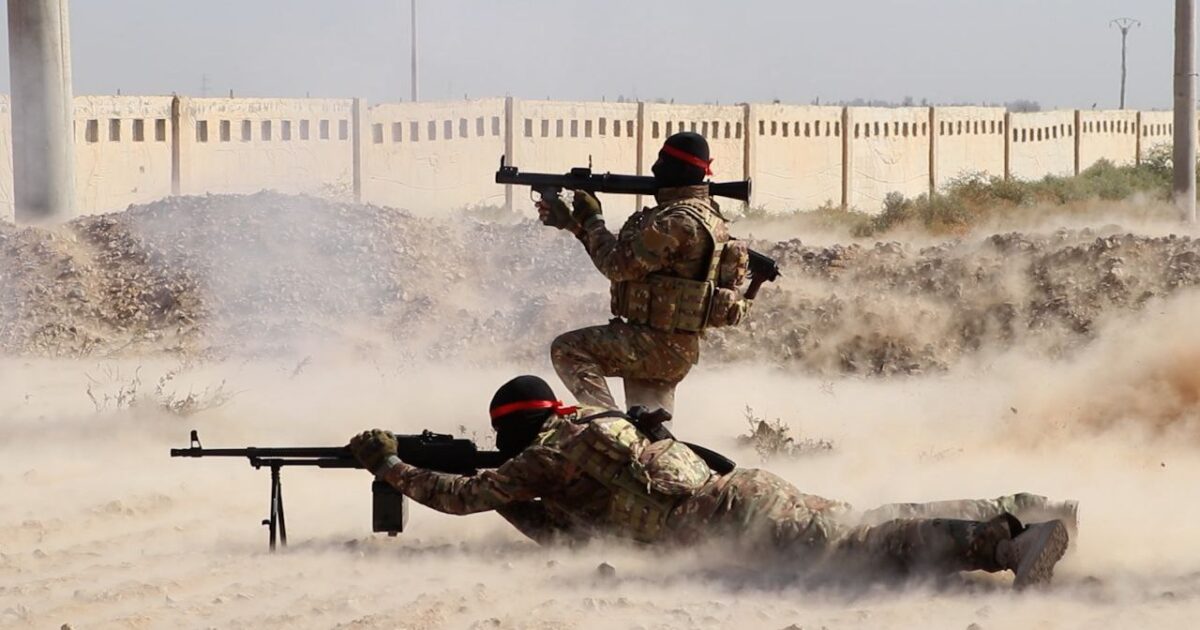
Photo courtesy of the Syrian Democratic Forces (SDF)
The Kurdish-led Syrian Democratic Forces (SDF) have been sending out urgent messages stating that they are currently under attack at Shaddadi prison in Hasaka Province, which holds thousands of the most dangerous Islamic State prisoners. Reports from the ground indicate that the attack is being led by Syrian government forces and supported by various Islamist extremist groups operating in the area, including Al-Qaeda.
Syria’s current leader, Ahmed al-Sharaa (formerly known as al-Julani), was previously an Al-Qaeda figure before attempting to rebrand himself as a head of state. A local observer said forces loyal to the al-Sharaa government attacked in order to liberate “their sons” from Syrian Democratic Forces custody.
The SDF requested assistance from the U.S.-led international coalition, which is only about a mile and a half away from the prison, but the coalition did not respond. Local residents now fear that “the United States and its allies have an interest in giving Islamic State a free hand again in Syria.”
Simultaneously, there are reports of attacks on civilians in and around Kobane, which sits directly on the Turkey–Syria border, about 150 miles from Shaddadi prison.
According to the SDF, its forces repelled multiple assaults but suffered heavy losses, with dozens of fighters killed. The group said it repeatedly requested assistance from the U.S.-led coalition, but no intervention came. At the same time, the SDF reported clashes near the Al-Aqtan prison outside Raqqa, another major ISIS detention facility, warning that any takeover could trigger renewed chaos and a resurgence of terrorism.
Syria’s defense ministry denied attacking the prisons, claiming government forces were deployed only to secure Al-Aqtan and its surroundings and had not entered Shaddadi prison. The SDF reported additional casualties around Al-Aqtan, including nine fighters killed and twenty wounded.
After recent negotiations, and amid renewed fighting, Syrian forces loyal to Ahmed al-Sharaa and the Damascus government quickly moved into vacated territory, tightening control across northern and eastern Syria and strengthening al-Sharaa’s rule. In Raqqa, government internal security forces and military police established checkpoints overnight and cleared the city of remaining Syrian Democratic Forces fighters.
At Shaddadi prison, the SDF reported losing control of the facility after attacks by Damascus-affiliated factions, claiming guards were killed and some beheaded. The Syrian army acknowledged that dozens of ISIS inmates escaped.
Reports also indicated that other detention facilities in Raqqa, including Taameer prison and a juvenile center, may have been emptied or compromised amid the chaos.
The situation around Kobani has further heightened fears. Under the terms of the new agreement, Kobani was meant to be secured by a local force drawn from its residents. However, tensions remain high as Damascus seeks to centralize authority. Despite the announced ceasefire, the SDF has accused government forces of continued pressure and provocations against Kurdish-held areas. Turkey has publicly praised the Syrian army’s offensive, adding regional pressure on Kobani and other border communities.
The agreement, signed on January 18, 2026, between interim leader al-Sharaa and the SDF, called for an immediate halt to hostilities, the withdrawal of SDF forces east of the Euphrates, and the transfer of Raqqa and Deir ez-Zor to Damascus.
It also stipulated the integration of SDF personnel into the Syrian ministries of defense and interior following security vetting, and the transfer of full legal and security responsibility for ISIS detention facilities, including Al-Hawl, to the Syrian government.
Turkey has not launched a large-scale ground invasion, but it has maintained sustained military pressure through drone strikes and artillery, even as a ceasefire was being finalized. On January 18, the Syrian Democratic Forces reported that Turkish drones carried out an airstrike on Mount Kazwan, also known as Abdulaziz Mountain, south of Hasakah. The strike was reportedly accompanied by artillery fire.
Additional reports from January 17–18 indicated multiple Turkish drone strikes, including Bayraktar systems, targeting SDF positions near Maskanah and Tabqa in eastern Aleppo province. These strikes occurred at the height of the Syrian government’s offensive, shortly before the ceasefire was signed.
The SDF and local monitors have also reported that Turkish drones provided aerial surveillance and operational support to Syrian army ground units and allied tribal factions during their advance into Raqqa and Deir ez-Zor.
To recap: America’s ally, the Syrian Kurds, are being attacked by the Damascus government and Al-Qaeda-linked forces to free ISIS prisoners from jails, while a U.S. NATO ally, Turkey, is providing fire support.
The post Urgent: Kurdish Forces Guarding ISIS Prison Under Attack by Syrian Government and Extremist Groups appeared first on The Gateway Pundit.