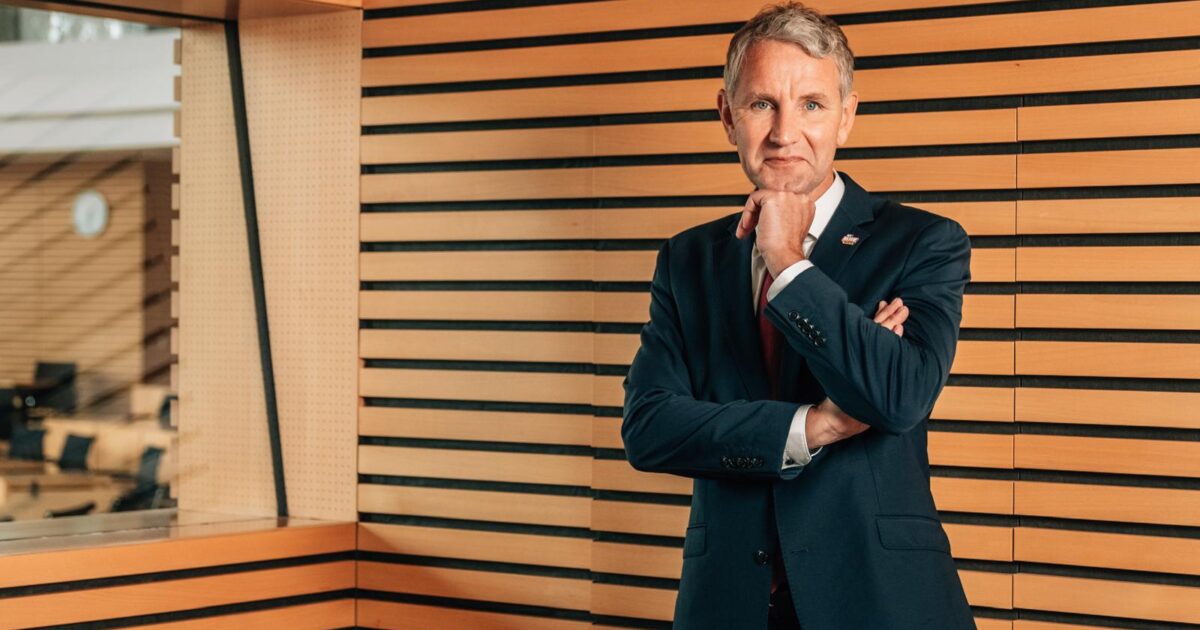
Alternative for Germany MP Björn Höcke (Chairman of AfD Thuringia)
Björn Höcke is a German and a leading figure within conservative, anti-globalist Alternative for Germany (AfD), particularly associated with the party’s right-conservative wing. He serves as a member of the Thuringian state parliament (Landtag), chairs the AfD state branch there, and is one of the most prominent voices in contemporary conservative German politics. Höcke, a history teacher before entering politics, is known for his razor sharp criticism of Germany’s left-globalist political establishment, its pro-mass migration policy, and what he refers to as ideological conformity in legacy media and institutions. His pointed rhetoric and political positions have made him influential among supporters and a frequent target of criticism from opponents.
In this comprehensive interview, Höcke offers a sweeping, incisive critique of Germany’s current political system, arguing that the country is entering the terminal phase of a failed postwar order characterized by elite decay, left-liberal ideological conformity, and the hollowing out of the democratic order. He discusses in-depth what he sees as the transformation of Germany into a post-democratic system, the marginalization of opposition through institutional exclusion and media hostility, and the consequences of mass migration, geopolitical confrontation, and cultural disintegration.
Furthermore, Höcke outlines the AfD’s growing electoral strength—particularly in eastern Germany, but increasingly in the west and at the federal level—lays out his strategic vision for governing at the state level as a prelude to national leadership, and calls for a fundamental political realignment centered on remigration, family policy, and the de-ideologization of state institutions.
Germany is facing profound political, economic, and social tensions. From your perspective, how would you describe the current state of the Federal Republic, and where do you see the main causes of instability today?
From a historical perspective, we are experiencing the final crises of a system that has run itself into the ground, with all the upheavals and abysses that entails. Unfortunately, it is the citizens and the democratic opposition who have to bear the unpleasant consequences, but we can take comfort in the knowledge that these impositions will only accelerate the decline of the political class. This gives us hope for a fundamental new beginning. The causes of this decline lie primarily in the rapid decay of the ruling elites. In Germany, we say, “The fish stinks from the head down.” The worn-out elites are no longer capable of much more than maintaining their power through propaganda and repression. The decline of the elites, in turn, is the result of permanent negative selection – just compare the generation of politicians in the early Federal Republic of Germany with today’s “Muppet Show”! Here, one can trace the transition from a democracy to an ochlocracy, as described by the ancient historian Polybius in his politeíōn anakýklōsis. To continue the chain of causes: negative selection, in turn, has its roots in extreme party dominance on the one hand and decades of external control on the other. Both factors tend to promote a certain type of person: those who only have to fight their way to the top in order to then willingly carry out the agendas of foreign powers need only a moderate amount of brains and even less backbone.
Many German and EU citizens express concern that decisions in Berlin and Brussels are increasingly determined by ideological dogmas rather than by true democratic debate. How do you view the role of left-liberal political elites in shaping Germany’s current domestic and foreign policy?
First of all, an ochlocracy only uses the label “democracy” to legitimize its rule. On the outside, it still says “democracy” – but on the inside, a totalitarian monster is growing. It is very revealing that the establishment of the Federal Republic of Germany always speaks of “our democracy” being endangered by the AfD. That is not even wrong: we do indeed want to end their “fake democracy,” their post-democracy with its misanthropic woke ideology projects, and restore normal democratic conditions in the country. If we do not manage to put the brakes on, the power cartel will drive our country into the ground!
The AfD has long criticized what it sees as increasing militarization and confrontation in Europe. Do you believe Germany is being pushed onto a dangerous geopolitical course, and who benefits from it?
Yes, there is no doubt that the foreign policy situation for Germany is coming to a dangerous head. It is well known that regimes threatened by the loss of power like to lash out wildly. The German regime has created an internal and an external enemy in order to divert the explosives that have been accumulated internally: the internal enemy is the AfD and the external enemy is Russia or Putin. Our externally controlled elites have therefore gotten involved in what was originally an American-Russian conflict that is not ours and that Trump is now commendably trying to overcome. One of many absurdities is that the very political class that is neither capable nor willing to secure its own borders against illegal migration and protect our citizens is now demanding financial and, in the worst case, human sacrifices from them in order to ultimately keep a corrupt, undemocratic oligarchic regime in power in Kiev. This has rightly outraged the American people under Biden’s presidency. A confrontational stance toward Russia is foolish anyway, based on sober political considerations: the unspeakable war propaganda against a nuclear power, the deliberate cutting off of inexpensive, environmentally friendly energy, and the prevention of peaceful coexistence with our continental neighbor Russia are contrary to European and German interests. It is ridiculous that the former US satellite EU and its globalist elites are now dabbling in independent foreign and military policy, while Trump is seeking a direct deal with Putin and Kiev and simply ignoring the EU vassal troops. I am certain that in the end, we Europeans will pay for the reconstruction of destroyed Ukraine, and US companies will get the largest slice of the contract pie.
Recent polls suggest that the AfD could soon become the strongest political force at the state level in Germany. Do you have the impression that more and more citizens are recognizing the AfD’s struggle as a legitimate and necessary representation of the people’s interests?
We are already consistently trailing the Union in federal polls and will take a solid lead in the coming years because, although the party cartel is expending a lot of energy and sweat to combat the AfD, it is not solving any of the pressing problems. More and more citizens see us as the only relevant opposition to the old party cartel, as the voice of the people against the aloof, anti-popular elites. This will make us stronger and stronger—provided we remain true to our positions and do not make any lazy compromises with the establishment.
Eastern Germany in particular has developed into a stronghold of the AfD, with polling figures in some regions approaching or even exceeding 40 percent. How can this strong resonance among voters in the East be explained, and what still distinguishes their political experiences from those in West Germany?
There are several reasons for the high level of support in the east: on the one hand, the inhabitants of the former communist GDR are very sensitive to state control and propaganda. They rightly compare the subversive activities of the domestic intelligence service (known as the “Verfassungsschutz”) against the AfD with the activities of the Stasi and question the distorted image that the mainstream media paint of the opposition. On the other hand, denationalization in the course of “re-education” after 1945 was more superficial among the communists in the East. The core of German identity was less damaged there than in the West, where the combination of re-education and prosperity had a devastating effect. The East is more “German” and more resilient than the West—although the mood in the West is also shifting: the noticeable collateral damage caused by failed migration policy and the increasing loss of the sweet pill of prosperity are also sparking resistance here, as can be seen from the good poll results in the western federal states.
In the state of Thuringia, in eastern Germany, you are widely regarded as a potential future Minister-President. How do you personally view this possibility, and what would be your main priorities if you were entrusted with leading the state government?
As the situation in the country becomes ever more disastrous due to the policies of the cartel parties, which are practically indistinguishable in substance, Germans are left with only one choice: either they want more of the same, in which case they vote for the cartel parties, or they want change, in which case they vote for the AfD. And more and more people want change.
In 2024, 32.8 percent voted for the AfD in the state election in Thuringia. For the first time, my party became by far the strongest force in a German parliamentary election. One year later, we now stand at 39 percent in the polls. Depending on how many small parties fail to clear the five-percent threshold, 45 percent would be sufficient for us to achieve an absolute parliamentary majority.
Since the Federal Republic of Germany is a federal state, my strategic assessment is that we will only govern at the federal level once we have demonstrated at the state level that we are capable of doing so. I therefore want to create and implement a political blueprint in Thuringia for a fundamental realignment of German politics. Thuringia is to become the Piedmont of a German new beginning.
Concrete priorities will be a large-scale remigration offensive, a family offensive, and the de-ideologization of the state and its institutions.
The so-called “firewall” against the AfD remains a defining feature of German politics. How do you interpret this strategy of exclusion, and what does it say about the current understanding of democracy among established parties? Will it end soon?
In its fight against the AfD, the political and media establishment of the Federal Republic of Germany has abandoned a fundamental principle of parliamentary democracy. This fundamental principle is that the government can become the opposition and the opposition can become the government if the people so desire. In order to keep the AfD out of government and secure their own privileges, they have formed a cartel that has barricaded itself behind a “firewall,” as they call it. The cartel party politicians exclude the AfD not only with words, but also with deeds. In the German parliaments, AfD members of parliament are treated like pariahs. The candidates of the AfD factions are not elected to important committees, even though constitutions and rules of procedure provide for this. AfD motions are regularly not referred to committees for further discussion, even though this is parliamentary culture. In Thuringia, the strongest force is practically excluded from parliamentary participation. Parliament, as the “transmission belt of the will of the people,” as Edmund Burke called it, is blocked. Here, the formerly bourgeois CDU even allows itself to be tolerated by the Left Party—the legal successor to the communist SED of the GDR—in order to maintain the firewall against the AfD. What will happen next? I see two possibilities: First, the cartel saves itself by declaring a state of emergency and takes action with openly dictatorial means. The second possibility is that the cartel will collapse under the weight of escalating problems. Then the “firewall” will become the gravestone of a CDU that has been completely gutted of its substance. It will then end up where the Democrazia Cristiana in Italy ended up—in political insignificance.
AfD members frequently report legal, institutional, and social pressure measures as clear political persecution. Do you believe Germany is experiencing a worrying erosion of pluralism and equal political competition?
Yes, the totalitarian metamorphosis in Germany is indeed dramatic. It is the hysterical, panicked reaction to a looming loss of power that is causing the establishment to resort to repression. However, this is not a sign of strength, but of weakness. As unpleasant as the personal consequences are for many patriotic comrades-in-arms, we must persevere.
You yourself have often been the target of public campaigns, controversies, and professional ostracism. How do you personally experience “cancel culture,” and what impact does it have on open debate in Germany?
The social exclusion and demonization of opposition politicians by the power cartel is an ongoing violation of human dignity, which, grotesquely, is always blamed on us because of our justified criticism of migration. However, the aggressiveness of the establishment also shows that we have struck a nerve with our political demands. However, one must be careful not to become hardened oneself as a result of permanent exclusion. Then our opponents would have us exactly where they want us. But I believe that I have managed this quite well so far; I have always remained open and willing to engage in dialogue, even when our opponents have brusquely rejected any exchange. Ultimately, however, this refusal only leads to a clear alternative for our country: them or us.
Media coverage of the AfD is openly biased and hostile. How do you view the state of media freedom and journalistic neutrality in Germany today, especially regarding dissenting or nonconforming viewpoints?
Freedom of the media is now defended by alternative media, which have exploded in recent years. They, too, are merely a reaction to an acute problem in the country. The mainstream media have failed completely and discredited themselves. They no longer have anything to do with their original claim to be the democratic “Fourth Estate” keeping a critical eye on those in power and the establishment. They paint black-and- white pictures, have become indistinguishable in their left-liberal woke stance, and have debased themselves to become propaganda organs of the government. They continuously incite hatred against opposition forces, especially the AfD. When we come to power, we will terminate the state media contracts and support the development of a fresh, free media landscape. True democracy needs freedom of expression and media pluralism!
On the other side of the Atlantic, the MAGA movement in the United States has mobilized millions around issues such as sovereignty, national interests, and resistance to globalist governance. How do you view this movement and its broader cultural significance?
I follow the MAGA movement with interest and sympathy. It is rooted in good conservatism. For me, conservatism, in the words of Antoine de Rivarol, does not mean clinging to what was yesterday, but living by what is always true.
In his book “The Road to Somewhere,” David Goodhart points to the central social conflict in the Western world. On the “progressive” side are the Anywheres, as he calls them. They are often above-average educated, wealthy, multilingual, cosmopolitan, and enjoy the benefits of a globalized world. They no longer know home in the traditional sense, identify with woke identity concepts, and tend to support one-world concepts. And then there are the Somewheres, who defend their identity as men and women, who do not want to overcome the nation and family as anachronisms, and who consider a transcendent location to be human beyond cold materialism.
Yes, MAGA and we, the AfD, are fighting against the dissolution of all things. We do this because we classify the dissolution of all things as a phenomenon of decadence and because we recognize that it is being catalyzed by small interested circles in order to secure permanent rule for themselves that is not democratically legitimate.
Once again: we and MAGA have a lot in common. And MAGA is a role model because we are dealing here with a movement that is more than just a party. This movement provides the dynamism we now need to break up the encrustation of the party state, including the deep state structures. MAGA needs a MEGA pedant in Europe!
This interview was conducted by Alexander Junger and originally published by Eagle Eye Explore on January 16th, 2026. It has been edited for clarity and readability, and is republished here at The Gateway Pundit with the kind permission of Eagle Eye Explore.
The post Interview With German MP Björn Höcke: On the Decline of Elites, MAGA, Post-Democracy, and the AfD’s Path to Power appeared first on The Gateway Pundit.