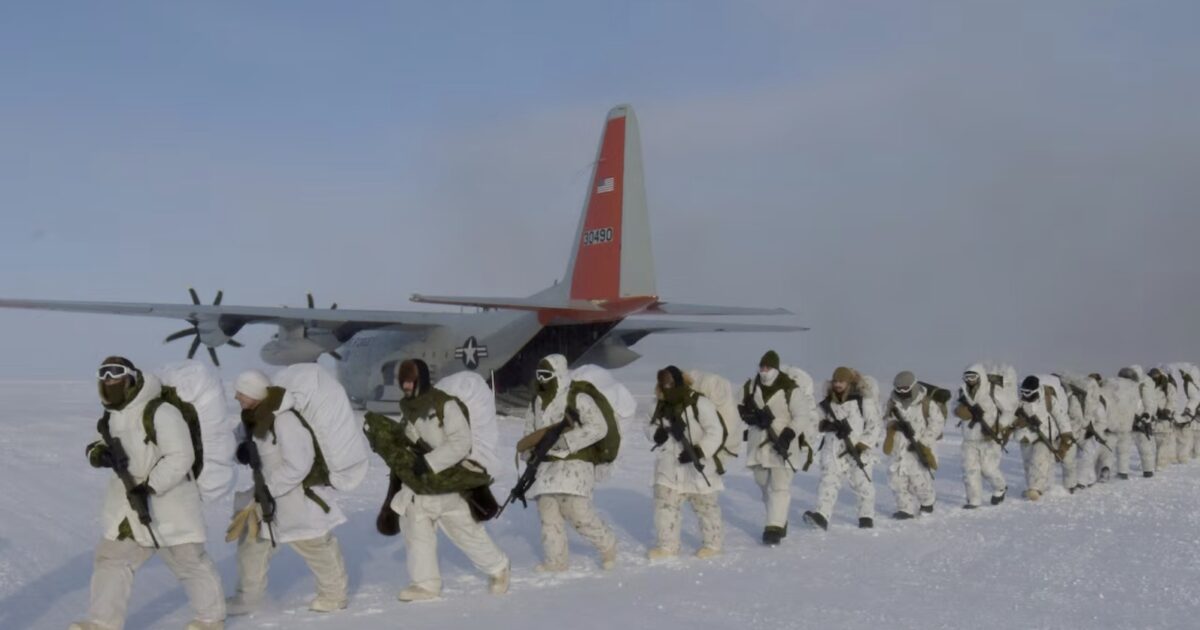
U.S. troops in Greenland. Photo courtesy of the U.S. Department of War.
By Publicola
President Trump arrived in Davos with one item on his mind: Greenland. The goal was to make a bid for the ice-covered landmass, which is so valuable to the United States from both a geopolitical and financial standpoint. At the crossroads of the Arctic, the great “piece of ice,” as our President endearingly labeled it, is situated at a crucial intersection for trade and military operations. It can provide a great strategic boost to any superpower which claims it, a reason for President Trump’s strong campaign to acquire it, and on the flipside of that, a reason for Chinese and Russian warships becoming an increasingly common sight off its coastline.
Greenland also has tactical utility: intercontinental missiles from any of the aforementioned nations may use Greenland as a strategic outpost for launching them. Likewise, drones. Its close proximity to the United States thus heightens the stakes for modern technological warfare if any of the other powers were to claim it for themselves. While President Trump may have backed away from deploying troops to acquire Greenland by force, instead resorting to diplomacy, if heaven forbid China or Russia, and not our ally in Denmark, should claim this land for themselves, a military option for acquisition would then not only be revived, but perhaps foregone.
Thus, the strong campaign for Greenland is a rare example of an American leader responding to an evolving world order and mapping out a long term strategy in real time. While the United States is enjoying something of a renaissance under the second Trump administration, Europe continues to languish. By every metric, European strength, relative to the United States, depreciated exponentially over the last two decades, a trend forecasted to only accelerate in the years ahead. Europe and the United States may be partners, but the union forged between them today is not that of co-equals. President Trump knows this; based on similar principles, he understands that it is no longer realistic for Greenland to be managed by a country that has not been geopolitically significant in at least four centuries.
Then there are the resources. Greenland, which is more than three times the size of Texas and five times that of California, is teeming with natural riches: from rare earths to precious metals to natural gas. In this respect, it can be an economic windfall for the United States, a benefit that if annexed for Uncle Sam would accrue to the rest of the world as well. This is because only the United States possesses the technological know-how and manpower to penetrate Greenland’s rough and lifeless tundra that stretches on for miles. Denmark lacks the requisite drilling equipment; it also lacks the ability to secure the landmass militarily or otherwise. Already, it has long managed Greenland in a semi-dependent partnership with the United States and other nations. It is about time that it abdicates its role to greater powers, recognizing that the United States is the clear regional hegemon, and only it can maximize Greenland’s potential, with its vast mineral resources, and stave off hungry competitors like China or Russia in the process.
Beyond the economic upside, Greenland also symbolizes President Trump’s renewal of the Monroe Doctrine: a reinvigorated United States willing to defend its hemisphere responsibly, with a peace through strength foreign policy approach grounded in realism. This is a gritty philosophy that aptly recognizes power dynamics for how the world is, not how liberals and globalist technocrats would like it to be. The ideology of globalism, paired with its promise of a new world order, had long deluded European leaders into thinking borders were no longer necessary, human conflict had been permanently abolished, and that Europe could indefinitely profit off American industry, goods, and services, while never having to pay anything remotely close to a fair share in return.
The result of this bad deal has been catastrophic for the United States; not only did we get robbed, over decades, by our European partners, who were smart to exploit our leaders’ “generosity.” But additionally, as we allowed our industries to get bled dry in service to the false creed of globalism, China and other rivals started to sink their teeth into our territory. Though America’s leaders were wedded to globalism, China felt no special obligation to the same faith. So they began planting their companies on our shores, offloading their industries on us and our allies, while making use of lax immigration laws to penetrate Western nations, their schools, and their job markets, with Chinese migrants, transforming our demographics along the way. These trends have allowed China to take up shop, both in Europe and on America’s own shores; they took what they felt they could claim for themselves, sensing the weakness of their enemies and the dysfunction sown throughout their societies by a negligent ruling class over many decades.
Donald Trump has ushered in a new era in American-European relations. Rather than subscribe to a deluded and outdated quasi-religious doctrine, he has recognized reality for what it is. He knows the current state of global affairs. He also knows the strength of American power and is not afraid to flex its muscles to get what he wants, which is what is in America’s best interests. For Europe to recoil from that ask speaks less about the United States and more about Europe and its continued devotion to a subversive, backward-looking worldview. Donald Trump knows Europe is weak and has called its bluff; he also realizes that weakness begets more weakness. Thus, given the choice between entertaining Europe’s charade, which acts as if NATO does not entirely owe its existence to the United States, and the alternative – a world of vigorous American power, a renewed Monroe Doctrine that rightly claims territories like Greenland in its sphere of influence – Donald Trump has signaled the alternative is the way forward. It is, in fact, the only way forward.
In a world where great powers such as America, China, and Russia increasingly steward global affairs, it is best that smaller countries recognize these emerging arrangements and take sides accordingly. If Europe pushes America out of its house, China (or Russia) will move in. At that point, Europe may face a reckoning – and realize that it would rather have the United States, with its shared Western culture, Christian religion, and commitment to liberty, than the autocratic alternatives. If there is a takeaway from Davos 2026, it would be this. Greenland boasts incredible strategic and economic potential, for sure. But even more than that, it is a portent for an evolving world order, one where Western countries will be forced into decisive commitments, or else face conquest by emerging threats. Donald Trump is showing, by his example, how the United States might remain on top of this power hierarchy long into the future. Europe will have to take heed of these lessons if it wishes to remain relevant in this century as well.
The post Trump’s Greenland Gambit Pays Off appeared first on The Gateway Pundit.