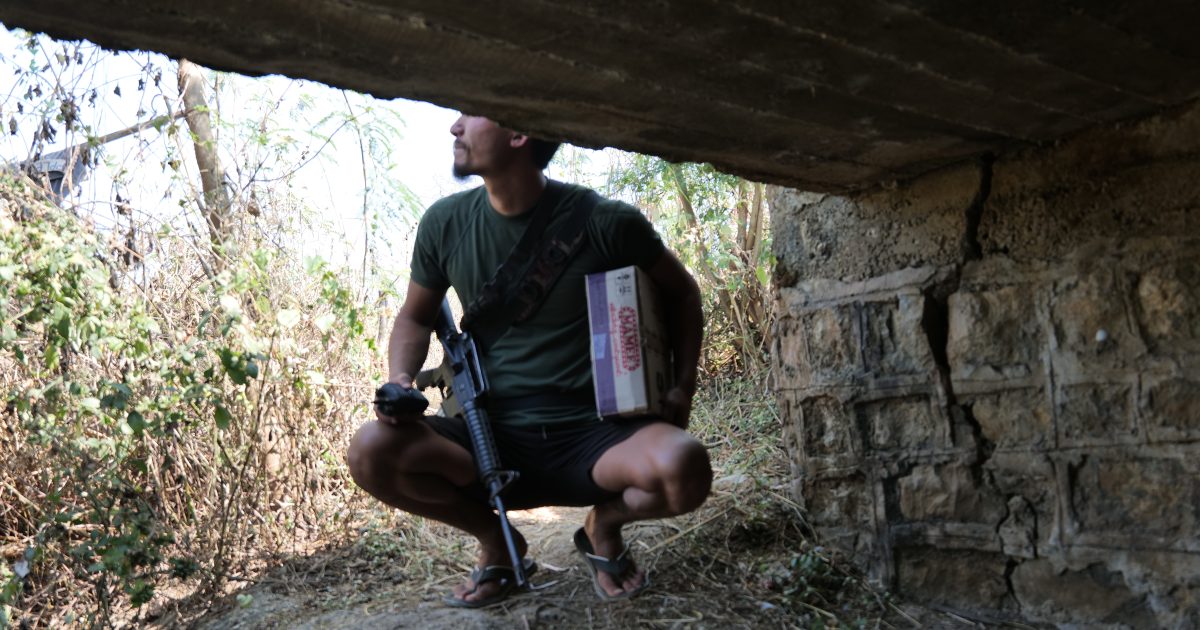
Bunker and trench lines on the front lines of the war in Burma separate government-controlled areas from revolution-controlled areas. Although large-scale ground assaults with troops charging the lines are rare, government mortars, artillery, drones, and airstrikes target and kill civilians in revolution-controlled areas on a daily basis. Photo by Antonio Graceffo
It is winter in Burma, so daytime temperatures range between 86°F and 92°F, while at night they drop into the fifties. This is the dry season, with lower humidity, and the dusty season is just beginning. During the rainy season, soldiers in the field contend with constant mud and moisture. Everything is wet and uncomfortable, and clothes mildew before they can dry on the line. During the dry season, the problem is dust, which works its way into clothing, bedding, and sometimes even food.
Soldiers have boots, but most grew up wearing flip-flops. They usually prefer the latter, and the boots often sit unused beside their weapons and other gear when they are not moving. Inside the bunkers, low stone or earth ceilings create a sense of claustrophobia, while the colorful quilted blankets typical of Burmese homes serve as a reminder that the revolution has been going on for five years already. For these boys, this is home.
Ask any seasoned soldier from any army and he will tell you that war is mostly hurry up and wait. Long hours of tedium are broken by brief moments of violence and death. This is a war of attrition, with both sides waiting for the other to give out. The difference is that the Tatmadaw has resupply, while the resistance has only what it can carry, with the entire army living on donations. Another difference is that the families of Tatmadaw soldiers are safe behind government lines, while every resistance soldier knows his own family is being targeted daily and is likely displaced, even as he sits at the front line waiting to make the Tatmadaw pay for its war against his people.
Soldiers spend weeks in these holes, enduring boredom and isolation. Photo by Antonio Graceffo
The revolution began when most of these young men were around 14 years old, forcing them to leave school behind. While visiting a bamboo university the other day, the director told me that girls now outnumber boys in higher education by three to one. “Boys would rather pick up a gun and fight for our country,” she said. Wasted time and a loss of purpose have destroyed more lives in this war than bombs ever have.
Most resistance soldiers are so young that the war already spans a quarter of their existence, and they know no other kind of life. Photo by Antonio Graceffo
The rainy season must be like hell, sitting in water and mud for five months out of the year, exposed to mosquitoes and malaria.
Where some of the holes looked lonely, others were overcrowded. But there was always a pervasive feeling of discomfort and close quarters. Weapon maintenance helps fill part of the day, both to fend off boredom and as a practical necessity to ensure weapons will fire when needed to ensure survival. The nonstandard uniforms—soccer shirts and gym shorts—underscore the ad hoc nature of the resistance.
Boot camp is generally short, and young soldiers learn most of their craft on the front line from more experienced soldiers acting as teachers. Photo by Antonio Graceffo
The past ten days have been relatively quiet. Normally, the sounds of explosions are constant, but in the past twenty-four hours there have been only one or two. It is possible that the Tatmadaw is preparing for a major attack. If so, these guys will spring to life with renewed purpose, as they have time and again in the past. If not, they will sit and wait, sleep, and live in discomfort while worrying about their families in internally displaced people’s camps, dreaming of the day they can come down from the mountains and no longer need to protect their homeland from their own country’s government.
Antonio Graceffo reporting from Karenni State, Burma (Myanmar).
The post Exclusive from the Burma War: Life on the Front Lines appeared first on The Gateway Pundit.