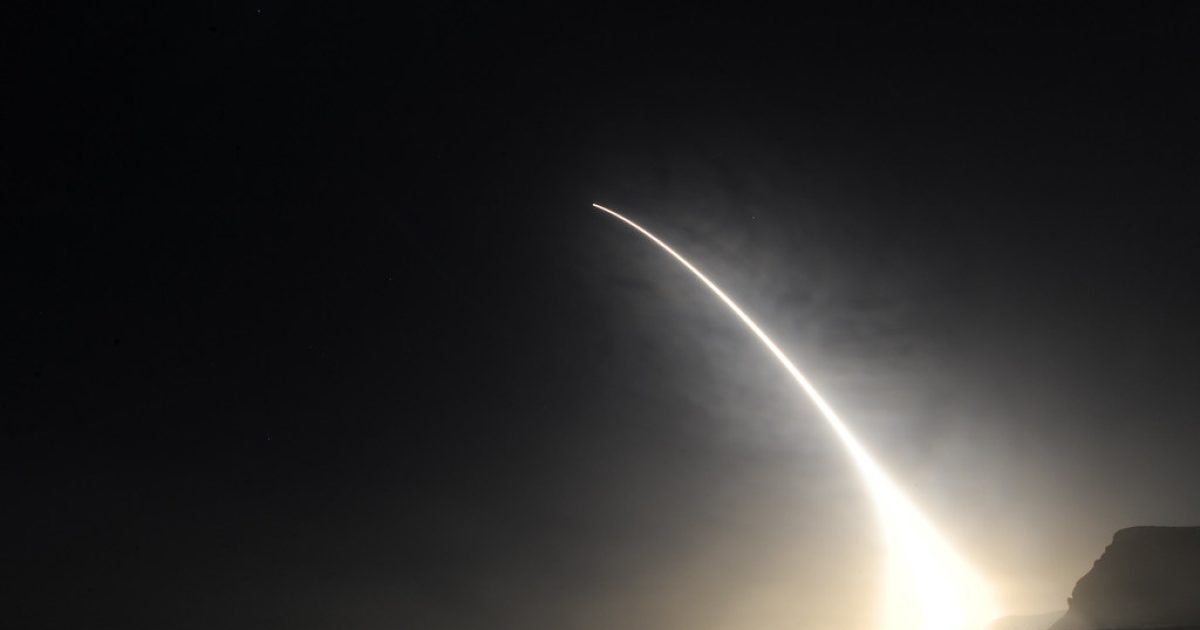
Minuteman III intercontinental ballistic missile launches via Flickr
The United States conducted a test launch of a nuclear-capable intercontinental ballistic missile Tuesday night from California’s central coast, a chilling reminder of just how dangerous the global situation has become.
As the world watches wars rage in Ukraine and an expanding conflict erupt across the Middle East, the launch boldly underscored the grim reality that nuclear deterrence is once again at the center of international security.
According to a press release from Vandenberg Space Force Base near Santa Barbara, shortly after 11 p.m. local time, a Minuteman III missile lifted off from the base. The test involved an unarmed rocket equipped with multiple test re-entry vehicles.
U.S. just tested a Minuteman III ballistic missile off the California coast while war rages in Iran.
The ICBM can carry nuclear warheads 20x more powerful than Hiroshima and travel 6,000 miles at 15,000 mph.
It hit its target near the Marshall Islands.
Pentagon says it was… https://t.co/0Xqjtatg7T pic.twitter.com/xYUN2yGOvj
— Mario Nawfal (@MarioNawfal) March 5, 2026
The missile traveled thousands of miles across the Pacific Ocean before striking its designated target near Kwajalein Atoll in the Marshall Islands. The journey covered roughly 4,200 miles and lasted about 22 minutes.
Officials from the US Air Force confirmed that the test was designed to evaluate the missile’s readiness and reliability. Air Force Global Strike Command said the launch was conducted to “verify the effectiveness, readiness, and accuracy” of the weapons system.
Yet even as the Pentagon insists the test was routine and planned years in advance, the timing could hardly be more sobering. The world today faces a geopolitical climate that increasingly resembles the darkest moments of the Cold War—perhaps darker.
Across Europe, the war in Ukraine continues to grind on after four years of devastating conflict. Entire regions have been destroyed, millions have fled their homes, and the confrontation between Russia and the Western alliance has reshaped the continent’s security landscape.
Now a second crisis is rapidly unfolding in the Middle East. The United States and Israel recently launched major strikes against Iran, killing the country’s supreme leader, Ayatollah Ali Khamenei, and triggering a widening regional war.
Tehran has responded with retaliatory attacks across the Gulf region, pushing the Middle East into one of its most volatile confrontations in decades. What began as targeted strikes now threatens to spiral into a broader conflict involving multiple nations.
President Donald Trump has made clear that the confrontation could escalate further. “The big one is coming,” he warned while promising intensified strikes against Iran.
Trump has repeatedly argued that Iran must never be allowed to acquire nuclear weapons. “Just imagine how emboldened this regime would be if they ever had and actually were armed with nuclear weapons,” he said.
Against that backdrop, the Minuteman III launch carried an unmistakable message about deterrence. The missile, capable of traveling at more than 15,000 miles per hour, can strike targets nearly anywhere on the planet within roughly half an hour.
Lt. Col. Karrie Wray, commander of the 576th Flight Test Squadron, explained that the launch provided critical data about the system’s performance. “GT 255 allowed us to assess the performance of individual components of the missile system,” she said.
“By continually assessing varying mission profiles, we are able to enhance the performance of the entire ICBM fleet,” Wray added, noting that the goal is ensuring the “maximum level of readiness for the land-based leg of the nation’s nuclear triad.”
The nuclear triad—land-based missiles, submarine-launched ballistic missiles, and long-range bombers—forms the backbone of America’s strategic deterrent. The Minuteman III represents the land-based component of that system.
Although Tuesday’s test used no nuclear payload, the missile is capable of carrying multiple nuclear warheads. Each warhead possesses destructive power far exceeding the bombs that devastated Hiroshima and Nagasaki.
For the test, the missile was randomly selected from a silo at F.E. Warren Air Force Base in Wyoming. It was transported more than 1,300 miles to California before being reassembled for launch.
Personnel from multiple units participated in the operation. Airmen from Minot Air Force Base in North Dakota provided maintenance support, while operators from all three missile wings assisted with the launch.
Gen. S.L. Davis, commander of Air Force Global Strike Command, emphasized that such tests are critical to maintaining credible deterrence. “The data we gather ensures our long-range strike capabilities are not just a theoretical concept, but a proven, reliable, and lethal force.”
The United States has conducted more than 300 similar tests over the decades as part of a long-running program designed to ensure that its nuclear arsenal remains operational and effective.
But the world in which those tests take place has changed dramatically. After decades in which globalist leaders insisted major wars were relics of the past, the international order now appears increasingly unstable.
The conflict in Ukraine has revived the specter of large-scale war in Europe. At the same time, the rapidly escalating confrontation with Iran threatens to engulf the Middle East in a broader regional conflict.
Together, these crises are pushing the world toward a far more dangerous era. Strategic competition between major powers is intensifying, alliances are hardening, and the risk of miscalculation is growing.
The Minuteman III missile itself is scheduled to be retired later this decade. It will be replaced by the next-generation LGM-35A Sentinel system, designed to maintain America’s land-based nuclear deterrent through at least 2075.
Yet the symbolism of Tuesday night’s launch goes beyond a single weapons test. It reflects the sobering truth that the world has entered a period of profound instability.
From Eastern Europe to the Persian Gulf, conflicts are expanding, alliances are shifting, and the shadow of nuclear deterrence once again looms over global politics.
The missile rising into the dark sky above California was therefore more than a technical demonstration. It was a stark reminder that in an age of escalating wars and geopolitical upheaval, the stakes for humanity have rarely been higher.
The post Doomsday Missile Test in California Highlights Perilous Global Moment as Wars Spread Across Continents appeared first on The Gateway Pundit.