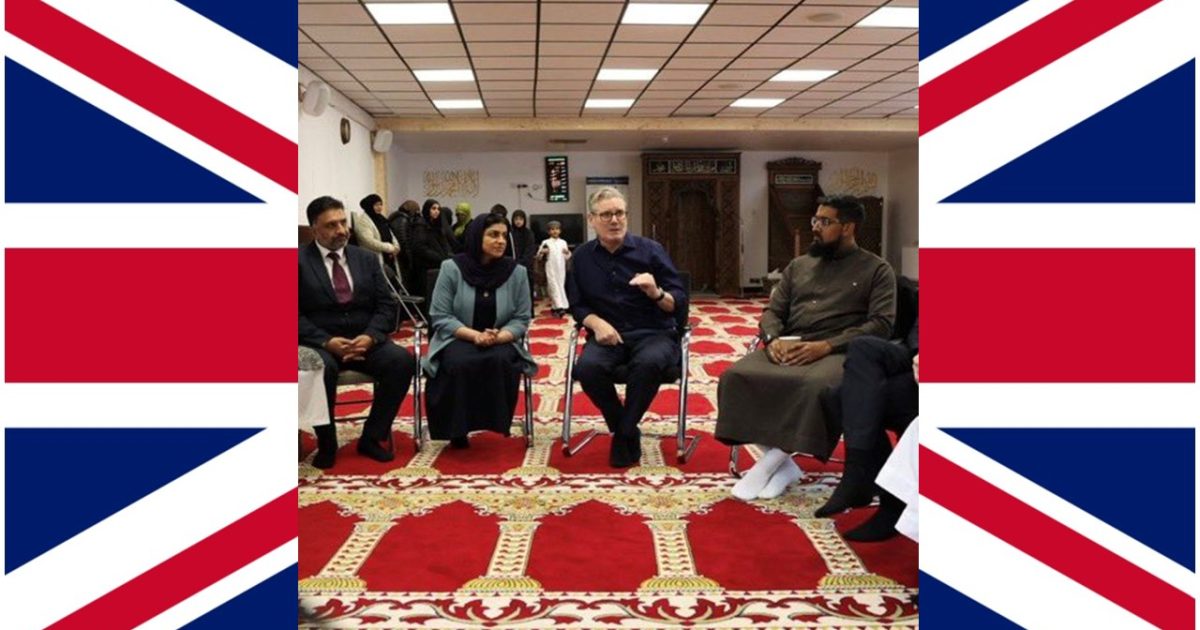
The five members of the team tasked with writing the British government’s definition of Islamophobia have all been found to have ties to Islamist extremism. Photo courtesy of Britain Is Broken via X.
Zara Mohammed, Secretary General of the Muslim Council of Britain, said “Our view is that the Islamophobia in the Party is institutional, tolerated by the leadership and seen as acceptable by great swathes of the party membership.”
The Muslim Council of Britain is the organization pushing for the British government to accept its restrictive definition of Islamophobia. The group has consistently promoted the definition produced by the All-Party Parliamentary Group (APPG) on British Muslims in 2018–2019. That definition states: “Islamophobia is rooted in racism and is a type of racism that targets expressions of Muslimness or perceived Muslimness.”
When the U.K. government released its own definition in March 2026, using the term “anti-Muslim hostility” rather than “Islamophobia,” MCB Secretary General Dr. Wajid Akhter called it a “diminished version” of what the government’s own working group had recommended and declined to endorse it.
Working from a restrictive definition of Islamophobia, the British government has been cracking down on free speech in order to appease Muslim groups. In 2025, Hamit Coskun was handed a criminal conviction for burning a Quran outside the Turkish Embassy in London, shouting “F–k Islam” and “Islam is a religion of terrorism.” He was convicted of religiously motivated harassment, alarm, or distress and received a fine of approximately $300 plus a surcharge of $120.
Coskun was attacked by Moussa Kadri, who came at him with a knife, beating and slashing at him. Kadri pleaded guilty to assault and possession of a bladed article and received a 20-week prison sentence, suspended for 18 months, with 150 hours of unpaid work. The judge spared him jail because he had “lost his temper” and was of previously “exemplary character.”
Another recent case involved online speech targeting Islam. Pete North was arrested in 2025 on suspicion of a public-order offence after posting a meme that read “F*** Palestine, F*** Hamas, F*** Islam.” He was later released without charge.
A broader enforcement pattern has also emerged. According to Freedom House, 12,000 people were arrested in 2023 alone, including for social media posts, under the Communications Act 2003 and the Malicious Communications Act 1988.
Hatun Tash, an ex-Muslim convert to Christianity who preaches publicly, has been arrested multiple times in 2020, 2021, and 2022. She was arrested once for alleged criminal damage to a copy of the Quran she says was her own property and once under the Public Order Act for wearing a Charlie Hebdo T-shirt depicting the Prophet Mohammed.
In June 2022, police arrived at Speakers’ Corner to find a crowd surrounding Tash after a man had stolen her Quran. Rather than pursuing the thief, officers restrained her, marched her through the crowd, strip-searched her, and detained her overnight. She was then charged with “criminal damage” for her own property.
Tash had previously been stabbed in the face and hands at Speakers’ Corner in July 2021. Her attacker was never arrested. An Islamic terrorist was later jailed for a minimum of 24 years for plotting to murder her with a firearm.
A Christian pastor, Pastor Dia Moodley, was arrested in 2024 by Avon and Somerset Police and held for 13 hours after street preaching outside Bristol University, where he contrasted Christianity and Islam in response to a question from the crowd. The arresting officer cited the fact that his comments were made during Ramadan.
During the same incident, Moodley was physically assaulted, pushed from a stepladder, and had a sign torn from his hands, but police arrested him rather than his attackers. He was charged under the Crime and Disorder Act and the Public Order Act. The investigation was later dropped after legal representations by ADF U.K., and Moodley subsequently filed a complaint against the police.
The definition of Islamophobia currently adopted by the U.K. government is non-statutory, meaning it does not directly create a criminal offence. However, the Free Speech Union (FSU) warns that, in practice, the definition amounts to a Muslim blasphemy law through the back door, 18 years after Parliament voted to abolish such laws. Several parliamentarians and free speech campaigners have warned that the definition could be used as a covert anti-blasphemy law to severely curb freedom of expression and legitimate criticism of Islam.
An FSU investigation found that all five members of the U.K. government’s Islamophobia working group have links to Islamism or has publicly expressed extremist views, meaning the panel was compromised from the start. The report also found connections to groups including the Muslim Council of Britain (MCB) and Muslim Engagement and Development (MEND), two organizations successive governments have declined to engage with since 2009 due to concerns about their views.
These individuals with extremist sympathies have been involved in defining what people can and cannot say, with those who go against it potentially facing punishment. According to the FSU, rather than objectively debating whether a definition was needed, the group appears to have been assembled to justify a pre-decided political outcome by the Labour government.
Most members had connections to organizations or figures linked to extremist ideology, including support for blasphemy-style restrictions on speech and the defense of individuals tied to radicalism. They had also already endorsed a controversial definition linking Islamophobia to racism and restricting discussion of issues such as grooming gangs, historical Islamic conquests, and criticism of Muslim-majority countries.
The report states that multiple panel members have supported censorship, downplayed crimes involving Muslim perpetrators, or promoted narratives aligned with Islamist positions.
Chair Dominic Grieve is described as having shifted from criticizing integration failures to promoting Islamophobia as the primary problem, influenced by Islamist-linked groups. A leaked version of the proposed definition suggests it could function as a de facto blasphemy law, effectively shutting down criticism of Islam while punishing dissent through professional or social consequences.
Critics warn the entire process was politically motivated and designed to appease radical elements rather than protect free speech, marking a significant step toward institutionalizing restrictions on open discussion of Islam in the U.K.
Grieve also wrote a glowing foreword to the 2018 APPG definition of Islamophobia after seeking advice from MCB and MEND leaders, including one who blamed the 2017 London Bridge terrorist attack on Jews and Zionists. His 2017 report was sponsored by the East London Mosque, which has been linked to the revolutionary Islamist group Jamaat-e-Islami.
Another member of the working group, Asha Affi, was a council candidate for George Galloway’s Respect Party in 2010, when its policies included support for the Iranian and former Syrian regimes and the elimination of the state of Israel.
Baroness Shaista Gohir tweeted support for Hamas in 2014 and wrote a report claiming it is Islamophobic to suggest grooming gangs are disproportionately Muslim.
Akeela Ahmed has for years worked closely with the MCB in demanding restrictions on reporting on Muslim affairs. She is on record stating that although the government claims the new definition will be non-statutory, laws against expressing Islamophobia should be enforced by the police.
Javed Khan runs the Muslim think tank Equi, whose trustees include Labour MP Afzal Khan, who was forced to apologize for sharing a Facebook post referring to the “Israel-British-Swiss-Rothschilds crime syndicate.” In September 2025, Khan was a keynote speaker at the U.K. launch of the Muslim Impact Forum, which has close ties to Turkey’s Islamist government.
The post Britain’s Islamophobia Panel Linked to Extremism appeared first on The Gateway Pundit.