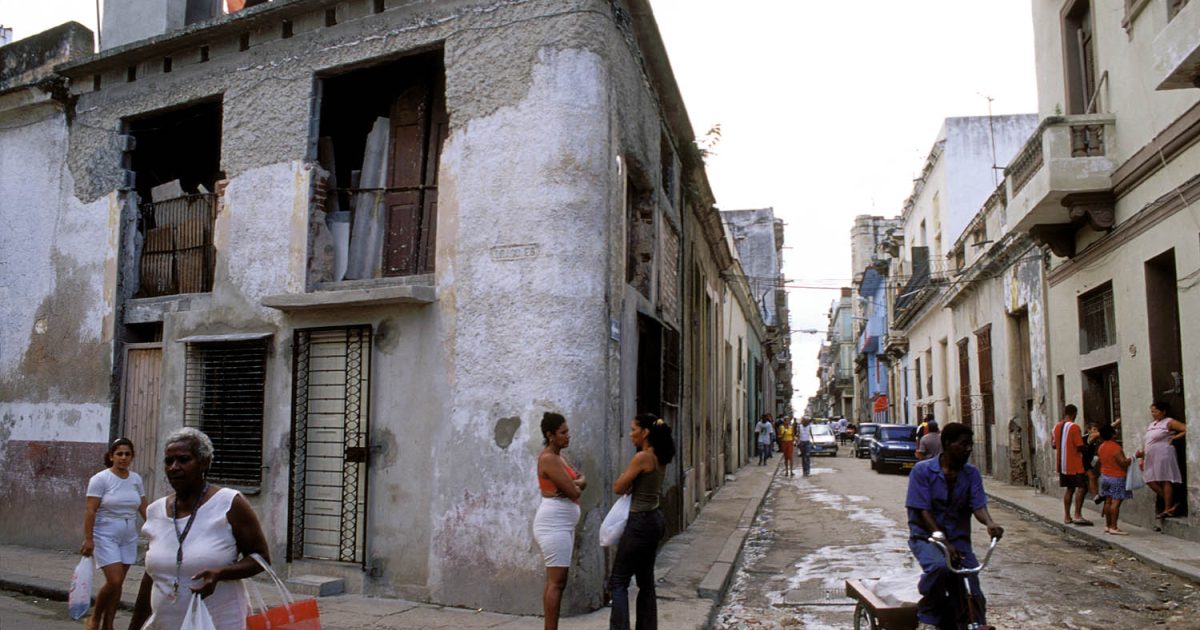
By current GDP per capita, Cuba ranks last among all countries in Latin America and the Caribbean, a striking and useful data point. Cuba’s GDP per capita stands at approximately $1,083, compared to a regional average of $10,212, a gap of roughly 90%. Jialiang Gao, www.peace-on-earth.org, CC BY-SA 3.0 http://creativecommons.org/licenses/by-sa/3.0/, via Wikimedia Commons
For decades, leftists, including participants in the Nuestra América Convoy, have blamed Cuba’s poverty on the United States rather than on the communist dictatorship that has denied basic rights, including multiparty elections, since seizing power in 1959.
They attribute Cuba’s crisis entirely to the U.S. oil blockade, ignoring decades of government mismanagement and centrally planned economic failure that preceded it. The embargo is real and has economic impact, and the UN General Assembly again voted in 2025 to condemn it, but it does not account for Cuba’s broader productive failure, which long predates the 2026 oil blockade.
Cuba’s economy ministry confirmed that GDP contracted 1.1% in 2024, and over the last five years, GDP has declined by roughly 11% in total. Twenty-twenty-four marked two consecutive years of negative growth and contractions in four of the last six years. Primary sectors, including agriculture, livestock, and mining, have been the most affected over the five-year period, falling 53%. Secondary activities, including the sugar industry and manufacturing, declined by 23%.
The country trades with the European Union, China, and other nations, meaning it is not under a total blockade. The real issue is that Cuba does not produce or sell enough goods and services to sustain itself without the economic support it previously received from the USSR.
Leftists are correct that U.S. secondary sanctions restrict Cuba’s access to dollar-denominated trade and international financial institutions. Cuba was added to the U.S. State Sponsors of Terrorism list in 2021, further limiting its access to World Bank and IMF lending.
A functioning economy should not need to rely on foreign borrowing to sustain itself. Cuba produces approximately 40,000 barrels of oil per day against a daily requirement of roughly 100,000, leaving a structural deficit of about 60,000 barrels.
That gap has historically been filled by subsidized oil from Venezuela, Russia, and Iran. Venezuela alone supplied a significant share of Cuba’s needs, often on preferential or barter terms exchanged for Cuban doctors and services rather than at market prices.
Following the U.S. intervention in Venezuela in 2026, that supply was cut off. Cuban officials have acknowledged that domestic companies may not be able to afford oil purchases on the spot market even if suppliers are available.
Even absent the U.S. embargo, Cuba’s productive base does not generate sufficient income to purchase oil at world market prices. The country remains structurally dependent on external support.
At the same time, Cuba had been receiving substantial financial aid from its allies for decades. China, Russia, and Venezuela all provided economic support. This demonstrates that Cuba had access to massive external resources and still failed to build a productive economy.
Secondary sanctions create real friction in Cuba’s access to international finance. However, they do not explain why decades of Soviet subsidies, followed by Venezuelan support, failed to produce durable economic capacity.
American leftists defend socialism while living in the richest country on earth. However, those living under communism do not share this fondness for the alleged workers’ paradise.
Thousands of Cubans have died at sea over decades attempting to reach the United States, while there is no comparable pattern of Americans attempting to reach Cuba.
Even China, the richest communist country, which boasts an average annual income of about $13,000, is unable to retain all of its citizens. Approximately 37,000 Chinese nationals crossed the U.S. border illegally in 2023, with a further 50,000 to 55,000 encounters in fiscal year 2024. By contrast, there is no recorded flow of Americans seeking asylum in China.
More than 34,000 North Koreans have defected to South Korea, while movement in the opposite direction is effectively zero. Millions of East Germans fled to West Germany before the Berlin Wall was built. An estimated 140 or more people were killed attempting to flee to the West, while no West Germans attempted to break into East Germany.
No country that transitioned away from a centrally planned communist economy has returned to one. Russia and Belarus retain heavy state involvement in key sectors but continue to operate market economies. Eastern European countries, Mongolia, and the former Soviet republics have all moved toward markets, and none has reversed course.
China and Vietnam, the two communist countries with the highest standards of living, achieved those gains only by transforming from pure communism to market socialism. Both countries allow private property and entrepreneurship, and both manufacture and export goods.
Cuba remains one of the purest communist systems and thus a clear example of how the model fails.
The post Cuba’s Crisis Is the Product of Communism, Not the U.S. Blockade appeared first on The Gateway Pundit.