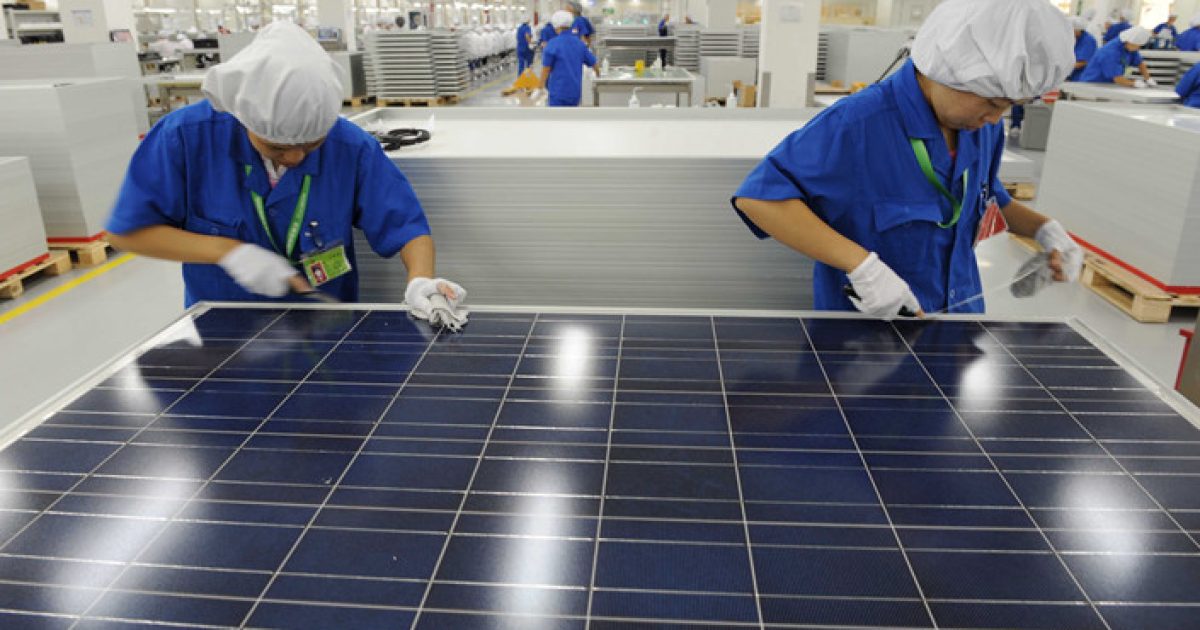
China leads in solar panel manufacturing and sales, not in implementation. Caixin Daily
If solar were actually feasible and cheaper, companies would be switching to save money on operating costs. However, they are not. This suggests that those mean, greedy corporations liberals complain about, because they only care about profits, do not see their profits increasing by switching to solar.
Oil prices are high right now and were even higher during the Biden era. The economic law of substitute goods holds that when the price of a good rises, demand for a substitute increases. For example, when beef gets expensive, people buy more chicken. In the energy sector, rising oil prices should drive increased demand for solar. If consumers were genuinely switching to solar during price spikes, demand for oil should not fully recover when prices fall.
However, there appears to be no major switch to solar. After oil prices come down, demand returns to essentially the same level as before the spike.
The left claims that arguments that solar cannot replace fossil fuels are propaganda and right-wing fake news. However, the data does not support that dismissal. The proof is that not only have companies not switched, but China, which claims to be the world’s leader in renewable energy, is still getting nearly all of its energy from fossil fuels.
What China actually leads the world in is the production of solar panels. China uses fossil fuels to produce those panels, sells them to the world, and continues expanding its own coal consumption year after year.
Coal generates over 60% of the electricity used for global solar PV manufacturing, significantly more than coal’s share in global power generation overall, largely because production is concentrated in China. China controls over 80% of all manufacturing stages of solar panels, polysilicon, ingots, wafers, cells, and modules, and it powers that manufacturing with coal.
According to the IEA, China consumes 30% more coal than the rest of the world combined and continues to define global coal market trends. In 2025 alone, China commissioned more coal power capacity than India did over the entire previous decade.
China claims that it now generates over half of its energy from renewable sources. Solar’s share of China’s actual electricity generation is far smaller than renewable energy headlines suggest. Figures commonly cited for China’s renewable energy output bundle hydropower, wind, and solar together. Separated out, hydropower contributed 13% of China’s electricity in 2024, wind and solar combined contributed 18%, and solar alone contributed approximately 9%.
Even the 9% figure overstates solar’s functional contribution for several reasons. First, approximately 70% of China’s utility-scale wind and solar farms are built in sparsely populated northern and western provinces with low local energy demand, and the resulting power does not reliably reach the heavily populated eastern coast, where industrial and residential demand is concentrated.
Second, curtailment rates in some western provinces exceed 30%, meaning that power is generated but the grid cannot absorb or transmit it. The average solar panel utilization rate fell 12% in the first quarter of 2025 compared to the 2020–2023 average, and the share of potential solar output that went unutilized rose to 5.7% in the first half of 2025, from 3.2% a year earlier.
Third, from 2020 to 2024, China installed an unprecedented 900 GW of renewable capacity and still failed to meet the energy and carbon intensity reductions its own 14th Five Year Plan required, a 13.5% reduction in energy intensity and an 18% reduction in carbon intensity. The installations are not translating into actual fossil fuel displacement.
Just like with other socialist programs supported by Democrats and liberals, the switch to solar is only occurring in markets where governments mandate or subsidize it. The residential solar growth seen in the United States during the Biden era, with installations rising 40% in 2021 and 43% year over year in Q3 2022, is sometimes cited as evidence that high energy prices drive solar adoption. But the primary driver was the 30% federal Investment Tax Credit and net metering policy, not oil prices.
Another crucial issue is that the 40-year-high inflation under Biden artificially inflated the sales revenues of solar companies. Another driver of solar adoption is government coercion. The growth in U.S. markets was concentrated in California, where net metering policy created a deadline-driven demand surge before NEM 3.0 took effect.
When the 30% residential solar tax credit expired at the end of 2025 under the One Big Beautiful Bill, residential solar installations were projected by Ohm Analytics to fall 25% in 2026. If high energy prices had genuinely driven a structural shift to solar, removal of the tax credit would not produce a 25% demand contraction.
Oil demand, by contrast, has shown no permanent destruction from any price spike. The EIA projects global liquid fuel consumption to continue rising through 2026. Brent crude averaged $103 per barrel in March 2026 and is forecast to peak around $115 per barrel in the second quarter of 2026 before easing as Strait of Hormuz production shut-ins resulting from the U.S.-Iran conflict gradually abate.
Even at those prices, there is no documented evidence of a structural consumer shift to solar. Analysts and industry observers noted increased interest in solar inquiries following the oil price spike, but interest is not demand, and demand is not installation. The substitute goods dynamic that economic theory predicts has not materialized in any durable form across multiple oil price cycles, including the Biden-era highs of 2022, the Russia-Ukraine-driven European energy crisis, and the current Strait of Hormuz disruption.
The pattern is consistent across every cycle: oil prices spike, solar interest rises, prices fall, oil demand recovers, and solar’s share of actual energy consumption remains anchored to the level that subsidies and mandates support. This is proof that solar cannot compete with oil or, said another way, cannot replace oil.
The post The Solar Myth: High Oil Prices Never Trigger a Real Shift appeared first on The Gateway Pundit.