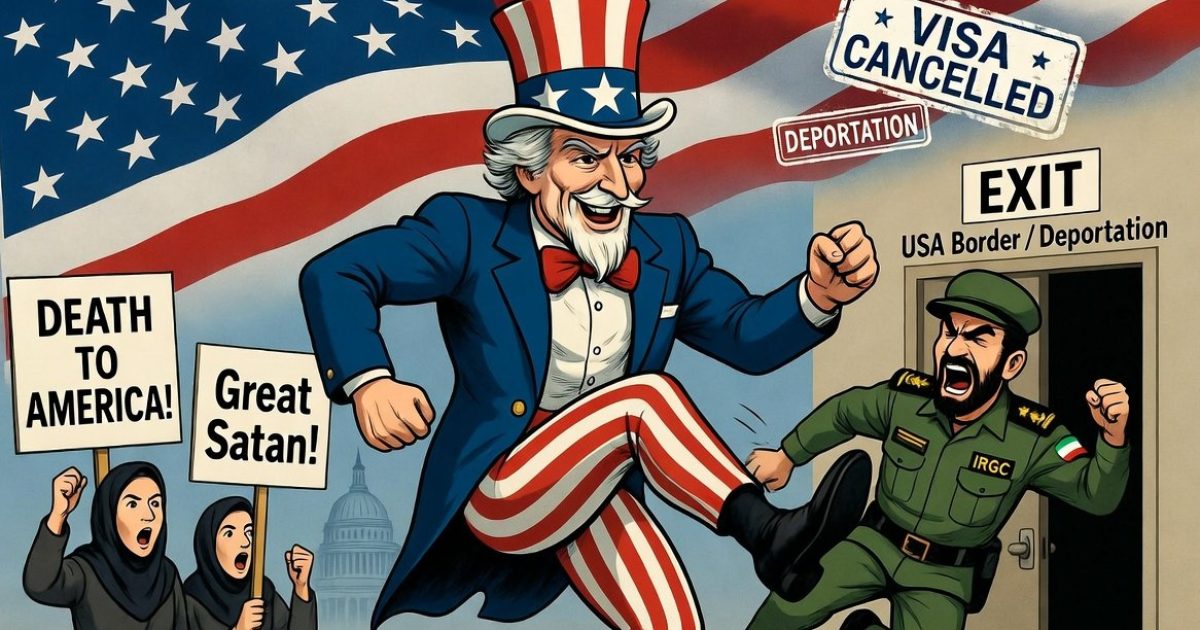
Secretary of State Marco Rubio has been criticized for canceling the residency permits of IRGC family members and deporting them due to their support for the regime.
Democrats are attacking Secretary of State Marco Rubio for canceling the legal status of Iranian Major General Qasem Soleimani’s family members. Critics claim he abused his authority. However, they were outspoken supporters of the Iranian regime. Rubio has pointed out many times during his career that, under the law, supporters of terrorist organizations should not have visas.
Soleimani’s niece and grand-niece were arrested by federal agents following Rubio’s termination of their lawful permanent resident status. Hamideh Soleimani Afshar entered the U.S. on a tourist visa in 2015, received asylum in 2019, and became a lawful permanent resident in 2021. Her daughter entered on a student visa in July 2015, received asylum in 2019, and became a green card holder in 2023. In a 2025 naturalization application, Afshar disclosed multiple return trips to Iran after receiving her green card, which DHS cited as evidence that her asylum claim was fraudulent.
The State Department accused her of promoting Iranian regime propaganda, celebrating attacks against American soldiers and military facilities in the Middle East, praising the new Iranian Supreme Leader, denouncing America as the “Great Satan,” and voicing support for the IRGC, a designated terrorist organization. The State Department identified her conduct through both press reporting and her own social media commentary on her Instagram account, which she deleted after her arrest.
Both women are being held at a South Texas ICE detention facility awaiting a deportation hearing.
Rubio also revoked the visas of Fatemeh Ardeshir-Larijani, an academic and daughter of Iran’s former national security adviser Ali Larijani, who was killed in a U.S.-Israel airstrike, and her husband Seyed Kalantar Motamedi. Both are no longer in the United States and are barred from future entry.
Ardeshir-Larijani had worked in oncology at Emory University School of Medicine. After Iran initiated a crackdown against anti-government protesters in December and January, demonstrators gathered at the university’s cancer institute to demand her removal. As of January, she was no longer employed by Emory.
A Change.org petition calling for her deportation gathered 157,017 signatures. In early December, the State Department revoked or declined to renew visas of several Iranian diplomats, including the deputy ambassador and staffers at Iran’s UN mission, confirming the action was taken on December 4 but declining to comment further.
Republican Congressman Earl “Buddy” Carter called for Ardeshir-Larijani’s State medical license to be revoked, writing that America’s medical institutions must not serve as a refuge for individuals connected by blood and loyalty to regimes that openly call for the death of Americans. Trump ally Laura Loomer wrote on social media that she had reported Soleimani’s niece to the State Department.
The legal basis for the revocations draws on three overlapping provisions of the Immigration and Nationality Act.
INA § 237(a)(4)(C)(i) authorizes the deportation of a lawful permanent resident if the Secretary of State determines that the individual’s presence would have potentially serious adverse foreign policy consequences. Rarely invoked before September 11, 2001, the provision was strengthened by the USA PATRIOT Act. A 1999 Board of Immigration Appeals precedent, Matter of Ruiz-Massieu, established that the Secretary’s formal determination alone satisfies the clear and convincing evidence standard required to prove deportability.
INA § 212(a)(3)(C), the foreign policy ground of inadmissibility, applies when the government believes a person’s presence could have potentially serious adverse foreign policy consequences. Its use to revoke green cards has been described as exceedingly rare.
Presidential Proclamation 10998, issued under INA § 212(f) and effective January 1, 2026, fully suspended entry and visa issuance for Iranian nationals. Iran is also among 23 countries subject to a separate pause on immigrant visa issuance effective January 21, 2026.
USCIS Policy Memoranda PM-602-0192 and PM-602-0194 placed an indefinite hold on pending immigration benefits for citizens of fully banned countries. This effectively closed off the adjustment-of-status pathway for Iranians already inside the United States.
The INA contains a First Amendment safeguard providing that no noncitizen may be removed solely because of beliefs, speech, or associations that would be lawful in the United States. To override this protection, the Secretary of State must personally certify that the individual’s presence would compromise a compelling U.S. foreign policy interest, a higher standard than the general “seriously adverse” threshold.
In the Soleimani family case, Rubio grounded the action not only in speech but in Afshar’s fraudulent asylum claim, established by her documented return trips to Iran, and in her support for the IRGC, a designated foreign terrorist organization.
The State Department did not specify the precise legal process used to terminate the LPR status. It did not confirm whether an administrative hearing preceded the revocation or clarify whether the women could contest the action in immigration court. Under INA § 212(a)(3)(C)(iv), the Secretary of State is required to report all foreign-policy-based visa denials to the House and Senate Judiciary Committees, the House Foreign Affairs Committee, and the Senate Foreign Relations Committee within 30 days. Whether Rubio has fulfilled that requirement in these cases has not been publicly confirmed.
Human rights organizations argued that the approach risks targeting individuals with no direct connection to the Iranian government and raises due process concerns. The Iranian government described the revocations as vindictive and as collective punishment. The State Department stated on April 4, 2026, that the Trump administration “will not allow our country to become a home for foreign nationals who support anti-American terrorist regimes.”
The post IRGC Family Members Chanting “Death to America,” Outraged Over Visa Cancellation appeared first on The Gateway Pundit.