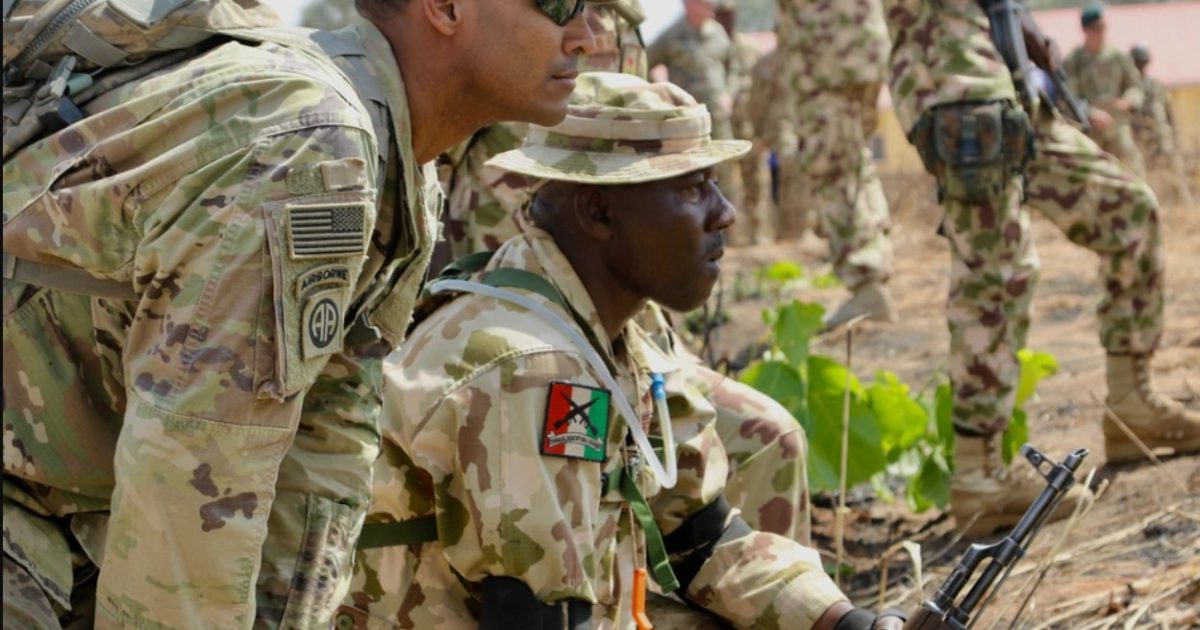
The U.S. Army trains the Nigerian military in counterterrorism operations. Photo courtesy of Defense Visual Information Distribution Service.
On April 8, 2026, the U.S. Department of State authorized non-emergency embassy staff and their families to depart Abuja, citing a deteriorating security environment marked by crime, terrorism, and civil unrest. The move comes in the wake of multiple massacres of Christians during Holy Week, including on Palm Sunday, Good Friday, and Easter Sunday.
The order is an “authorized departure” rather than a mandatory evacuation, giving affected personnel the option to leave at government expense while the embassy remains open with a reduced footprint.
The Lagos consulate continues to provide routine and emergency services. The State Department also expanded its travel advisory, placing 23 of Nigeria’s 36 states under a “Level 4: Do Not Travel” designation, the highest risk category, adding Plateau, Jigawa, Kwara, Niger, and Taraba to the list. Nigeria as a whole remains at “Level 3: Reconsider Travel.”
The immediate trigger was an attack the day before the order, when gunmen struck two villages roughly 155 miles from Abuja, killing at least 20 people. The evacuation followed weeks after the U.S. military deployed MQ-9 Reaper drones to Nigeria amid fears of renewed Boko Haram insurgency, and two months after 200 U.S. troops arrived to provide training and intelligence support to Nigerian forces.
The evacuation order is the latest development in a rapidly escalating U.S.-Nigeria security relationship that began in November 2025, when President Trump warned the Nigerian government: “If the Nigerian government continues to allow the killing of Christians, the USA will immediately stop all aid and assistance to Nigeria and may very well go into that now disgraced country, guns a-blazing, to completely wipe out the Islamic terrorists who are committing these horrible atrocities.”
President Trump concluded by stating, “I am hereby instructing our Department of War to prepare for possible action. Warning, the Nigerian government better move fast before it’s too late.”
Secretary of War Pete Hegseth backed the threat, posting: “The Department of War is preparing for action. Either the Nigerian government protects Christians, or we will kill the Islamic terrorists who are committing these horrible atrocities.”
Trump had designated Nigeria a “Country of Particular Concern” under the 1998 International Religious Freedom Act, stating that “Christianity is facing an existential threat in Nigeria” and that “radical Islamists are responsible for this mass slaughter.” Nigerian President Bola Ahmed Tinubu rejected the characterization, saying it “does not reflect our national reality” and citing constitutional guarantees of religious freedom for all citizens.
Rather than escalating into open confrontation, the situation shifted toward a security partnership. On Christmas Day 2025, the U.S. launched strikes in northwest Nigeria, firing 16 Tomahawk missiles at sites used by extremist groups. Trump called the attack a “Christmas present” to Christians. AFRICOM stated the strikes were carried out at the request of Nigerian authorities.
Behind the scenes, Nigeria hired Washington lobbying firm DCI Group for a reported $9 million to help manage the relationship with the Trump administration. On January 22, 2026, AFRICOM Deputy Commander Lieutenant General John Brennan traveled to Abuja to launch a U.S.-Nigeria Joint Working Group, providing intelligence and training to Nigerian security forces.
On February 23, the House Appropriations Committee and House Foreign Affairs Committee delivered a joint report to the White House following two congressional delegations to Nigeria. The FY26 appropriations legislation withholds U.S. funding to Nigeria until action is taken to stop violence against Christians.
The report recommended a bilateral security agreement, sanctions on perpetrators, visa restrictions, and pressure to repeal sharia-based blasphemy laws. In March, Archbishop Ignatius Kaigama of Abuja publicly thanked Trump, calling him “the first head of state to declare clearly and unequivocally that Christians in Nigeria are being persecuted,” and called on him to provide intelligence assets and weapons.
The violence driving these developments has been building for over 16 years. Since Boko Haram’s insurgency began in 2009, civil society monitors Intersociety and Open Doors estimate between 50,000 and 125,000 Christians have been killed in targeted attacks, accounting for the majority of global faith-related Christian deaths.
In 2025 alone, more than 7,000 Christians were killed, an average of 32 to 35 per day, primarily by Boko Haram, ISWAP, and Fulani militants in the north and Middle Belt regions. Approximately 19,100 churches have been attacked, looted, burned, or forcibly closed since 2009, alongside over 4,000 Christian schools, displacing entire communities.
More than 1,100 Christian villages have been abandoned, contributing to the displacement of an estimated 12 to 40 million people. The Nigerian government has repeatedly attributed many deaths to broader banditry or ethnic conflict affecting all faiths, rather than targeted religious persecution.
The U.S. provides between $800 million and $1 billion annually in aid to Nigeria, totaling $7.8 billion from 2015 to 2024, directed primarily at health programs, security assistance against Boko Haram, and humanitarian relief. Under Trump’s aid freeze and CPC designation, obligated assistance dropped to approximately $550 million, with an additional $32.5 million in hunger aid approved in September 2025.
The April 8 evacuation order signals that, despite five months of military cooperation and diplomatic pressure, the security situation on the ground has continued to worsen. Former Nigerian presidential candidate Peter Obi called the evacuation “a clear signal of declining confidence in Nigeria’s national security architecture” and warned it should be treated as a national emergency, particularly given Nigeria’s struggle to attract foreign investment.
Nigeria currently ranks fourth on the Global Terrorism Index. The departure of U.S. diplomatic families from the capital is a development that frequently triggers similar actions from other Western nations, with cascading consequences for investment, business travel, and Nigeria’s international standing.
The post U.S. Evacuates Embassy Staff and Families in Nigeria Amid Islamist Violence Against Christians appeared first on The Gateway Pundit.