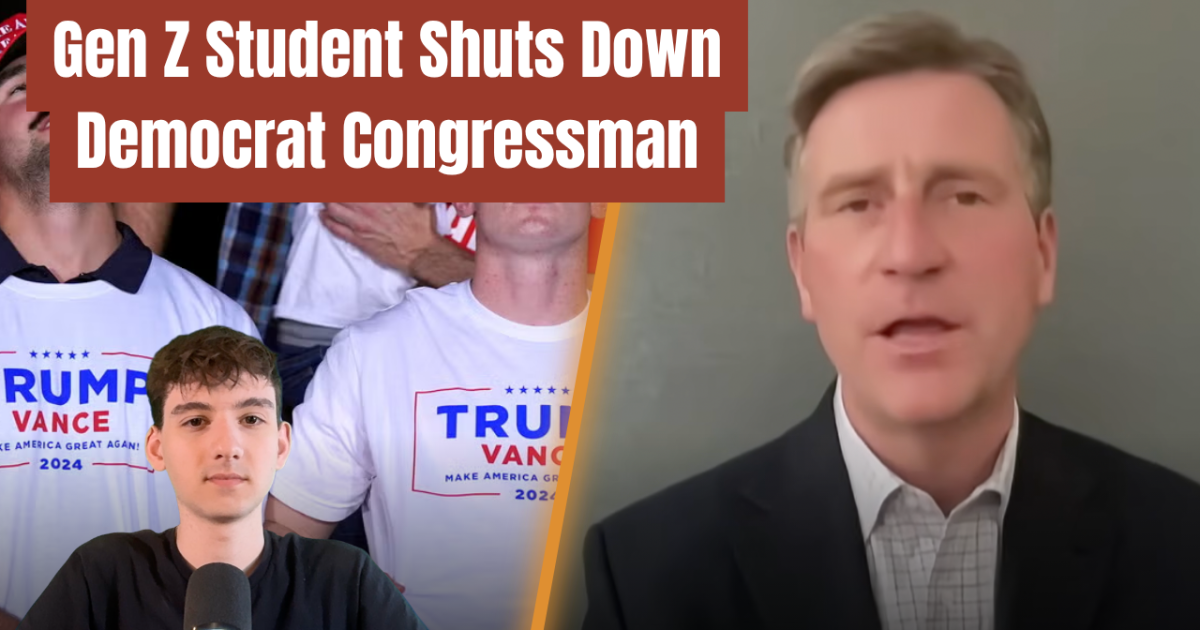
In a recent interview on MSNOW, Democrat Rep. Greg Stanton claimed that Republicans are somehow “disengaged” from young voters and that conservative values lack appeal among Gen Z.
The argument does not hold up under even basic scrutiny, especially after what unfolded in the 2024 election.
The data and the momentum both point in the opposite direction. In the 2024 race between President Donald Trump and Democrats, younger voters moved toward Republicans in numbers that would have been unthinkable just a few election cycles ago.
That shift was the result of a sustained effort to engage younger audiences where they actually are, led largely by figures like Charlie Kirk and his organization, Turning Point USA.
Stanton’s claim ignores a structural change in political communication. For years, Democrats held an advantage with younger voters through cultural dominance and institutional messaging. That advantage has weakened.
Conservative voices have built parallel ecosystems across social media, campus networks, and independent platforms, allowing Republican ideas to reach younger voters without being filtered through legacy media narratives.
This interview itself reflects a broader pattern. Rather than engaging with why younger voters are shifting, Democrats are dismissing the trend altogether. That approach mirrors previous miscalculations, including the assumption that Gen Z would remain uniformly aligned with progressive politics.
Stanton also leaned on familiar talking points about midterm trends and polling narratives, referencing outlets like The Atlantic to argue that Republicans are facing structural disadvantages.
That argument lacks context. Midterm outcomes historically vary based on economic conditions, presidential approval, and turnout patterns. The 2022 midterms under former President Joe Biden, for example, did not produce the kind of dominant Democrat performance seen in 2018, despite similar expectations.
More importantly, focusing on midterm cycles misses the central issue: voter realignment. Younger voters are no longer a guaranteed Democrat bloc.
Economic concerns, foreign policy developments, and dissatisfaction with institutional messaging have all contributed to a more competitive landscape.
Many young conservatives are rejecting the premise entirely, pointing to their own experiences and engagement. The idea that conservative values are “unpopular” among Gen Z becomes harder to defend when those same voters are actively organizing, attending events, and influencing online discourse at scale.
There is also a credibility gap in Stanton’s argument. Dismissal of an observable shift as nonexistent does not persuade voters already participating in it.
Rather, it signals a refusal to engage with reality instead of a serious attempt to understand it.
If Democrats continue to misread the youth vote, they risk losing further ground in a demographic that was once considered reliably supportive.
Meanwhile, Republicans have an opportunity to solidify gains by continuing targeted outreach and maintaining a presence in the spaces where younger voters are most active.
Stanton’s comments may resonate within certain media circles, but they do not align with the electorate’s direction. The youth vote is no longer predictable, and pretending otherwise does not change the numbers.
The Patriot Perspective has recently switched its main platform from YouTube, and we would greatly appreciate it if you subscribed to us there. [HERE]
The post Democrat Congressman Greg Stanton Rants That Trump Is Losing Young Voters — Gen Z Reacts appeared first on The Gateway Pundit.