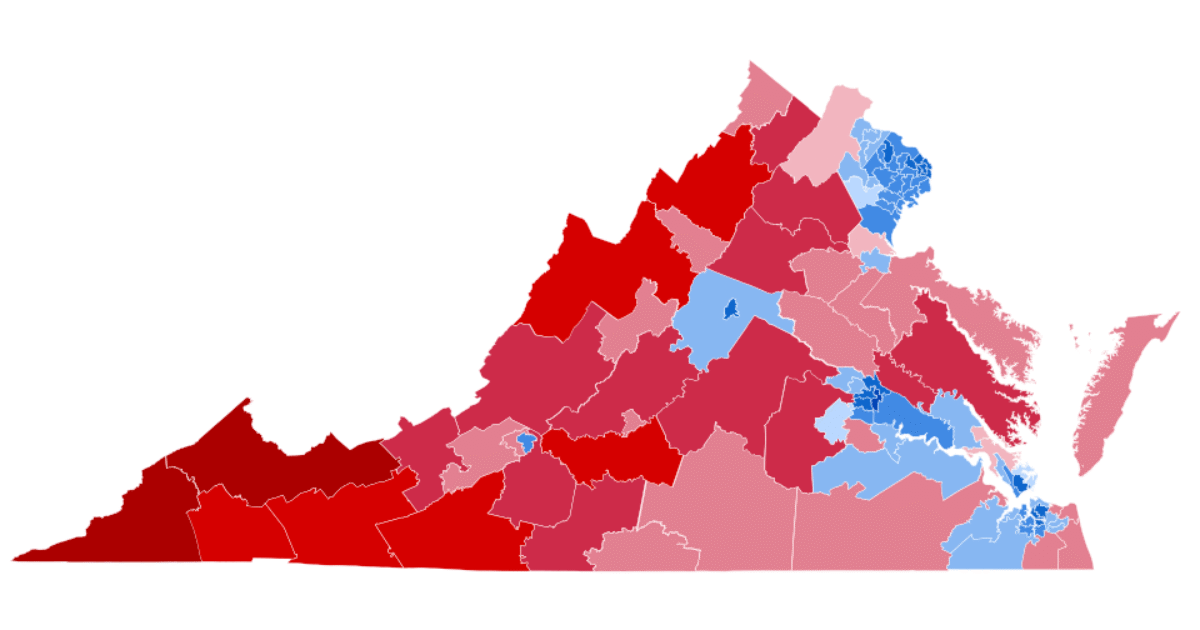
Yesterday, Virginians took to the polls to decide on a proposed amendment to the state’s constitution that would “restore fairness” by “ensuring” standards in redistricting.
Yes, those exact terms were used on the ballot seen by about three million Virginia voters. The proposed amendment on the ballot read:
Question: Should the Constitution of Virginia be amended to allow the General Assembly to temporarily adopt new congressional districts to restore fairness in the upcoming elections, while ensuring Virginia’s standard redistricting process resumes for all future redistricting after the 2030 census?
“Restore fairness”? In what world would anyone not want to “restore fairness” to something?? What a shamefully misleading phrase.
The amendment does anything but “restore fairness.” Virginia voters “voted” 51.8% to 46% for Kamala Harris over President Donald Trump. The ballot measure passed 51.4% to 48.6%. Even the highly contentious 2020 election was 54% to 44% with Biden (allegedly) claiming Virginia’s 13 electoral votes.
Virginia’s U.S. Congressional representation is, at least for now, in line with these results, with six Democrat reps to five Republicans.
The new redistricting effort will hand over four of those GOP seats to the Democrats in an already-passed new map, resulting in 10 to 1, or 90.91% Democrat representation in a state where the Democrats barely have a majority.
Democrat, Not Republican, Gerrymandering
California passed Prop 50, which will likely add 5 seats to the Democrats, bringing their total to 48 seats versus just 4 Republican seats (previously, Republicans held 9 seats), giving Democrats 92% of the state’s seats with a population that Biden only won by 63% in 2020 and Harris by 58%.
In the New England states, where the population voted around 40% for Trump in 2020 and 2024, Republicans have ZERO U.S. House seats. Forty percent of New Englanders have no representation in Congress. “Restore fairness.”
But California and New England aren’t the only examples:
California has 17% GOP representation in Congress in a state where President Trump garnered 38% of the vote.
Texas has 34% Dem representation while Harris garnered 43% of the vote.
Last time I checked, 9% < 21%.
Texas is currently 25-13 in Congress in favor of Rs. If all 5… https://t.co/SxoICTicpR
— CannCon (@canncon) August 12, 2025
With a Pending Appeal, Virginia Supreme Court Must Act
The journey for this proposed amendment to make its way onto the ballot is wild, to say the least.
In 2020, Virginia voters passed a constitutional amendment that gave a bipartisan commission the power to draw congressional districts. But following Texas’s adoption of a new congressional map that would potentially give Republicans five new seats, several states began to gerrymander their own congressional maps.
Following the redistricting in Texas, the Virginia Democrat delegation launched its scheme.
A constitutional amendment in Virginia requires approval by the legislature in two consecutive legislative sessions, with a general election in between. It then goes to the public for a vote.
On October 31, 2025, the General Assembly first passed the proposal during the 2024 Special Session, in which the scope and purpose were expanded to include considering and passing the proposal.
The required second passage of the proposal occurred on January 16, 2026, with Governor Abigail Spanberger signing legislation to enable the referendum vote on February 4, 2026.
However, on January 27, a circuit court judge ruled the amendment was unlawful, with the judge concurring that the passage of the proposal was outside the scope of the 2024 Special Session and that the requirement of a general election between the two votes in the General Assembly was not accomplished because voters had already begun early voting on September 19, before the proposal passed for the first time on October 31, thus failing to accomplish the general election between assembly votes.
On February 13, the Supreme Court of Virginia lifted the temporary restraining order (TRO) and permitted the special election to proceed while it considered the case.
On February 18, the Republican National Committee filed a separate lawsuit contesting the phrase “restore fairness” as misleading and deviating from the language of the amendment passed by the General Assembly. The same circuit court judge granted another TRO barring officials from administering the election on those grounds.
The Virginia Supreme Court also stayed that ruling until after the special election, with briefs due two days after the vote on April 23. If the amendment failed, the case would be deemed moot and dismissed. But since the amendment passed, the Virginia Supreme Court must now decide the case on the merits.
The Circuit Court’s Declaratory Judgment
The method by which the amendment was proposed and passed failed to meet the constitutional requirements on numerous grounds.
RNLA Chair Lee Goodman on VA Election Results: “
This referendum was advanced to the ballot through a rushed and unprecedented process. The constitutional validity of the referendum now goes before the Virginia Supreme Court, where I am confident it will be invalidated. If I’m…
— RNLA (@TheRepLawyer) April 22, 2026
Strike 1
Tazewell County Circuit Court Judge Jack Hurley, Jr. concurred that the General Assembly did expand the scope of the 2024 Special Session, ruling that “the first passage of the proposed constitutional amendment is void ab initio,” or from the beginning.
Strike 2
Next, the court ruled that the “next general election of members of the House of Delegates” had already begun, with early voting starting on September 19, 2025. Over one million Virginians had already cast ballots by the time of the General Assembly’s first passage on October 31.
Side Note: The Supreme Court of the United States recently heard arguments in Watson v. RNC to determine whether “Election Day” refers only to the day voters cast their ballots or if deadlines can be set by law for receiving ballots after “Election Day.” The case was not asking SCOTUS to determine when “Election Day” began.
Strike 3
The court decided that, “Even if the General Assembly’s first passage…were valid and even if ‘election’ is defined narrowly as only Election Day and not the entire period of voting,” the General Assembly still failed to provide copies of the amendment to “every circuit court clerk to post at the front door of the courthouse at least three months prior” to the next general election (which had already begun).
Strike 4
Regarding the text of the proposal on the ballot argued in the second case, Judge Hurley wrote that the ballot language was misleading and violated the Submission Clause of Article XII, Section 1 of the Virginia Constitution. “It submits a different question on the referendum ballot than the language of the constitutional amendment passed by the General Assembly.”
Strike 5
The Virginia Constitution also requires the proposed amendment to be presented to voters “not sooner than ninety days after final passage by the General Assembly.” If that final passage was, in fact, on January 16, 2026, then the 90-day requirement was not fulfilled before early voting began on March 6, 2026.
Strike 6
The court determined that HB 1384 violated Article IV, Section 12 of the Virginia Constitution by passing a bill that “embrace[s] more than one object.” In this case, the bill not only proposes the constitutional amendment; it also addresses, “providing for appropriations of public revenues,” “establishing the ballot question and procedures for submitting the proposed constitutional amendment to the voters,” “repealing Code § 30-13,” and “transferring venue to the Richmond Circuit Court for civil actions challenging the proposed constitutional amendment.”
Sen. Tim Kaine on FOX News last weekend said the quiet part out loud. This amendment isn’t about “restoring fairness.” It is about combatting President Trump’s mandate from the 2024 election. Kaine said, “We’re deeply worried that Donald Trump will try to interfere with the election results this November or in 2028 because we saw him do it before. And we have to have a Congress that will stand up to it.”
The post “Restore Fairness”? The Ballot Battle for Virginia’s Map Now Can Continue in the Virginia Supreme Court appeared first on The Gateway Pundit.