via Flickr
A biotechnology firm’s claim that it has taken a major step toward “bringing back extinct species” is raising not only scientific debate, but deeper ethical and moral questions about humanity’s growing willingness to reshape life itself.
The company at the center of the controversy, if you want to call it that, Colossal Biosciences, says it has successfully hatched live chicks using an artificial egg system—an achievement it describes as a breakthrough.
To some, the development represents cutting-edge innovation. To others, it signals a troubling step further into territory long associated with science fiction—and, increasingly, with man attempting to take on the role of Creator.
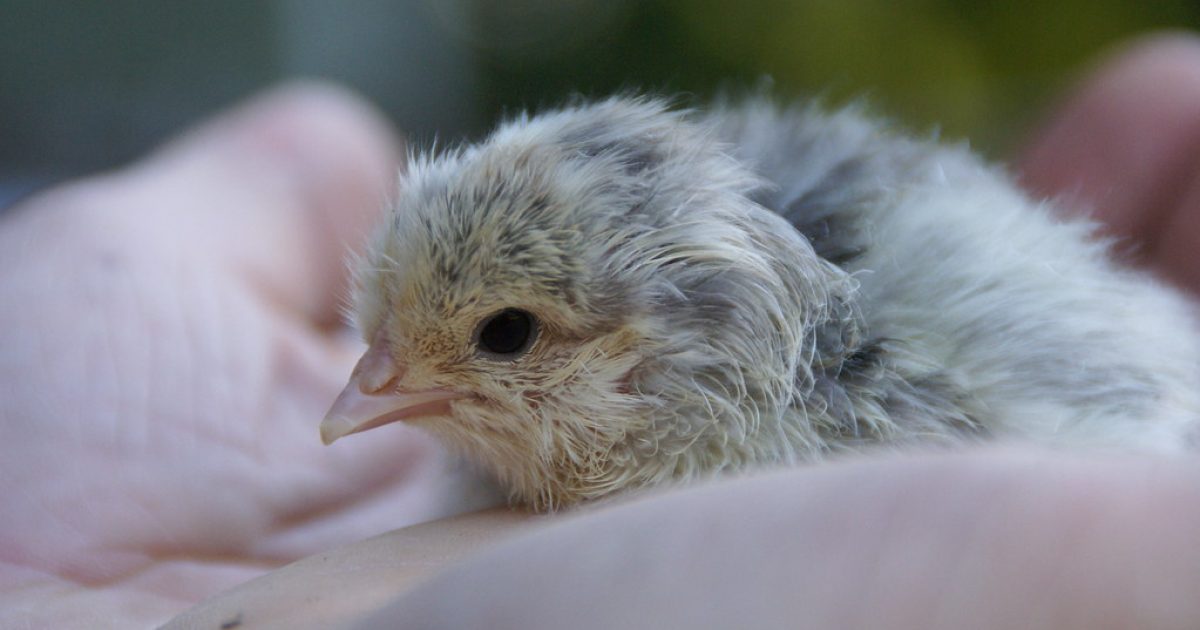
The company says it hatched 26 chicks using a 3D-printed structure that allows embryos to develop outside a natural shell.
CEO Ben Lamm framed the project as a bold reimagining of biology itself. “We didn’t just copy nature… we tried to re-engineer it,” he said.
That statement, while celebrated in some scientific circles, is precisely what gives others pause.
For generations, the natural order—life emerging through processes designed by God—has been understood as something to be respected, not redesigned.
Now, companies backed by billions in investment are openly discussing not only replicating those processes, but improving upon them.
The artificial egg system uses a synthetic membrane to regulate oxygen flow and development, allowing scientists to monitor and control every stage of growth.
Those in favor of this kind of technology argue that such control could have positive applications, particularly in preserving endangered species that struggle to reproduce.
Colossal itself claims the technology could help “rescue fragile bird embryos” and support conservation efforts. Critics, on the other hand, caution that the line between conservation and creation is becoming increasingly blurred.
Independent scientists have also pushed back on the company’s claims, noting that the technology may not be as revolutionary as it sounds.
Evolutionary biologist Vincent Lynch argued that the system is not a true artificial egg.
“That’s not an artificial egg… it’s an artificial eggshell,” Lynch said, pointing out that key biological components were still manually supplied.
Others note that similar techniques have existed in simpler forms for decades, raising questions about whether the current breakthrough is being overstated.
But the larger concern for many is not whether the technology works—but where it leads.
Colossal has made clear that its ultimate goal is to revive extinct species such as the dodo and the giant moa.
To achieve that, scientists would need to reconstruct ancient DNA and genetically engineer modern birds to resemble creatures that vanished centuries ago.
Even if successful, experts stress that such animals would not truly be the originals—but modified approximations.
“They might be able to make a genetically modified bird… but it’s not a moa,” Lynch said.
Beyond the technical challenges lie deeper moral questions. If humanity can recreate life forms that no longer exist, what limits—if any—should be observed?
The concern, for a great many, is that scientific ambition is moving faster than ethical reflection.
Bioethicists have also raised practical issues, including how such creatures would survive in a modern world vastly different from the one they once inhabited.
“The big challenge is, what environment is this animal going to live in?” asked Arthur Caplan of New York University.
Even among scientists, there is growing debate over priorities. Some argue that resources would be better spent protecting the species that still exist, rather than attempting to resurrect those that are gone.
“My personal interests lie more in preserving what we’ve got,” said researcher Nicola Hemmings. That perspective resonates with many who see stewardship—not reinvention—as humanity’s proper role in relation to the natural world.
Still, the push for de-extinction continues, fueled by technological optimism and significant financial backing. Lamm has suggested that resurrecting species like the moa could become reality within the next decade or two.
But even some supporters acknowledge that such projections may be overly ambitious. The science remains uncertain, the challenges immense, and the long-term consequences largely unknown.
For a public already wary of rapid technological change, the idea of engineering life at this level raises profound questions.
At its core, the debate is not just about science—it is about limits. How far should humanity go in attempting to control and redesign the natural world?
And perhaps more importantly, whether there are boundaries that should not be crossed at all.
The post Re-Engineering Nature: Biotech Firm Plays God with Artificial Egg Breakthrough appeared first on The Gateway Pundit.