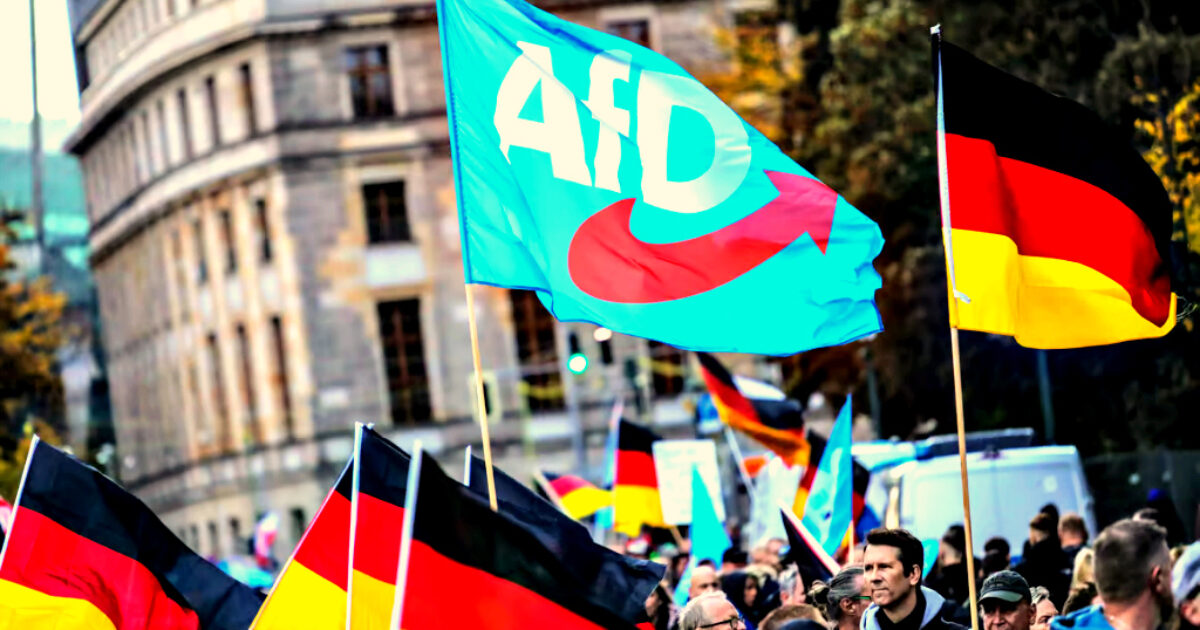
AfD supporters rally in Germany
The Alternative for Germany (AfD), the country’s sole right-wing, anti-globalist party, has surged to a record 42% in the eastern state of Saxony, putting the party within striking distance of an outright majority and raising the real possibility it could soon govern alone if it gains just a few more percentage points.
With analysts estimating that around 46% would be enough to secure a single-party government, the latest polling data suggests that threshold is now within reach. The development marks a potential political shift that could reshape Germany’s power structure.
The numbers place the AfD far ahead of its nearest competitor. The establishment, globalist Christian Democratic Union (CDU), led nationally by Chancellor Friedrich Merz, trails at mere 21%.
The gap is striking. In practical terms, the AfD now commands roughly double the support of the CDU in Saxony.
The polling data appears to reflect more than a temporary polling fluctuation, instead signalling a deeper realignment in voter sentiment across eastern Germany.
The AfD’s rise has been rapid. The party gained seven percentage points compared to the previous survey conducted roughly a year ago.
At the same time, traditional parties are losing ground. The CDU’s result represents one of its weakest performances in the region.
Other establishment, globalist parties, on the left and the right, are also struggling to maintain relevance. The Social Democrats and Greens hover at around six percent, while the Left Party remains in single digits.
Taken together, the data points to a collapse of the political center. Voters appear increasingly unwilling to support established parties.
In the neighboring state of Saxony-Anhalt, the trend is similar. There, the AfD has also reached 42%, reinforcing its momentum across eastern Germany.
With elections approaching, the implications are significant. The party is now positioned to challenge the long-standing political order.
Public dissatisfaction appears to be a key driver. According to the survey, 58% of respondents are unhappy with the current government.
Only a minority expressed satisfaction. The figures suggest a growing disconnect between voters and those in power.
Trust in federal leadership has also eroded sharply. A large majority of respondents say their confidence in political institutions has declined.
The issue, for many voters, is not just policy but direction. They feel that Germany is moving away from its core priorities.
Economic concerns are a major factor. Rising living costs and uncertainty about energy policy are weighing heavily on households.
Migration policy remains another flashpoint. It continues to dominate public debate and influence voting behavior.
Cultural and social questions are also shaping the landscape. Issues tied to identity, national cohesion, and social policy are increasingly prominent.
Polling data reveals a widening openness to alternatives. Nearly half of respondents said they have either voted for the AfD or could imagine doing so.
Only 39% categorically ruled out supporting the party. This suggests further growth potential remains.
At the same time, the political establishment remains resistant. All major establishment parties have pledged not to cooperate with the AfD.
This creates a structural dilemma. Forming governments without the leading party, depending on how much support that party has, will of course become increasingly difficult—if not impossible.
For the CDU, the situation is particularly challenging. Even with allies, it would likely require a broad coalition with all of the leftist parties—even the communists—to secure a majority.
Such coalitions are often unstable. They also risk further alienating voters who already feel disconnected and ignored.
The broader political environment is shifting rapidly. Traditional party loyalties are weakening across the electorate.
Instead, voters are seeking alternatives that they believe better reflect their concerns. This trend is especially pronounced in eastern Germany.
For critics of the current system, of which there doesn’t seem to be a shortage, the surge reflects accumulated frustration. They argue that key issues have been ignored for too long.
The coming elections will be a decisive test. Polling trends will soon be measured against real-world outcomes.
The post AfD Surges to 42% in East German State, Closing In On Absolute Majority appeared first on The Gateway Pundit.