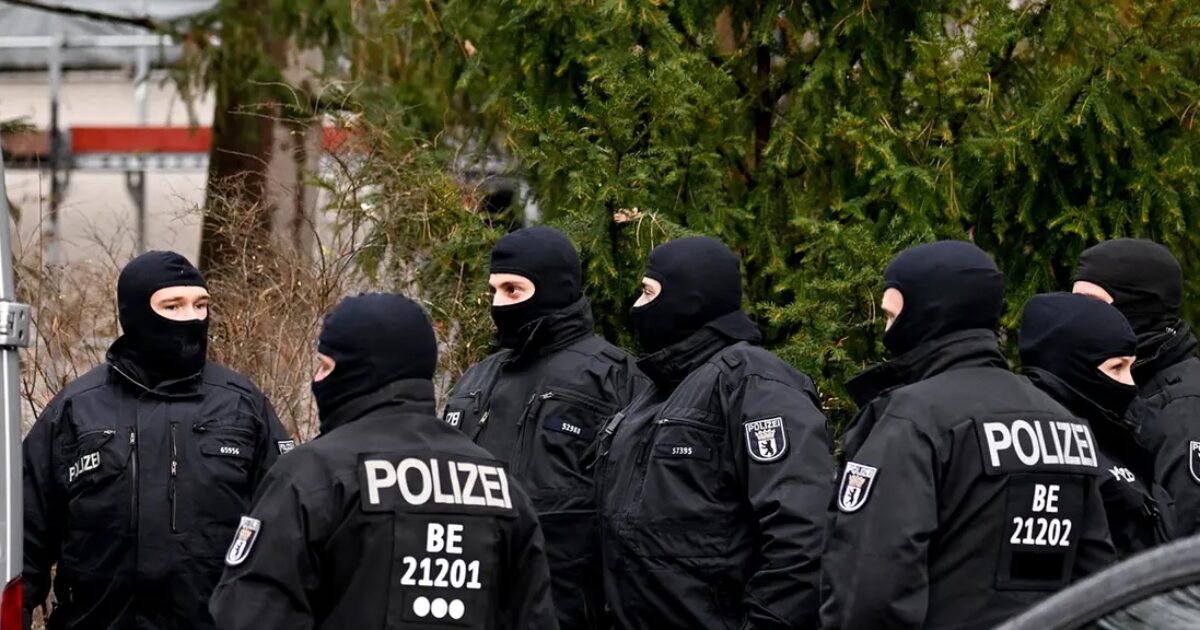
Federal prosecutors in Germany, according to various reports, have charged two men accused of participating in an Iran-linked plot to carry out violent attacks against Jewish leaders, in what officials describe as a chilling escalation of foreign-backed threats on European soil.
The case, naturally, has reignited urgent concerns across the continent about rising anti-Jewish violence, foreign intelligence operations, and the growing vulnerability of Europe’s Jewish communities.
According to prosecutors, a Danish national identified as Ali S. and an Afghan national, Tawab M., are accused of helping to prepare attacks targeting prominent Jewish figures in Germany. Both men face charges related to attempted murder.
Ali S. is also charged with acting as an agent for a foreign intelligence service. Authorities allege he was working on behalf of Iran’s Revolutionary Guards.
Investigators say he maintained close ties with the elite Quds Force, a unit known for conducting operations abroad. The allegations point to a coordinated effort reaching far beyond Germany’s borders.
Prosecutors state that in early 2025, Ali S. was tasked with gathering intelligence on high-profile targets. Among them were Josef Schuster, president of the Central Council of Jews in Germany, and Volker Beck, head of the German-Israeli Society.
Additional targets reportedly included Jewish businesses in Berlin. Investigators say the intent was to map out potential sites for attacks.
“All of this was intended to facilitate the planning of murder and arson attacks in Germany,” prosecutors said in an official statement.
Authorities allege that Ali S. scouted locations in Berlin and attempted to recruit accomplices. By mid-2025, he had allegedly established contact with Tawab M.
Prosecutors claim Tawab M. offered to help procure weapons. He is also accused of supporting plans to carry out a targeted attack.
The two suspects were arrested separately in Denmark. Ali S. was detained in June 2025, while Tawab M. was arrested several months later in November.
German prosecutors formally filed charges at Hamburg’s state court earlier this month. The case is expected to move forward in the coming weeks.
Following the arrest, Germany summoned Iran’s ambassador. The move underscored the seriousness with which Berlin views the allegations. Tehran, however, has rejected the accusations. Iranian officials described them as “unfounded and dangerous.”
The case comes amid a broader warning from German intelligence services. Authorities say Iran may expand covert operations across Europe
.
Germany’s domestic intelligence agency, the Bundesamt für Verfassungsschutz (the Office for the Protection of the Constitution), has cautioned that Jewish institutions and Israeli-linked sites could be at increased risk.
Officials have warned that Iranian dissidents living in Europe may also be targeted. Individuals labeled as “traitors” by Tehran are seen as particularly vulnerable.
Across Europe, law enforcement agencies are already investigating a pattern of incidents. These include arson attacks, vandalism, and small explosive devices targeting Jewish and Israeli-linked sites.
Investigators believe some of these attacks may be connected to proxy networks aligned with Iran. The scale and coordination of such activity remain under review.
At the same time, European officials are confronting a growing digital front. Authorities say networks linked to Iran’s Revolutionary Guards have been spreading propaganda online.
According to European People’s Party (EPP) lawmaker Tomáš Zdechovský, thousands of accounts and websites tied to these efforts have been identified. Many have since been removed or blocked.
Police forces across EU countries have uncovered a vast online network of accounts and websites spreading propaganda linked to Iran’s Revolutionary Guards.
Authorities succeeded in removing thousands of links and blocking the organization’s main account on the X platform. pic.twitter.com/f3z5k0844Q
— Tomáš Zdechovský (@TomasZdechovsky) May 19, 2026
The Revolutionary Guards were designated as a terrorist organization by the European Union earlier this year. The move followed international outrage over Tehran’s internal crackdown.
The current case, for many onlookers, highlights a broader pattern. Europe is increasingly facing external threats that intersect with internal vulnerabilities
.
Many argue that weak enforcement and fragmented security responses have made the continent more exposed. They warn that foreign actors are exploiting those gaps.
The targeting of Jewish communities has drawn particular concern. Many see it as part of a wider trend of rising anti-Semitic incidents across Europe.
The case raises serious questions from a national security perspective. How effective are current measures in protecting vulnerable communities?
It also underscores the challenges posed by globalized threats. Intelligence operations, proxy networks, and ideological conflicts are increasingly crossing borders.
The stakes couldn’t be higher for policymakers. The need to balance openness with security has become more pressing than ever.
As the investigation continues, authorities say vigilance remains critical. They warn that this case may not be an isolated incident.
For Europe’s Jewish communities, the developments are obviously deeply troubling. The prospect of organized, foreign-backed violence has rightfully heightened fears.
The post Iran-Linked Terror Plot in Europe: Migrant Spy Ring Accused of Targeting Jewish Leaders in Germany appeared first on The Gateway Pundit.