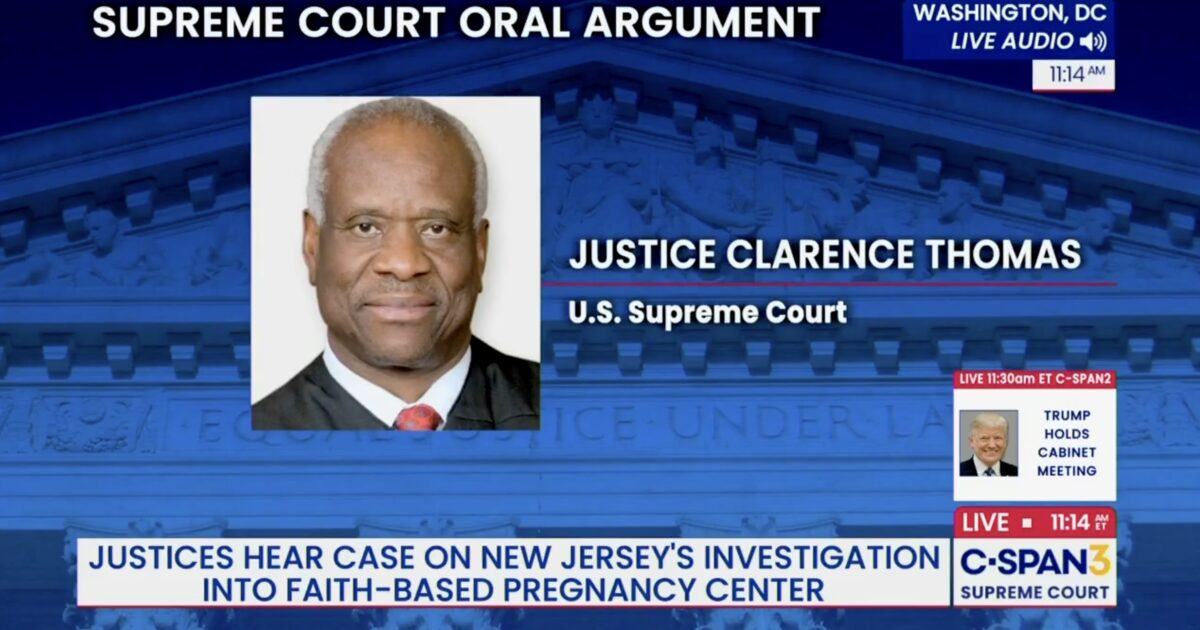
Justice Clarence Thomas forced New Jersey Attorney General Matt Platkin’s chief counsel to admit that the state launched an intrusive investigation into a pro-life pregnancy center without receiving a single complaint about the organization.
During oral arguments in First Choice Women’s Resource Centers v. Platkin, Justice Thomas methodically dismantled the state’s justification for issuing a donor-snooping subpoena targeting First Choice, a faith-based, pro-life pregnancy support network that has operated for over 40 years.
Justice Thomas drilled into a simple, devastating question: “You had no basis to think that they were deceiving any of their contributors?”
Sundeep Iyer, chief counsel to AG Platkin, conceded that New Jersey received zero complaints about First Choice Women’s Resource Centers.
Instead, he claimed the state merely “canvassed public information” before issuing a sweeping subpoena demanding years of internal records, including confidential donor information.
Iyer further admitted that the state did receive complaints about other pregnancy centers, but not First Choice.
First Choice, a faith-based pro-life nonprofit operating in New Jersey since 1985, provides free ultrasounds, pregnancy tests, counseling, and material support to women. It is fully upfront about its pro-life mission, stating on every page of its website that it does not provide or refer for abortion services.
Despite that transparency, Democratic Attorney General Matt Platkin launched an investigation in November 2023 alleging “possible deceptive marketing practices,” even though:
The AG had no complainants claiming deception.
The center’s messaging is overwhelmingly clear.
The investigation was enabled by New Jersey’s consumer fraud laws and charitable-registration statutes—giving the AG sweeping discretion to demand documents, even without probable cause.
The subpoena, as detailed in First Choice’s petition for certiorari, demanded donor identities, staff identities, internal communications, marketing materials, and years of operational records, an all-encompassing probe that the center says violates its First Amendment rights to free association and political expression.
And on Tuesday, Justice Thomas made clear he saw the same red flags.
Thomas Clarence:
Did you have complaints that formed the basis of your concern about the fundraising activities here?
Sundeep Iyer:
We certainly had complaints about crisis pregnancy centers.
Thomas Clarence:
No — about this crisis pregnancy center.
Sundeep Iyer:
So, I think we’ve been clear from the outset that we haven’t had complaints about this specific—
Thomas Clarence:
So you had no basis to think that they were deceiving any of their contributors?
Sundeep Iyer:
I don’t think that’s correct, Your Honor. I think we had carefully canvassed all of the public information that is provided on the website of First Choice in making a determination that we wanted to initiate an investigation.
Thomas Clarence:
But you had no factual basis?
Sundeep Iyer:
I don’t think that’s true, Your Honor. I think, for example, you could take a look at a comparison between the donation page for First Choice that we have carved out from the very beginning—
Thomas Clarence:
But you had no complaints?
Sundeep Iyer:
We had no complaints, but state governments and the federal government initiate investigations all the time in the absence of complaints, where they have a reason to suspect that there could be potential issues of legal compliance. And look, it could be the case, based on our investigation—when we look at documents, when we look at information—that ultimately we will determine that First Choice isn’t liable for any violation.
Thomas Clarence:
That just seems to be a burdensome way to find out whether someone has a confusing website. But you said earlier that you did not agree with their characterization of why they were being put to this. It would seem that the obvious way to refute that would be to say, “We had 100 complaints.” But you say you have no complaints—rather, you looked at the website and their materials and you think it could have been misleading. Why is your characterization any better than theirs?
Sundeep Iyer:
So, Your Honor, I’d point you to the Turner Declaration, which is at pages 400 to 401 of the joint appendix, which lays out the predicate for the state’s investigation of First Choice. And we had concerns in four buckets: we had concerns about potentially misleading donors; we had concerns about the unlicensed practice of medicine; we had concerns about patient privacy practices; and we had concerns about potentially misleading or untrue medical statements. So I think we had a more than ample basis to initiate this investigation.
Thomas Clarence:
But you had no complaints.
Sundeep Iyer:
We had no complaints — but I think that, Your Honor, goes at most to the merits. That doesn’t go to the standing analysis.
LISTEN:
Justice Thomas forces the New Jersey AG’s chief counsel to admit the state issued a subpoena for a pro-life pregnancy center’s donors without receiving a single complaint about the organization.
“So you had no basis to think that they were deceiving any of their contributors?”… pic.twitter.com/oN5TAt1RPm
— Katelynn Richardson (@katesrichardson) December 2, 2025
The post WEAPONIZATION EXPOSED: Justice Thomas Corners New Jersey AG’s Counsel — Confirms Subpoena for Pro-Life Donors Issued Even Though NO ONE Complained appeared first on The Gateway Pundit.