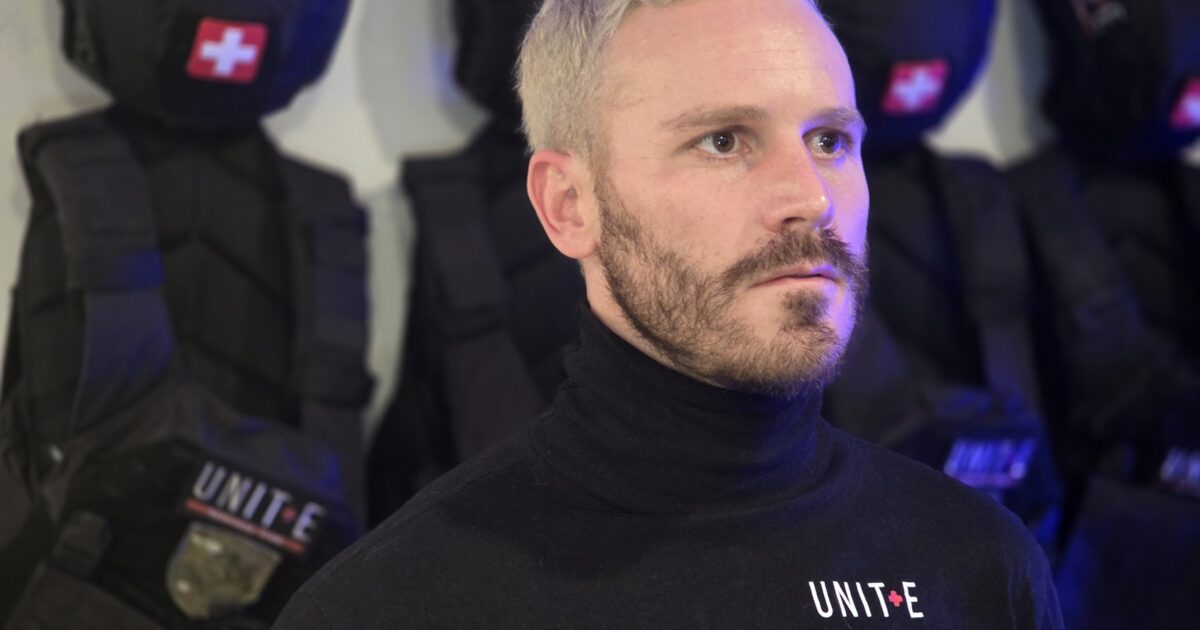
Unit+E, a Christian counter-human-trafficking organization. Screen grab. Photo courtesy of Unit+E.
In a residential house in a suburban neighborhood in the southern United States, Lane Terzieff, founder and leader of Unit+E, conducts a debriefing with his team following a recent counter-human-trafficking mission in Asia.
One wall is lined with body armor worn during raids, as traffickers are often armed. Another displays flow charts and plans for future operations.
According to its website, the group’s mission is “fighting human trafficking at its source.” Terzieff summarized it more directly: “Our goal is to make doing evil as inconvenient as possible.”
Terzieff grew up between Washington State and Wyoming. He left high school without a diploma, saying he “wanted to do things.” His interest in music and his desire to become a missionary led him to Southeast Asia, where he became involved in hip hop ministry.
There, he encountered the suffering of people in Burma and spent time accompanying the Free Burma Rangers, playing gospel music for internally displaced people inside the war zone.
“I saw what they had been through, and the conditions there, and it broke my heart,” he said.
From his experience in Southeast Asia and from observing how the Rangers operate, Terzieff learned to identify major humanitarian gaps.
He discovered there were areas of severe need that were not being addressed, including by large international aid organizations and government-to-government assistance programs.
Unit+E, a Christian counter-human-trafficking organization. Screen grab. Photo courtesy of Unit+E.
He said the work of bringing love, hope, and joy to people most in need, felt right. “It really matched with what I was reading in the Bible about God’s heart to free the oppressed and help those in need.”
He took the phrase “free the oppressed” literally and committed himself to dismantling human trafficking networks and rescuing victims. Human trafficking takes many forms.
In Southeast Asia, two have drawn particular attention: child sex trafficking and forced labor in online scam compounds..
In the Philippines, child sex trafficking is driven largely by online sexual exploitation of children.
Studies estimate that nearly 500,000 Filipino children were trafficked to produce child sexual exploitation material in 2022.
An estimated 60,000 to 100,000 children are affected by labor or sex trafficking more broadly, and one in five children aged 12 to 17 has experienced online sexual abuse.
The Philippines has become a central hub for livestreamed child sexual exploitation.
These crimes are facilitated through online platforms that allow foreign offenders to pay local traffickers to abuse children in real time via video calls, sometimes for as little as $25 per session.
U.S.-originating payments account for the largest share of suspicious financial transaction reports related to child sexual abuse in the Philippines.
Victims are often trafficked by family members, and children as young as six have been identified. Documented hotspots include Angeles City, Olongapo, Cebu City, Davao, Puerto Galera, and Pagsanjan.
In Burma, Cambodia, and Laos, trafficking is closely tied to large-scale online scam compounds.
At least 300,000 people are estimated to be held in forced labor across the Mekong region, with victims from more than 60 countries.
These operations generate billions of dollars in global losses each year, including major losses in the United States and the United Kingdom.
Scam compounds operate mainly in border regions, particularly along the Burma–Thailand frontier. One of the largest sites, KK Park, spans hundreds of acres and can house thousands of workers.
Since 2021, the number of documented scam compounds has expanded rapidly, with dozens identified in Cambodia alone. These facilities function as closed environments where workers are confined and monitored.
Unit+E, a Christian counter-human-trafficking organization. Screen grab. Photo courtesy of Unit+E.
Recruitment typically occurs through false job advertisements promising high-paying white-collar work in fields such as marketing, IT, or customer service.
Traffickers arrange travel, housing, and documentation. Victims include educated and multilingual individuals from across Asia, as well as growing numbers from Africa and Latin America. Minors have also been trafficked.
Inside the compounds, victims face strict control. Identification documents and phones are confiscated, workdays can reach 17 hours, and armed guards prevent escape.
Failure to meet financial quotas results in beatings, electric shocks, confinement, or sexual abuse. Some victims are forced to harm others, and release is often conditioned on ransom payments or resale to other compounds.
The scams conducted include cryptocurrency investment fraud, romance scams, task scams, illegal online gambling, and other cyber fraud schemes.
These operations are primarily run by Chinese organized crime networks operating across borders and rely on advanced technology, including satellite internet systems, to continue operating after regional governments cut utilities to known scam zones.
When people imagine Americans infiltrating foreign criminal networks and risking their lives to rescue victims, they may picture a muscular Rambo, a hardened combat veteran.
The reality is very different. None of the team members present during my visit had military or law enforcement experience, and all were slim and physically unassuming.
In many cases, that likely works to their advantage, as their work focuses more on gathering information than kicking in doors, though none of them would shy away from direct confrontation with bad people when necessary. They are also willing to die for the victims they serve.
Terzieff said, “Sometimes we don’t have all the best contingency plans. But God says go and be willing to lay down your life for your brothers and sisters.
You know, First John 3:16, we know what real love looks like because Jesus laid down his life for us, so we should lay down our lives for our brothers and sisters.
Sometimes we go into an operation and we’re like, ‘Hey guys, I don’t know exactly how this is going to go,’ but that’s our family on the other side of that wall.”
Jordan Guerrero, one of the volunteers who had just returned from a mission, reflected on the faith that drives his work. “Jesus, when he was on the cross, he saw and felt all sin.
This is why I need to die for the people I love. And it was for us. And we get like a little crumb of that when we see this evil. And the most that we can be like Christ in that moment is to bear that weight,” he said.
Guerrero echoed Terzieff’s willingness to make the ultimate sacrifice for trafficking victims he loved but had never met.
These were powerful words spoken by men in their late twenties and early thirties, with many years of life ahead of them.
Guerrero then described a realization he had during his most recent mission. “The comfort we have isn’t ours to keep. It’s a blessing that God has given us so we can give it back to those kids,” he said, referring to the victims.
The group believes its mission is part of God’s plan, and when the path is unclear, resources are unavailable, or they are warned not to go, they pray and move forward.
“We learn from and collaborate with law enforcement and ex-military,” Terzieff said, “but oftentimes we’re training and deploying people from many different civilian backgrounds to respond to human trafficking.”
He added that the group also conducts limited relief work, particularly in areas cut off from aid. “We’ve gone to places like northern Ethiopia during the Tigray crisis, where people say there’s no way in,” he said.
“Then we use the same counter-human-trafficking methods to find a way in and get aid to people there. But most of our work focuses on investigating human trafficking.”
Terzieff said the group concentrates on two primary areas: prepubescent child sex trafficking and cases of severe human trafficking involving any age or ethnicity.
“I don’t care if they’re a 35-year-old Ethiopian stuck in Asia doing hard labor or sending scam messages,” he said. “If torture and severe abuse are being used to control them, if they’re being locked inside, those are the cases we pursue.”
These people are victims, even the ones calling to steal your money.
“We’ve all gotten those crypto scam texts. It’s annoying, but then you learn it’s a 21-year-old Filipino girl who thought she was answering an IT job posting, was put in a van, taken to a country she didn’t recognize, and locked behind barbed wire.”
He said scam centers vary in structure. Some operate openly, with casinos, commerce, and tourism nearby. Others are heavily fortified, with concrete walls, barbed wire, and armed guards.
Terzieff said he did not want Unit+E to resemble organizations that focus primarily on fundraising or planning rather than action. “One of our core values is a bias for action,” he said, while acknowledging the group’s limited resources relative to the scale of human trafficking.
That often means, he said, “leaving the ninety-nine for the one.” He cited a recent rescue in which four children around 12 years old were freed and several traffickers arrested. “That alone is worth everything.”
He acknowledged that some question how rescuing so few victims constitutes success. He responded that those cases are often used to pursue broader legal change. “
We partner with organizations that take those cases and use them to change laws across the EU regarding sex offenders and travel,” he said. “But even if we work nonstop for two weeks to rescue one five-year-old girl, that’s enough. That makes it worth it.”
Wrapping up, Terzieff said, “I believe Christians should be at the front lines of the world’s most tragic issues,” adding that they should follow the roadmap God provides through the Bible on how to love people and why that matters.
Unit+E, a Christian counter-human-trafficking organization. Screen grab. Photo courtesy of Unit+E.
The post Making Evil Inconvenient: Inside a Christian Counter-Trafficking Network appeared first on The Gateway Pundit.