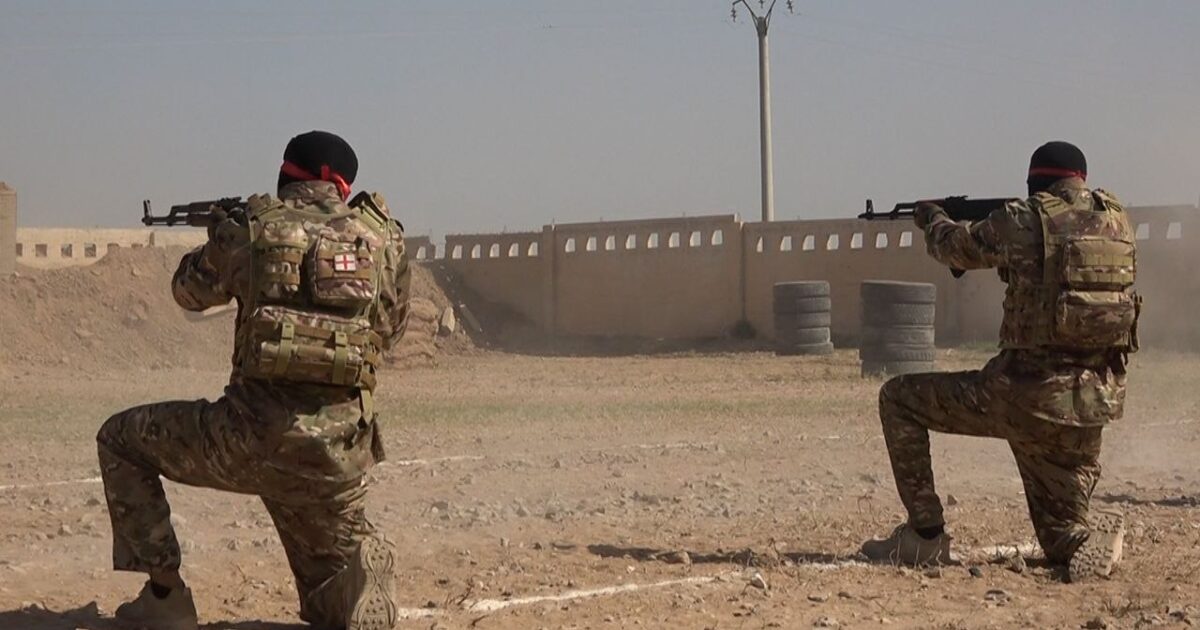
Photo by the Kurdish-led Syrian Democratic Forces
“Please tell Americans that the situation is extremely serious. Kobani is symbolic, not just militarily but morally. If it falls, it will be seen as revenge against a city that defeated ISIS. We need attention, pressure, and action.”
Those were the words of Barzan ISO during an interview as fighting escalated across northeastern Syria. Barzan, who coordinates with international humanitarian organizations and works alongside the Kurdish-led Syrian Democratic Forces, warned that Kurdish-held areas are facing simultaneous attacks from Syrian government forces, extremist groups, and Turkish bombings, as government forces and Al-Qaeda-linked fighters attack SDF-guarded prisons in an effort to free ISIS militants.
While interviewing Barzan, I received a desperate message from inside Qamishli, the largest city in Rojava, the Kurdish-led region officially known as the Autonomous Administration of North and East Syria (AANES):
“The situation here is very bad. Maybe within the next two days, the Jolani forces,” she said, referring to the Damascus army under the country’s current leader, Ahmed al-Sharaa, formerly known as al-Jolani when he was an Al-Qaeda commander, “will take control of Qamishli as well.”
“No one is asking or helping us from outside to protect us from ISIS. We are alone now. Unfortunately, the negotiations between the SDF and Jolani have failed, so now they will fight each other.”
Barzan reinforced that warning in a statement posted across social media, accusing the United States and the international coalition of abandoning the Syrian Kurds at a critical moment.
“History is repeating itself,” Barzan Iso wrote. “Once again, the United States of America is abandoning its most important ally for democracy and human rights in the Middle East. The Kurds of Syria sacrificed their sons and daughters to fight the most brutal organization in human history. Today, they are abandoned by the international community and by the Global Coalition to Defeat ISIS, for the benefit of ISIS’s former allies and those who will become its extension tomorrow.”
Iso said the Kurds had been defending their “very existence and freedom” while serving as a frontline force for those who claimed to stand for humanity. “Today, we wake up to the devastating realization that we have become victims of political deals, in which authoritarian regimes divide the spoils of a ‘new Middle East,’ under the sponsorship of those we once believed were our friends,” he wrote.
He drew a direct historical parallel, arguing that Kurdish trust in Western assurances had once again been betrayed. “Friends who stood on podiums and declared, ‘The Kurds no longer need the mountains; we are your friends,’ have betrayed us just as they did before,” Iso wrote, invoking Gertrude Bell and naming Thomas Barrack as a modern counterpart.
“We will remain,” he concluded. “But you must choose. Are you standing with justice, or with what is yet to come, built on the suffering and blood of the Kurds? This appeal is addressed to all who claim humanity, and to all who claim to uphold the values of journalism.”
In an interview, Barzan said heavy attacks had begun across northeastern Syria, including against civilians. He said forces guarding Raqqa prison were under siege and that roughly 600 personnel responsible for guarding ISIS detainees were trapped inside the area.
“They are completely besieged, and we are very afraid for their safety,” Barzan said. He explained that Syrian government forces had surrounded the prison, which holds some of the most dangerous ISIS prisoners. While government troops had not entered the facility itself, he said they were shelling the area, bombing nearby positions, and using snipers against guards stationed outside.
Barzan said there had been expectations earlier in the day that U.S. forces would escort personnel to Raqqa to evacuate prison guards along with high-risk ISIS detainees, but that authorization had not been granted. He said U.S. forces were nearby but lacked permission to act. According to Barzan, similar constraints had existed during earlier incidents.
He said the situation mirrored what previously occurred in Shaddadi, south of Hasakah, where ISIS detainees were also held. In that case, he said guards were killed and detainees escaped, despite the presence of nearby U.S. forces. The prison, he confirmed, was guarded by the Syrian Democratic Forces. He said Syrian government troops and armed groups aligned with the new Syrian regime attacked the facility, later releasing footage showing prisoners had been freed. Those involved in the attacks, he said, included both uniformed government forces and allied armed groups.
Barzan also warned that radical groups were now attacking Kobani, the Kurdish city that resisted ISIS in 2014 and 2015. He said Kobani was under siege and that residents feared a massacre or acts of revenge. He reported large convoys of fighters moving toward the city, including extremist groups from multiple countries.
“Turkey bombed checkpoints near the city to open the roads for these groups,” Barzan said, adding that Al-Qaeda-linked fighters were among those advancing.
Asked what message he wanted conveyed to Americans, Barzan said people in the region feel betrayed. “We fought together against the same enemy,” he said. “Now we are left alone, and the people we put in prison are being freed and sent back to fight us, while the world watches.”
If Damascus forces push on to Qamishli, the Kurdish-led government will collapse and many civilians will die. This is particularly alarming for the country’s minorities, including Christians, who have lived with and under the protection of the Kurds and who serve proudly in the SDF and the regional government.
The post Exclusive: U.S. Ally Kurds Desperate Plea for Support, Under Attack from Damascus Army appeared first on The Gateway Pundit.