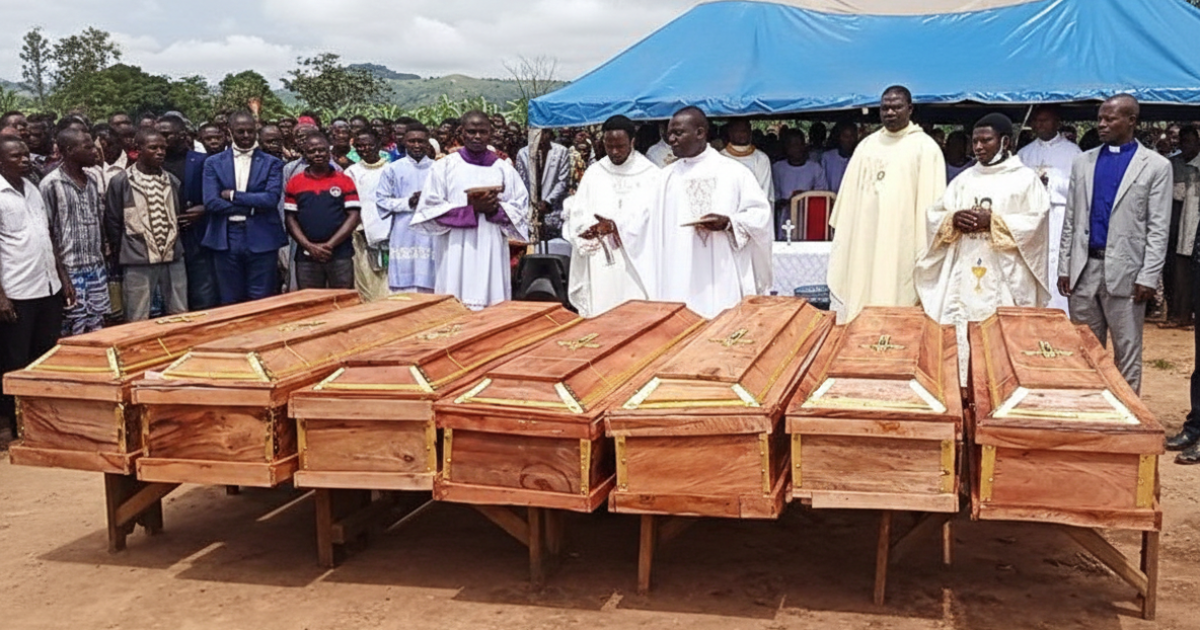
Image generated by AI using user prompts.
Congressman Riley M. Moore joined members of the House Committees on Appropriations and Foreign Affairs at the White House to present a report proposing actions to end the persecution of Christians in Nigeria and address rising extremist violence.
The meeting followed President Trump’s October 31, 2025, redesignation of Nigeria as a Country of Particular Concern. Christian activists had urged the Biden administration for years to restore the designation, a classification for nations where religious freedom is threatened and which can trigger sanctions.
President Trump originally placed Nigeria on the list during his first term, but the Biden administration removed it in 2021. That year’s State Department religious freedom report noted mass killings of both Christians and Muslims and did not identify Christians as a singular target. Trump’s return to office created a new opportunity for activists seeking redesignation.
At the press conference announcing the move, President Trump said, “Christianity is facing an existential threat in Nigeria. Thousands and thousands of Christians are being killed. Radical Islamists are responsible for this mass slaughter. I am hereby designating Nigeria as a Country of Particular Concern. That is a legal definition.” Referring to global figures, he added, “Whether Christians or any such group are slaughtered like in Nigeria, 3,100 versus 4,476 worldwide. What horrible numbers!”
At the same event, he asked Congressman Riley Moore and Appropriations Committee Chairman Tom Cole to lead an investigation into persecution against Christian communities, “and report back to me,” he said, taking ownership of the investigation and the policies that would follow. Unlike previous presidents, Trump demanded the work be done expeditiously, saying, “And I mean like immediately.” He added that the United States cannot stand by while such atrocities occur in Nigeria and elsewhere.
He said persecution was increasing “all over” and confirmed, “We stand ready, willing, and able to save our great Christian population around the world. This is not going to happen. The killing of Christians is not going to happen.”
In a statement, Moore thanked President Trump for the redesignation, saying the investigation provided a clear picture of the threat environment and the persecution Christians face.
Moore and Cole’s investigation resulted in a report issued by the House Appropriations Committee and the House Foreign Affairs Committee. The findings state that Nigeria is the deadliest place in the world to be a Christian, citing attacks by Fulani militias and terrorist groups that have resulted in tens of thousands of deaths, the destruction of churches and schools, kidnappings, and the targeting of Christians through blasphemy laws.
The report outlines congressional efforts to end persecution and address regional instability through accountability measures, counterterrorism initiatives, and coordination with the Nigerian government to improve security. It argues that President Trump’s action and increased congressional attention create an opportunity for change but stresses that Nigeria must demonstrate political will, commit its own resources, strengthen its relationship with the United States, and take concrete steps to eliminate violence against Christians.
The document recommends establishing a bilateral U.S.–Nigeria security agreement to protect vulnerable Christian communities, dismantle jihadist networks, and counter adversaries, including the CCP and the Russian Federation. It calls for withholding certain U.S. funds until Nigeria takes demonstrable action, imposing sanctions and visa restrictions on those responsible for religious persecution, repealing Sharia and blasphemy laws, and coordinating with international partners such as France, Hungary, and the United Kingdom.
Proposed commitments from Nigeria include co-funding humanitarian assistance, prioritizing Internally Displaced Persons in the Middle Belt, strengthening early-warning systems and rapid response measures, holding officials accountable for ignoring warnings, and removing Fulani militias from confiscated farmland to allow displaced communities to return home and restore agricultural productivity.
They also include replacing Russian military equipment with American systems, expanding security cooperation with the United States, and implementing demobilization and disarmament programs to counter armed Fulani militias and Foreign Terrorist Organizations, including those linked to Chinese illegal mining operations.
The report urges implementation of the National Security, Department of State, and Related Programs Appropriations Act of 2026 to advance accountability and priority reforms. It calls for requiring proof of progress before releasing additional funds, strengthening religious freedom protections, reforming the criminal justice sector, enhancing anti-money laundering efforts, disrupting terrorist financing, and safeguarding Nigeria’s financial system.
It also supports U.S. Development Finance Corporation investment in the Middle Belt, a GAO audit on aid effectiveness, and public use of CPC Presidential Directives to name perpetrators of violence. Additional measures include sanctions and visa restrictions on those involved in persecution, repeal of Sharia codes and anti-blasphemy laws, and economic leverage to compel Fulani herdsmen to disarm.
The report further recommends adequate diplomatic staffing, streamlining Foreign Military Sales, requiring a National Intelligence Estimate on sectarian violence, reviewing potential terrorist designations for Fulani militia groups, and continued coordination with France, Hungary, and the United Kingdom.
The post House Republicans Present Nigeria Christian Persecution Report to White House appeared first on The Gateway Pundit.