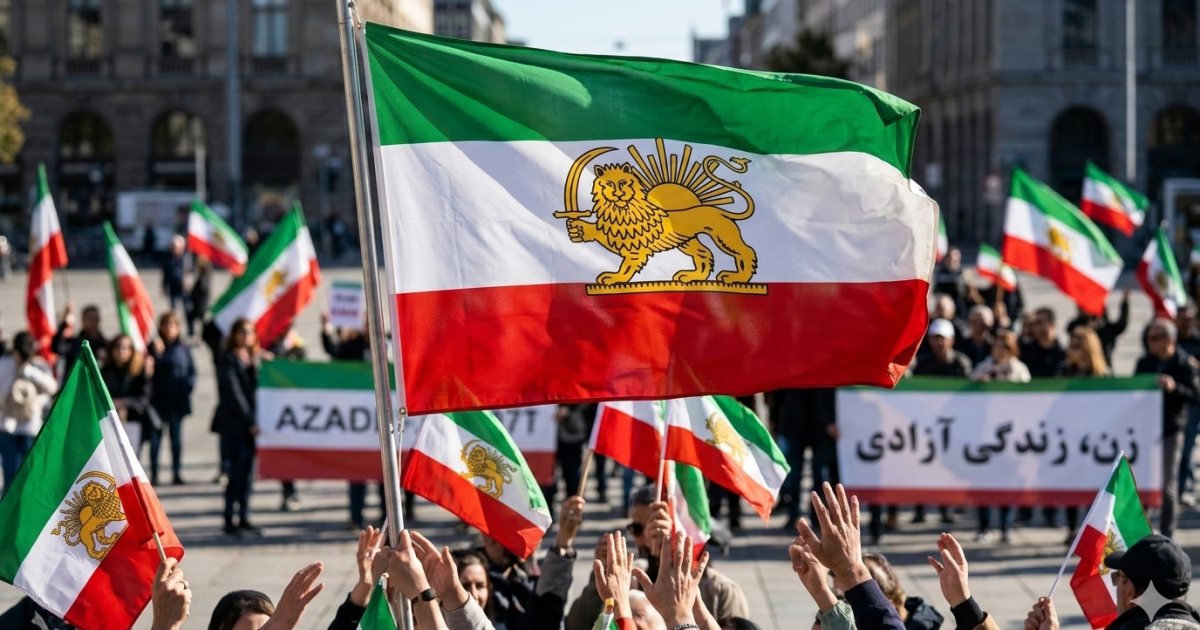
Those who despise the regime often call themselves Persian rather than Iranian, and they wave the Persian flag, which was later altered by the regime with Arabic writing added. Once the regime falls, the Persian people will be free to be Persian again and move beyond the memories of the disastrous Iranian regime. Image by Gemini.
In an Instagram video, a Persian protester goes out on the streets of Los Angeles to shout his praise for the U.S. government for killing Ayatollah Khamenei and bringing hope of liberation to the people of Iran. Across the street are American liberals with banners that read “Hands Off Iran.” He confronts them, furious not only that people who never suffered under the regime want it preserved, but also about the flag they are waving.
He holds the original Persian flag, the Lion and Sun, which has become the symbol of the anti-regime movement. The “Hands Off” protesters are waving the Islamic Republic’s flag, which bears Arabic rather than Persian writing. When he points this out, the liberals tell him he is wrong.
Before the revolution, Iran’s flag centered on the Lion and Sun emblem, traceable thousands of years to before the Achaemenid era. Following the 1979 Islamic Revolution, the flag was changed on July 29, 1980. The Lion and Sun was replaced with a stylized rendering of the Arabic word “Allah,” and the Arabic phrase “Allahu Akbar” was added 22 times in Kufic script along the edges of the green and red bands.
The Persian word for God is “Khoda” or “Parwardigār.” One Iranian commentator noted that Iran is the only country in the world with a flag containing a language other than its own official language. Critics argue the post-revolutionary flag deliberately marginalizes Iran’s pre-Islamic heritage, and its Islamic symbols have raised questions about inclusivity for Iran’s non-Muslim minorities: Christians, Jews, and Zoroastrians.
After 1979, the Lion and Sun was strictly banned from public use inside Iran. Yet a 2022 survey found that 46% of respondents inside Iran preferred it as their national flag, compared to only 30% who chose the Islamic Republic’s flag.
Following the U.S.-Israel strikes, an Iranian protester climbed the wall of Iran’s embassy in London to replace the official flag with the Lion and Sun, footage shared by U.S. President Donald Trump. Similar replacements followed at Iranian embassies in Canberra, Stockholm, Oslo, Rome, Munich, Hamburg, and Ljubljana. For many protesters, the flag is less about monarchism than about distancing themselves from the Islamic Republic.
London’s Metropolitan Police imposed conditions on both the Iranian diaspora rallies and the “Hands Off Iran” protests to prevent clashes between the two groups.
Yudval David, a Fox News commentator and member of the Middle East Forum, told The Gateway Pundit that there are four to five million Iranians around the world who fled the Islamic Revolution, and that many prefer to call themselves Persian to separate themselves from the regime.
“We’re seeing them supporting the United States and Israel,” he said, pointing to protests and marches across Europe and the U.S. in support of the strikes. He added that at Israeli embassies around the world, Iranians and Persians are gathering to lay flowers, sing songs, and express support for Israel for helping and rescuing them.
David explained that inside Iran many people have lived in fear under a regime that has maintained power through intimidation and repression, and that the airstrikes have given many a sense of hope.
He also noted the strikes fell during the Jewish holiday of Purim, which he described as commemorating the survival of Persian Jews during the Persian Empire, when leaders attempted to eradicate the Jewish people but the Jews survived and fought back.
David added that Persian Jews are one of the oldest Jewish communities in the world, with more than 2,500 years of history in Iran, and that the Islamic Revolution forced most of that community into exile.
“So the fact that all of this is happening right now, during the holiday of Purim, is very, very significant,” he said.
The scene on the streets of Los Angeles captures a divide that runs through the Western response to the fall of the Islamic Republic. On one side, Persians who lived under the regime, who lost family members to it, who fled it, and who have spent decades hoping for its end, are celebrating in the streets waving the flag of their ancestors.
On the other side, Western activists who have never set foot in Iran wave the regime’s Arabic-inscribed flag and demand it be left in peace. The Iranian diaspora has a name for what they are, Persian. What they are defending is not Iran. It is the Islamic Republic, and the Persians who survived it know the difference.
The post We Are Persian, Not Iranian: The Diaspora’s Response to the Fall of the Islamic Republic appeared first on The Gateway Pundit.