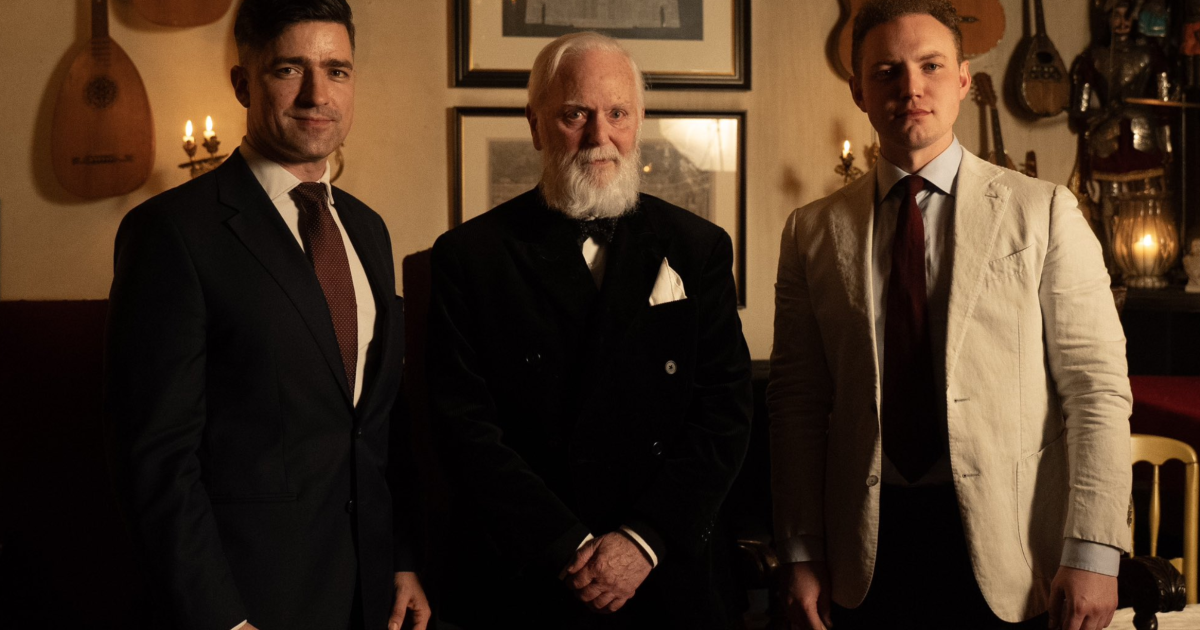
Harrison Pitt, Martin Sellner, Renaud Camus at European Conservative Remigration Discussion in Vienna
A private gathering in Vienna, hosted by The European Conservative, brought together highly esteemed French writer Renaud Camus, Austrian writer and activist Martin Sellner, and British writer and commentator Harrison Pitt for a discussion that treated mass migration not as a technical policy dispute, but as the defining civilizational question of our age.
The focus was remigration, demographic replacement, and whether Europe still has the will to defend its own peoples, borders, and cultural inheritance.
From the opening minutes, Camus invoked the Siege of Vienna in 1683 and cast the Austrian capital as a city that once stood as a bulwark of Christian Europe and now finds itself, once again, on the front line of a historical struggle.
That was not presented as a metaphor for its own sake. The point was clear: Europe’s migration crisis is no longer something that can be discussed in the sterile language of parliamentary NGOs and think tanks. It is, in the eyes of the speakers, a struggle over whether Europe remains Europe at all.
The event itself was private and filmed for later release, but the substance of the evening was anything but hesitant. This gathering was built around one central conviction: that demographic change in Europe is real, measurable, and accelerating—and inseparable from the collapse of political courage among the continent’s ruling class.
Thank you to @EuroConMag & @VaubanBooks for organising such a wonderful event.
Filmed before an audience in Vienna, the conversation itself goes live in just half an hour at the link below. pic.twitter.com/TUtdJz3gUN
— Harrison Pitt (@Harry_pitt) March 8, 2026
Camus was introduced as the man who gave the issue its most famous name: “the Great Replacement.” The argument made on his behalf was not that he is a demographer or a technocrat, but that he saw clearly what millions of Europeans had already begun to sense in their daily lives and gave it language.
That is why his work continues to resonate. He does not speak in the dry vocabulary of public administration, but in the language of memory, inheritance, beauty, and loss. His supporters see him as someone who named what polite society refused to name.
Sellner was introduced a bit differently—not as a literary figure, but as an activist who helped turn these anxieties into political language, organization, and action. His role in the Identitarian movement was presented as transformative, especially in shaping how a younger generation of European nationalists talks about migration, identity, and sovereignty.
Moderator Harrison Pitt pushed the conversation toward its core strategic question: why has remigration become such a central word for Europe’s conservative Right? Why, more broadly, has the defense of demographic continuity become the issue around which so many other debates now orbit?
Camus answered by going back to Europe’s twentieth-century collapse. In his telling, Europe emerged from the age of war and totalitarianism with a uniquely destructive form of guilt—one that no longer produced self-knowledge or restraint, but civilizational self-disgust.
That guilt, he argued, hollowed out Europe’s instinct for self-preservation. A continent that once believed in itself began to doubt its own legitimacy, then its own culture, and finally its own right to survive as a distinct civilization.
Sellner went on to expand that point further. Europe’s problem, he said, is not simply that it is being pressured from the outside, but that it is sabotaging itself from within. He likened the crisis to an “autoimmune” disease, only applied at a macro level—a civilization attacking its own defenses under the influence of ideological poison.
The culprits, in his telling, are not hard to identify: business interests that profit from cheap imported labor, political parties that hope to build new client electorates, and an entrenched ideological class in media, academia, churches, and NGOs that treats national continuity as something shameful or obsolete.
Camus then widened the lens. He distinguished between the “Great Replacement,” which he treats as a description of demographic change, and “global replacement,” a broader process in which modernity strips human beings of rootedness and turns them into interchangeable economic units.
That argument connected migration to a much larger civilizational breakdown. In his view, mass production did not stop with factories and consumer goods; it eventually produced mass culture, mass politics, and, finally, mass man—detached from ancestry, place, language, and historical memory.
That is why, for Camus, immigration is not merely a labor-market issue or even a border issue. It is tied to the flattening of all distinctions—to the idea that peoples, cultures, nations, and ways of life are all exchangeable.
-3 different Generations.
-an exciting debate and
-one goal: to save Europe.
Watch the Podium with @RenaudCamus, @Harry_pitt and myself. pic.twitter.com/pi8YF6hg26
— Martin Sellner (@MartinSellner_) March 8, 2026
He argued that once a society abolishes hierarchy, standards, and inherited forms in the name of egalitarianism, it also loses the mental framework needed to defend itself. A civilization that no longer believes in excellence, beauty, or continuity will not fight to preserve them.
Pitt compressed that idea into a useful phrase: “mass-produced synthetic culture” and “mass-produced synthetic man.” Camus accepted the formulation readily, and it captured much of the evening’s worldview in a single line.
The discussion also turned to Christianity, and here too the tone was unsparing. Sellner argued that traditional Christianity is not the root of Europe’s weakness, but that modernized Western churches have largely abandoned civilizational self-respect and become accomplices to mass migration under the cover of moral universalism.
Camus approached the matter from a more aesthetic and spiritual angle. He argued that the Church has stripped itself of beauty, seriousness, and transcendence, reducing faith to flat moral slogans about openness and welcome—precisely the kind of sentimental language that has accompanied Europe’s surrender.
Both men agreed on the broader point: Europe cannot defend what it no longer itself values. If its own elites are embarrassed by its history, indifferent to its culture, and hostile to its majority populations, then demographic replacement becomes not an accident but the predictable result of elite abandonment.
From there, the conversation moved to legitimacy. Pitt noted that remigration, whatever its appeal to sympathizers, still sounds harsh to many outsiders. Sellner’s answer was that the right’s problem is not logistics but moral confidence.
His argument was straightforward: if the right continues to speak defensively, apologetically, or in purely technical terms, it will lose. It must instead say openly that remigration is necessary, just, and morally serious—not only for Europe’s sake, but because mass migration itself is destructive, destabilizing, and exploitative.
He described today’s migration model as brain drain for the countries migrants leave behind and social disintegration for the countries they enter. In that sense, he argued, remigration should be understood not as cruelty, but as a restoration of order, legitimacy, and rootedness.
Camus made the most striking rhetorical move of the evening when he argued that “decolonization” is the strongest and most morally resonant framework for remigration. If colonization means population transfer, dispossession, and the erosion of a native people’s control over its homeland, then Europe, he argued, has every right to see itself as undergoing colonization and to reverse it.
That framing was not incidental. It was the centerpiece of the event’s attempt to put remigration on higher moral ground. By calling it decolonization, the speakers sought to replace the language of guilt with the language of national liberation.
When Pitt asked how this could be done without violence, Sellner insisted that remigration is the peaceful alternative to future unrest. If present trends continue unchecked, he argued, Europe will eventually face disorder, communal fracture, and possibly outright ethnic conflict; legal, orderly remigration is what might still prevent that outcome.
He also insisted on a point that now sits at the heart of many nationalist arguments: Europeans are the indigenous peoples of Europe. That simple fact, he said, has been systematically obscured by institutions that are willing to speak the language of indigenous rights everywhere except in Europe itself.
On the EU, the verdict from both men was grim. Sellner rejected the current European Union as a fundamentally anti-identitarian structure—hostile to borders, Christianity, nationhood, and any serious attempt to reverse demographic change.
He made clear that if Brussels blocks governments elected on a remigration platform, those governments should ignore it or leave. Pitt reinforced that point by raising the idea of a kind of “deportation NATO,” in which sovereign states cooperate on enforcement, removals, visa sanctions, remittance controls, and logistical coordination.
Camus, for his part, emphasized that he remains pro-European in the civilizational sense while rejecting the present Brussels order. He even suggested Vienna, rather than Brussels, as a more fitting symbolic capital for Europe.
The evening closed with a clear sense of urgency. Sellner argued that Europe may have only ten to fifteen years before current demographic trends become far harder to reverse, and he pointed to Vienna itself as an example of how quickly the social landscape can change.
The core message of the event was: remigration is no longer being presented merely as a policy preference, but as a civilizational necessity. In that view, Europe’s crisis is not temporary, not manageable through technocratic tweaks, and not something that can be solved by the same elites who created it.
It is a crisis of survival, legitimacy, and political will. And in Vienna, the speakers agreed that if Europe is to remain a home for its own peoples, it will have to rediscover the courage to say so—and to act accordingly.
The post The European Conservative Hosts Vienna Forum on Remigration and the Great Replacement; Discussion with Renaud Camus, Martin Sellner, Harrison Pitt appeared first on The Gateway Pundit.