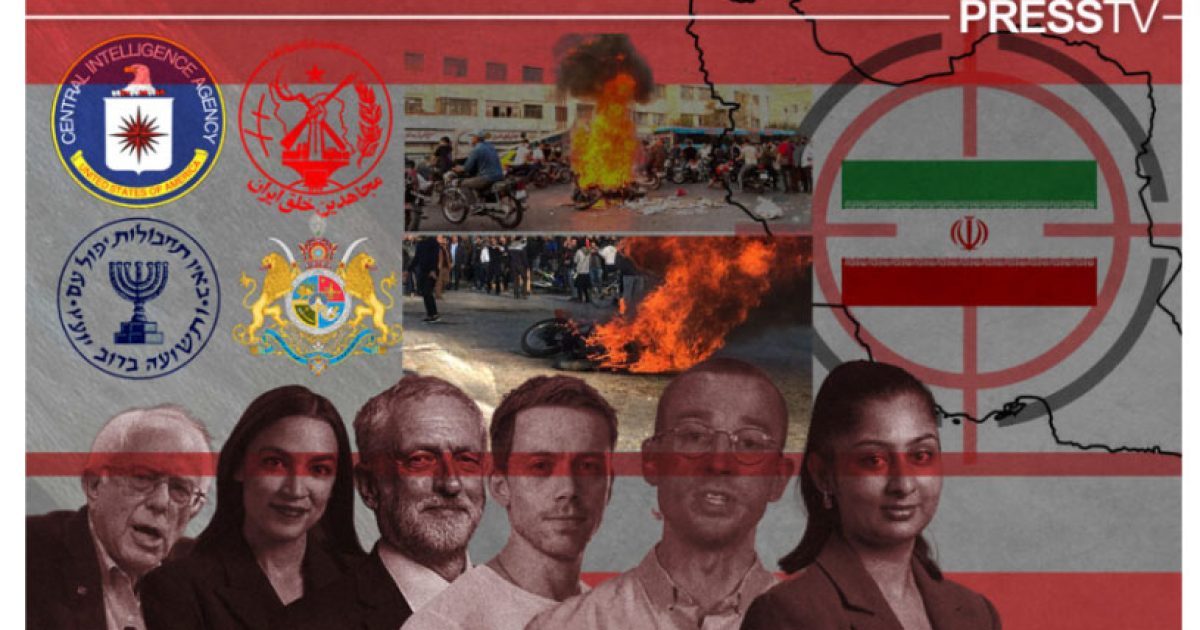
PressTV is the Iranian regime’s propaganda channel, which broadcasts in both English and Hebrew, vilifying the U.S. and Israel.
When mass protests erupted across Iran in late December 2025, driven by economic collapse and public fury at the regime, the Islamic Republic responded on two fronts simultaneously. Security forces killed thousands in the streets. But the regime’s propaganda apparatus launched an equally aggressive campaign, designed not just to survive the crisis, but to turn it into a weapon against its foreign enemies.
A detailed analysis published in February 2026 by the International Institute for Counter-Terrorism (ICT) documents how Tehran deployed a structured, phased information warfare strategy during the December 2025 to January 2026 protests. The findings reveal a regime that treats narrative control as essential to its survival and never stops targeting Israel and the West. At the same time, many of its own citizens despise the government so much that they are willing to risk being shot for a chance to speak out against it.
Iran’s information warfare apparatus developed as a practical response to the country’s conventional military limitations. Iran’s primary enemies are the US and Israel, and it has long been believed that Iran could not beat the US in a direct military conflict. Consequently, the regime has made information warfare a central strategic pillar of its survival.
The system combines ideological messaging, psychological pressure, targeted disinformation, media management, and digital network coordination to shape how domestic and foreign audiences perceive events. Its goals are consistent: to portray the United States as hypocritical and aggressive, to frame Israel as the primary enemy in a broader civilizational struggle, and to maintain the regime’s grip on power against any challenger.
The machinery is organized in a clear top-down structure. Khamenei or senior officials issue the core narrative. The Islamic Revolutionary Guard Corps (IRGC) and its media divisions translate those directives into operational content, arrests, confessions, documentary videos, and alleged field evidence.
A sprawling network of semi-official Telegram, Twitter, Instagram, and other channels in multiple languages, operating under the banner of the “axis of resistance,” then amplifies the message globally.
When protests first broke out, the regime’s initial response was carefully calibrated. Pro-government channels largely avoided the subject, apparently hoping the demonstrations would simply fade. When that failed, Khamenei addressed the situation directly on January 3, acknowledging that economic frustration was legitimate, while drawing a sharp distinction between peaceful protesters and what he characterized as “mercenaries” seeking to destabilize the state.
By conceding that some grievances were valid, the regime insulated itself from accusations of complete indifference. By defining violent protesters as rioters rather than dissidents, it established the justification for lethal suppression. The message was aimed primarily at the Iranian public and at security forces who needed ideological cover for the crackdown to come.
By January 9, as the protests intensified and international attention grew, the regime shifted from vague references to “mercenaries” to explicit accusations against the United States and Israel. Khamenei’s speech that day established what would become the dominant narrative for the remainder of the crisis: the protests were not an organic expression of Iranian discontent but a coordinated foreign operation, a covert act of war by Washington and Tel Aviv against the Iranian people.
The IRGC followed with what it presented as supporting evidence: arrested agents, confessional videos, and alleged documentation of foreign weapons distribution. The narrative divided protesters into two categories: paid foreign operatives at the top, and manipulated, innocent young Iranians who had been deceived into serving enemy agendas.
This framework accomplished several things at once. It delegitimized the protests. It allowed the regime to position itself as the defender of ordinary Iranians against external predators. And it provided retroactive justification for the massacre of thousands.
Three sub-themes ran through this phase. First, American hypocrisy: the United States, which had struck Iranian territory during the 12-Day War of June 2025, was now presenting itself as a champion of the Iranian people’s freedom. The regime hammered this contradiction relentlessly, packaging it in visually striking Telegram posts showing Trump being compared directly to the suffering of Iranian civilians.
Second, economic motivation: U.S. interest in Iran, the regime argued, was always about oil and resources, not human rights, drawing explicit parallels to American actions in Venezuela days earlier. Third, domestic U.S. instability: pro-government channels amplified footage of anti-ICE protests in American cities, suggesting that Trump had no standing to lecture anyone about governance.
Once the protests had been bloodily suppressed, the regime pivoted to a victory narrative. Beginning around January 12, official and affiliated channels shifted their messaging to portray the crackdown as a historic triumph of the Iranian nation over foreign conspiracy. Pro-government rallies were staged and filmed. Senior officials made public appearances projecting confidence. The “great Iranian nation,” in the language of state media, had faced down its enemies and prevailed.
The victory narrative served the domestic audience primarily, providing psychological closure, reinforcing the regime’s claim to popular legitimacy, and shutting down any remaining space for organized resistance. For external audiences, it was designed to rebut Western media coverage of the massacre, presenting a stable government with broad public support instead.
In the final phase, following Khamenei’s January 17 speech, the regime moved to recontextualize the entire episode within its broader confrontation with the West. The protests were no longer a domestic disturbance that had been suppressed; they were a new front in a war that had never actually ended. The June 2025 twelve-day conflict with Israel, in this telling, was merely a tactical pause. The unrest of December and January was the enemy’s next offensive, and Iran had repelled it.
This reframing served a crucial mobilization function. Casting the protests as an act of war transformed what had been a crisis of legitimacy into a national security emergency requiring unified public support. It also served as a warning to the international community: any future Iranian retaliation for the protests, against U.S. or Israeli targets, would be framed as a continuation of legitimate self-defense.
One of the report’s most significant findings is that throughout this entire domestic crisis, Iran’s foreign influence operations against Israel and the West continued uninterrupted, and in some respects intensified.
PressTV’s Hebrew-language channel sustained a steady stream of content designed to portray Israel as economically declining, politically fragmented, and morally discredited. Press TV is a state-owned media organization directly funded and controlled by the Iranian government. It operates as the English-language division of Islamic Republic of Iran Broadcasting (IRIB), which is the only legal broadcaster within Iran. The Hebrew-language service is the latest expansion of this state media apparatus targeted at Israel. The head of the IRIB was appointed directly by the Supreme Leader of Iran, Ayatollah Ali Khamenei, until his death on February 28, 2026. The content is unsurprisingly pro-regime and anti-U.S. and anti-Israel.
Hebrew-language articles highlighted coalition instability, internal protests, ultra-Orthodox confrontations with security forces, and demographic pressures, all framed to erode Israeli public confidence and sustain a sense of internal decay.
English-language channels targeted American audiences with footage of domestic unrest, framing U.S. political divisions as evidence of systemic collapse. Iranian-affiliated networks also sent threatening text messages directly to Israeli civilians’ phones, urging recipients to watch the sky at midnight in anticipation of strikes, a psychological operation designed to induce fear and undermine civilian morale without firing a single missile.
The regime’s ability to sustain coordinated foreign influence operations while simultaneously managing a catastrophic domestic uprising suggests that this system is deeply institutionalized and not easily disrupted.
For the United States, Israel, and allied governments now engaged in Operation Epic Fury, this has direct implications. Iran’s capacity to shape narratives about the current conflict, framing military strikes as atrocities, portraying Western governments as aggressors, mobilizing proxy audiences from Nigeria to Pakistan, is not a secondary concern. It is an active component of the battlefield.
The post Iran’s Information War: Crushing Protesters While Targeting Israel and the United States appeared first on The Gateway Pundit.