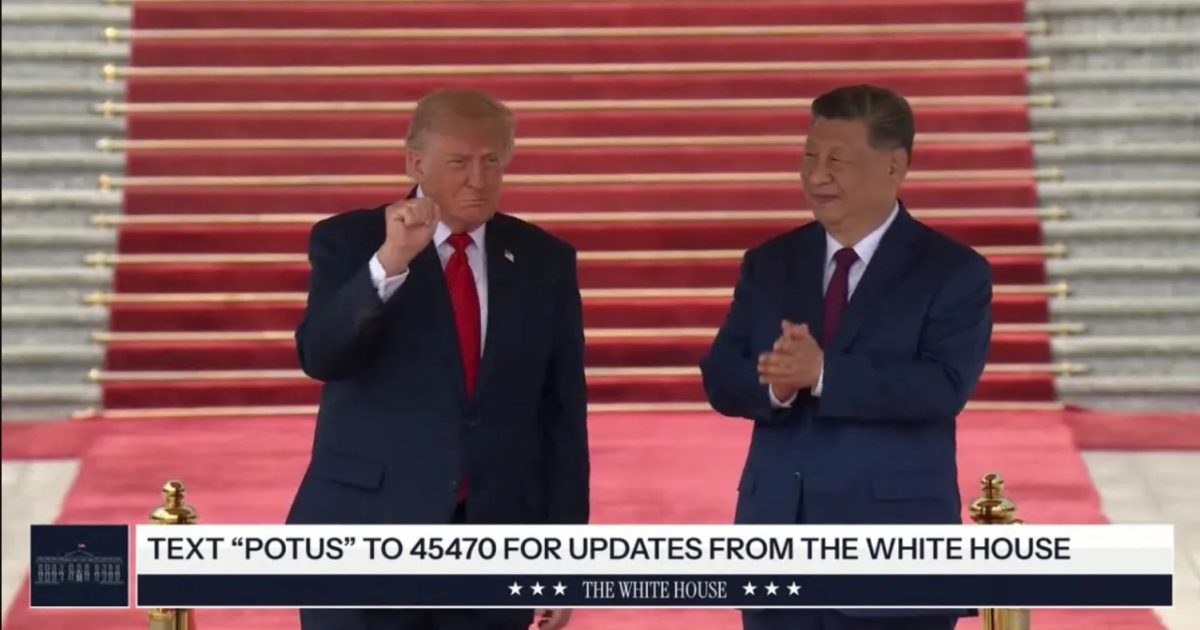
Mainstream media claim that President Trump is in a weaker position in his meeting with Chinese leader Xi Jinping, but he is actually in a much stronger position. Photo courtesy of the White House.
As U.S. President Donald Trump arrived in Beijing on May 14 for his first state visit to China since 2017, much of the mainstream media framed the moment as Xi Jinping holding the stronger hand. That framing is contrary to the facts.
The U.S. carried out 573 air strikes in Trump’s first year alone, more than Biden’s entire four-year total of 494, according to ACLED. When coalition strikes are included, the 2025 total rises to 658, approaching Biden’s four-year coalition figure of 694. The operations spanned eleven distinct theaters in seventeen months. In Somalia, the administration conducted more operations in 2025 alone than the Bush, Obama, and Biden administrations combined, beginning February 1 with ISIS strikes in the Golis Mountains coordinated with the Somali government.
In Iraq, a March 2025 al-Anbar strike killed Abdallah Makki Muslih al-Rifai, the ISIS second-in-command, coordinated with Iraqi intelligence. In Yemen, Operation Rough Rider launched in mid-March 2025 against Houthi command-and-control hubs using JASSM cruise missiles, JSOWs, and Tomahawks, surpassing $1 billion in costs within its first month, before concluding with an Oman-mediated ceasefire on May 6, 2025.
In Iran, Operation Midnight Hammer deployed seven B-2 stealth bombers from Whiteman Air Force Base to drop 30,000-pound GBU-57 Massive Ordnance Penetrators on Fordow, Natanz, and Isfahan, as part of the 12-day war that ended in a ceasefire.
In Syria, Operation Hawkeye Strike followed the deaths of two U.S. soldiers and a civilian interpreter in an ISIS ambush, killing more than 50 ISIS operatives by mid-February 2026, with 35 ISIS targets struck on January 10 alone. In Nigeria, Christmas Day strikes against ISIS in Sokoto State used more than a dozen Tomahawk cruise missiles from a Navy ship in the Gulf of Guinea, with 100 U.S. troops deployed to train Nigerian forces.
Against drug networks, a sustained maritime campaign in the Caribbean and eastern Pacific produced at least 44 aerial strikes and 150 deaths by early 2026, while a U.S. intelligence task force played a role in the Mexican raid that killed cartel boss El Mencho, the largest cartel takedown in at least a decade. In Ecuador, joint U.S.-Ecuadorian forces launched operations in March 2026 against designated terrorist organizations.
In Venezuela, a CIA drone strike marked the first known U.S. attack inside the country. That was followed by Operation Absolute Resolve on January 3, 2026. During the operation, U.S. special forces breached Maduro’s compound in Caracas. Approximately 75 Cuban and Venezuelan guards were killed, and Maduro and his wife were transported to New York on narcoterrorism charges.
On February 28, 2026, the U.S. and Israel launched Operation Epic Fury against Iran’s ballistic missile capabilities, naval capacity, nuclear program, and proxy network. The operation involved two aircraft carriers, 200 fighter jets and bombers, and more than 50,000 U.S. troops. Close to 2,000 targets were struck during the campaign.
The result, documented by analysts at Time, is that world leaders are now treating the management of Trump’s emotions as a strategic priority. ACLED described the approach as “strike first, ask questions later,” the most extreme tool at a president’s disposal, used not as a last resort but as a first move. That behavioral shift is visible in government decisions across every region.
Bilateral Trade Agreement negotiations between the U.S. and India were launched by Trump and Modi on February 13, 2025, with Modi positioning himself as one of the first global leaders to meet Trump after his inauguration. The Trump administration lifted 25 percent tariffs on India over its Russian oil imports in February 2026, underscoring Washington’s willingness to use coercive economic leverage even against close partners.
Gulf states that spent years cultivating neutrality were pulled directly into the conflict: Iran fired 438 ballistic missiles, 2,012 drones, and 19 cruise missiles at the UAE alone, striking airports, civilian areas, and U.S. military bases. Gulf capitals including Dubai, Manama, and Kuwait City were struck, and Qatar, Oman, Kuwait, and Bahrain, none of which had any role in initiating the conflict, all took Iranian fire.
In Latin America, the Atlantic Council noted that the “Trump Corollary” to the Monroe Doctrine was formally in effect after Maduro’s capture, with the November 2025 NSS explicitly authorizing targeted military deployments and lethal force against cartels. Trump is also the first U.S. president to hold Iran militarily accountable for its decades of state-sponsored terrorism, including the 1979 seizure of the U.S. Embassy, and when the IRGC declared the Strait of Hormuz closed, he was the only world leader willing to confront them with force.
Xi Jinping, by contrast, condemned U.S. interventions in both Venezuela and Iran while doing nothing to stop them. Beijing holds a “Comprehensive Strategic Partnership” with Tehran, buys up to 90 percent of Iran’s oil, and signed a 25-year partnership covering infrastructure, trade, and security cooperation. None of that stopped the U.S. from striking Iran, killing its supreme leader, and blockading its ports. China responded with phone calls: Wang Yi made 26 phone calls between February 28 and the lead-up to the April 8 ceasefire.
When CNN reported that China was preparing to ship MANPADs to Iran, President Trump warned China it would “have big problems.” Chinese leader Xi Jinping then reportedly told Trump in a letter exchange that Beijing was not providing weapons to Iran, and China backed down.
The spectacle extended to the summit itself. Secretary of State Marco Rubio had been sanctioned twice by China for his human rights criticism. Yet when he entered the country, he was not arrested. Instead, Chinese authorities reportedly used a different transliteration of his surname to sidestep their own sanctions without formally lifting them. A government that cannot enforce its own sanctions against the man it has banned is not negotiating from a position of strength.
Trump arrived in Beijing, and the summit’s central question is what Xi will do for Trump on Iran, not the reverse. Treasury Secretary Bessent called on China to join Washington in supporting an international operation to reopen the Strait of Hormuz, which China needs open as badly as anyone. Analysts note China could otherwise use this leverage regarding Taiwan. As of mid-May 2026, the ceasefire remains on “life support,” the Strait remains well below pre-conflict transit levels, and no comprehensive agreement has been reached.
China, presented with its most significant strategic opportunity in a generation, has done none of the things a peer competitor would be expected to do. PLA incursions into Taiwan’s Air Defense Identification Zone dropped to 147 sorties in February 2026, the lowest monthly total since President Lai Ching-te took office, with no incursions on 13 of 28 days, the opposite of opportunistic escalation.
A former PLA colonel quoted in the South China Morning Post said PRC military aid to Iran “makes no sense,” and a leading PRC think tank director stated that PRC-Iran military ties are “far below what the outside world assumes.” China has not meaningfully escalated in the South China Sea, has not surged support to Russia, and has not defended Venezuela, Iran, or any other declared partner.
The structural weakness of China’s position extends beyond military inaction. China’s actual 2025 GDP growth fell short of 3 percent, with late-2025 growth sputtering around 1 percent. Beijing set its lowest target in decades for 2026, aiming for 4.5 to 5 percent expansion while acknowledging “deep-seated structural problems.” China’s GDP deflator has remained negative since 2023 and is expected to fall a further 0.5 percent in 2026, the longest deflationary streak on record. Fixed asset investment fell 2.6 percent year-on-year through 2025, private investment declined 5.3 percent, and real estate development investment fell 15.9 percent. China remains a net importer of both oil and food.
The United States, by contrast, has been a net energy exporter since 2019, with total energy exports reaching a record high of approximately 30.92 quadrillion British thermal units in 2024, and is the world’s second-largest crude oil exporter. The U.S. is the world’s leading agricultural exporter, with $170 billion in crops and commodities shipped in 2025, dominating global corn production and ranking among the top producers of soybeans and wheat.
According to UNCTAD, the United States secured its position as the world’s top destination for FDI flows in 2025, ranked number one in the Kearney FDI Confidence Index for the 13th consecutive year.
The Heritage Foundation concluded that Trump’s demonstrated willingness to use kinetic force across multiple theaters complicates Xi’s Taiwan calculations, making a move on Taiwan a high-stakes gamble Beijing cannot afford. One leader is acting across eleven theaters simultaneously, and the other is calculating whether to act based on what the first one might do.
Xi has shown himself either unable or unwilling to defend his allies, enforce his own sanctions, or protect China’s stated strategic interests when they conflict with U.S. preferences. It is Xi, not Trump, who arrived at this summit from a position of weakness.
The post Trump vs. Xi: Why the Media Has the Summit Power Dynamic Backwards appeared first on The Gateway Pundit.