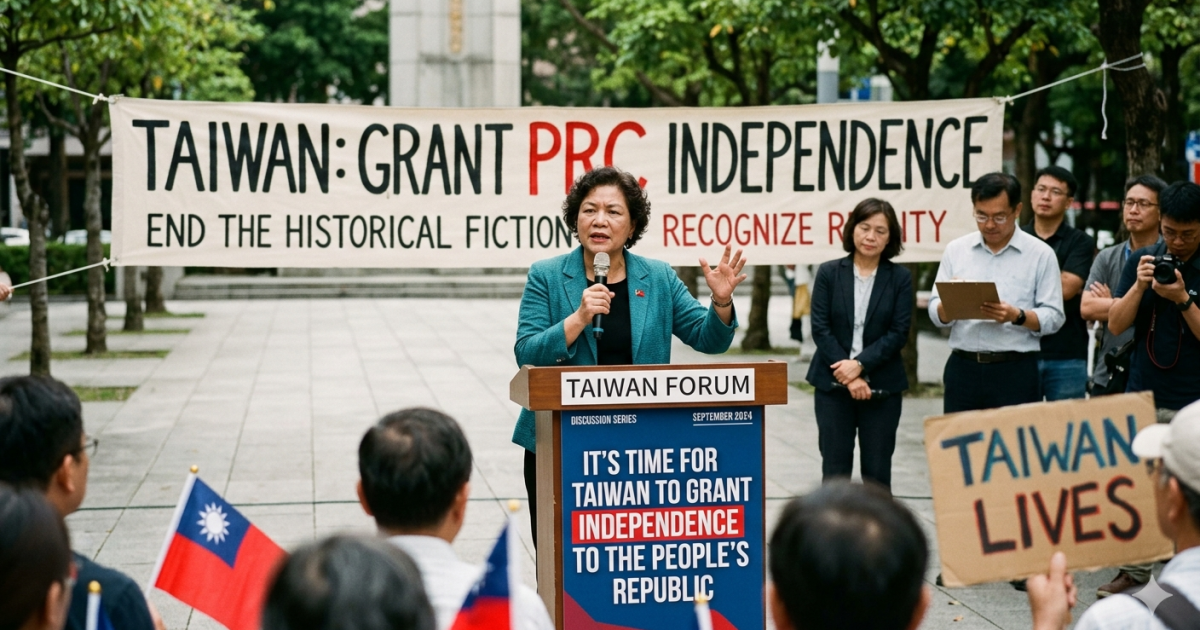
One of the last great injustices of the modern era could be righted if Taipei would just grant independence to mainland China. President Trump warned Taiwan against declaring independence, but he never said anything about Taiwan declaring the PRC independent. Image generated by Gemini
Whether you love or hate the People’s Republic of China (PRC), I think we can all agree that it is time Taiwan finally granted them independence.
Shortly after his meeting with Chinese leader Xi Jinping, President Donald Trump warned Taiwan not to declare independence unilaterally. The media took this to mean that Trump had thrown Taiwan under the bus or was withdrawing U.S. support for Taiwan’s current independent status. The reality is that Trump has always been a strong supporter of Taiwan.
During his first term, he placed U.S. combat troops and trainers in Taiwan, the first stationed there since 1979. He repeatedly increased both the type and value of weapons provided to Taiwan, approving a $1.4 billion package in June 2017 and a $330 million package in October 2018.
In 2017, the National Security Council introduced the Free and Open Indo-Pacific framework, which includes defending countries in the first island chain, including Taiwan, approved by Trump in 2018. In his second term, Trump approved an $11 billion weapons package for Taiwan, larger than anything in his first term.
Trump’s warning reflects longstanding U.S. policy, not a reversal of it. The U.S.-Taiwan defense framework recognizes a One China policy and holds that Taiwan’s status must be resolved peacefully between China and Taiwan. The U.S. position has long been that it would not defend Taiwan if Taiwan were to unilaterally declare independence.
Trump’s warning was a reminder of that framework, which has governed U.S. policy since the Taiwan Relations Act of 1979. The media’s claims that Trump is abandoning Taiwan should be accompanied by condemnation of Europe, which has never done a fraction of what Trump and the U.S. have done to maintain Taiwan’s sovereignty.
Taiwan is a multiparty democracy with its own army, currency, laws, and freedoms distinct from mainland China. Its passport ranks 31st globally, providing visa-free access to 134 countries including the entire EU. Taiwan’s GDP per capita was approximately $34,400 in 2024, more than double that of the average mainland citizen. Its people enjoy freedom of speech, religion, and political affiliation, as well as the freedom to leave and return as they wish. The fate of Hong Kong demonstrates what Taiwan would lose if absorbed into the PRC.
The question of Taiwan’s formal status, however, remains unresolved, and the resolution may lie not in a declaration of independence but in something more unexpected: Taiwan granting independence to the mainland.
The 1947 ROC constitution states in Article 4 that the territory of the Republic of China shall not be altered except by resolution of the National Assembly. No such resolution has ever been passed to remove the mainland claim, and in 2019 the ROC Supreme Court in Appeal 334 affirmed the ROC still claims sovereignty over mainland China under that article. Both the ROC and the PRC use maps derived from the same 1925 KMT territorial claims, with Taiwan’s constitution still asserting sovereignty over the mainland and the PRC claiming the same territory plus Taiwan itself.
In practice, Taiwan already treats the mainland as foreign. The 1991 constitutional amendments and the Cross-Strait Relations Act label the mainland as ROC territory while simultaneously treating it as foreign land. The 1991 amendment also recognized the PRC as a legitimate and equal political entity rather than a rebellious group.
Both the PRC and the ROC have officially adhered to the “one China” principle, differing only on who represents it. Beijing exploits this shared premise at every diplomatic turn to frame the Taiwan question as an internal Chinese matter. As long as Taipei’s own constitution claims the mainland, Beijing can point to Taipei’s own founding document to support that argument. By granting PRC independence, Taiwan would weaken any claim the PRC makes toward Taiwan.
Legal scholars at Lawfare have noted that Taiwan’s official position does not fulfill the international-law criteria for an independent state. This is because the ROC statehood claim extends not just to the Taiwan Area but also to the mainland, over which Taiwan exercises no effective control.
Dropping that claim and asserting sovereignty only over the territory Taiwan actually governs would align its legal position with reality. It would also strengthen Taiwan’s case under the Montevideo Convention criteria of defined territory, permanent population, government, and capacity for foreign relations.
Beijing has spent decades portraying Taiwan as a renegade province seeking to break away. If Taiwan formally relinquishes its claim to the mainland, framed as a sovereign act of recognition, it repositions Taiwan as the party ending a dispute, not a separatist movement.
It would be like Taipei saying to Beijing, “I think we should start seeing other people.” Taiwan could then add, to soften the blow, “But it’s not you, it’s me. I’m the broken piece.”
Recognition of the PRC as a separate country would force Beijing to either accept the recognition or publicly reject a peaceful resolution, exposing the PRC’s position as a territorial claim against a foreign sovereign state.
Under the current ROC constitution, changing the territorial claim requires initiation by one-fourth of Legislative Yuan members, passage by a three-fourths supermajority with three-fourths attendance, then approval by majority referendum. The bar is high, but the mechanism exists. It is a political will problem, not a legal impossibility.
The post It’s Time for Taiwan to Grant Independence to the People’s Republic appeared first on The Gateway Pundit.