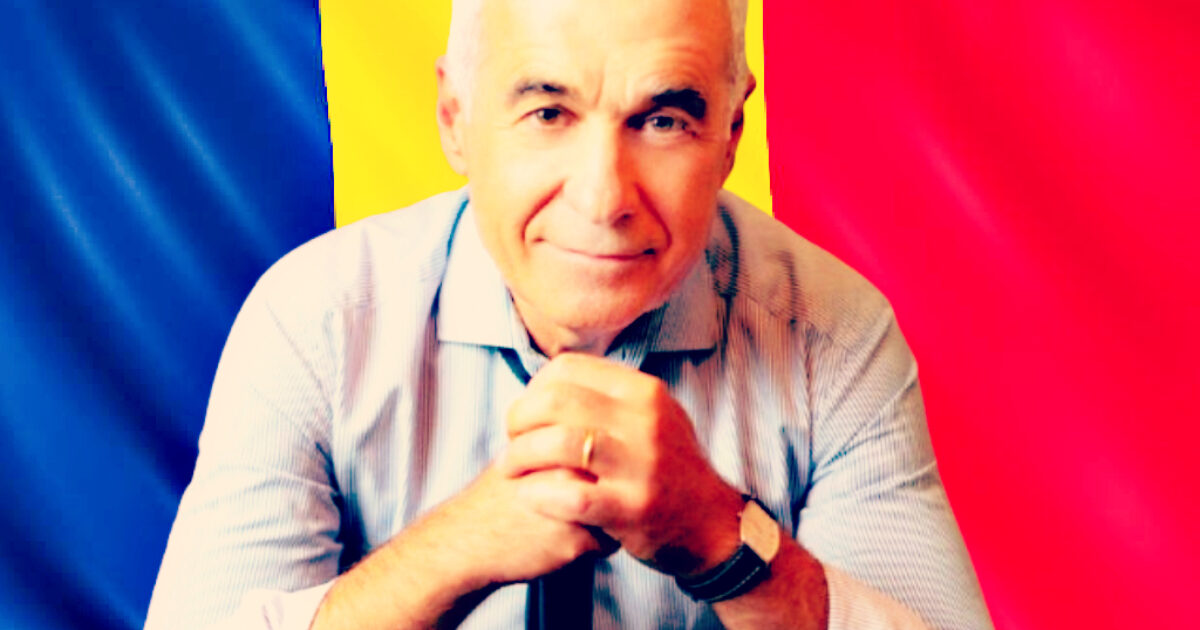
Flag of Romania waving with highly detailed textile texture patter as
On Sunday evening, March 15, 2026, a televised interview drew notable attention across Romania’s media landscape. Călin Georgescu, the former presidential candidate who largely withdrew from public view following the cancellation of the December 8, 2024 elections, appeared on Realitatea Plus for a two-hour conversation with Anca Alexandrescu.
According to available data, cited by various Romanian news outlets, the broadcast averaged nearly 460,000 viewers per minute—more than double the channel’s typical prime-time audience of around 190,000 in February. Realitatea Plus rose from ninth to fifth place in the daily rankings, trailing only major entertainment programs and leading generalist channels.
By comparison, a simultaneous appearance by the sitting prime minister on Digi TV attracted significantly lower viewership, averaging around 40,000 viewers per minute. While audience figures can fluctuate depending on programming and context, the contrast was widely noted. In a country where television remains a key source of political information, such disparities can offer insight into public interest and engagement.
The renewed attention surrounding Georgescu comes against the backdrop of a highly unusual political episode. In December 2024, the Constitutional Court annulled the second round of the presidential election, citing concerns related to alleged irregularities. The decision halted the electoral process at a critical moment, leaving the outcome unresolved and prompting ongoing debate about its implications.
Since then, Romania has operated under a transitional political arrangement, with broader concerns emerging about economic performance and institutional trust. Public opinion data reflects a significant degree of dissatisfaction. A survey conducted by Ipsos in October 2025 found that 74 percent of respondents expressed low trust in the government, while only a small minority reported confidence in current leadership. Broader attitudes toward political institutions have also been affected, with trust levels declining across multiple areas of public life.
These trends suggest a period of uncertainty and disillusionment for many citizens. Economic pressures—including inflation, energy costs, and wage stagnation—have compounded political frustrations, contributing to a more critical public mood. Analysts note that such conditions can increase openness to alternative political voices or proposals.
During his recent interview, Georgescu addressed these themes directly. He emphasized the importance of restoring public confidence and ensuring that democratic processes are perceived as fair and credible. “In a genuine crisis, what the people decide must be respected,” he said, calling for a renewed focus on public trust and institutional legitimacy.
He also pointed to broader structural challenges within the political system, suggesting that divisions between parties often reflect not only ideological differences but also difficulties in addressing economic concerns. Without clear and effective policy solutions, he argued, political fragmentation may deepen.
As part of his remarks, Georgescu proposed the idea of a broader political alignment among major parties, including the establishment left PSD, the up-and-coming, populist, anti-globalist right AUR party, and establishment centrist-right PNL, framed as a form of national cooperation aimed at stabilizing the country. He described such an approach as an effort to move beyond past disputes and focus on shared priorities. “We should approach past disagreements with greater moderation,” he said, adding that Romania is facing complex external and internal pressures.
Observers note that the proposal reflects an attempt to respond to both political and economic concerns highlighted in recent polling. Each of the parties mentioned represents distinct constituencies within the electorate, and any form of cooperation would likely require careful negotiation.
At the same time, discussions within political circles have touched on potential interim arrangements that could bring together different parliamentary forces. While such scenarios remain speculative, they illustrate the degree of ongoing debate about how best to address the current situation.
Critics of these ideas have pointed to practical and legal challenges, as well as the potential risks of increased polarization. Questions also remain about how such proposals would align with Romania’s commitments within the European Union and other international frameworks.
Nonetheless, the broader issue of public trust continues to shape the political environment. Many analysts agree that rebuilding confidence in institutions will be essential for long-term stability, regardless of the specific political path chosen.
Georgescu’s television appearance has been interpreted by some as a sign that he continues to resonate with a segment of the electorate. The level of viewership suggests sustained interest in his perspective, even after a period of relative absence from public life.
Romania’s current situation reflects a combination of economic pressures, political uncertainty, and evolving public expectations. Challenges such as inflation, demographic shifts, and migration trends continue to influence both policy debates and voter attitudes.
As the country moves forward, the ability of political leaders to respond to these concerns—while maintaining institutional credibility—will likely play a decisive role. The coming months may offer greater clarity on whether new forms of cooperation or alternative approaches can emerge.
What remains evident is that public engagement with political developments remains high. The response to Sunday’s broadcast highlights an ongoing demand for dialogue and direction in a period marked by significant change.
In this context, Romania’s political future will depend not only on institutional decisions but also on how effectively those decisions are communicated and understood by the public.
The post Stolen Election, Collapsed Trust: Georgescu Proposes Unity Government as Romania’s Last Best Hope appeared first on The Gateway Pundit.