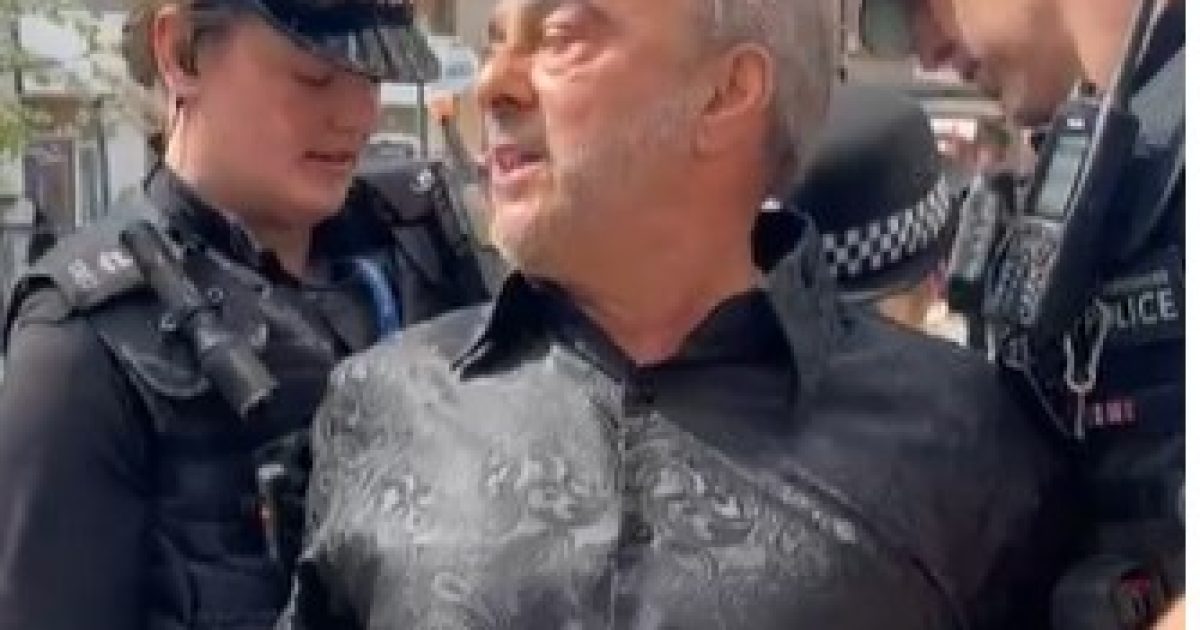
On April 18, 2026, in the town of Watford just outside London, British police handcuffed a Christian pastor for preaching the Gospel in public. Pastor Steve Maile, a 66-year-old minister with decades of experience, was standing in the town centre doing what has long been a normal part of British life—open-air preaching—when officers moved in, restrained him, and led him away in front of his wife and children. As he was being handcuffed, Maile continued to address the crowd, insisting, “You cannot arrest me. I am a preacher of the Gospel… There is no offense being committed here.” It was a striking moment, not only for those present but for the thousands who later watched the footage online.
What makes the incident particularly troubling is what followed. No charges were ultimately brought against Maile. The allegations, whatever they were, did not stand. Yet he was still detained for hours and placed on bail. In other words, a man engaged in peaceful religious expression was treated as a criminal, only for the legal basis of that treatment to evaporate shortly afterward. For many observers, that raises a fundamental question: if no crime was committed, why was such force deemed necessary in the first place?
Pastor Maile is not an unknown figure or a fringe agitator. He has spent more than 35 years in ministry, preaching in over 50 countries and working to establish churches and support Christian communities. Alongside his wife Karina, he founded Oasis City Church in Watford in 1999, raising a family and building a reputation rooted in outreach and evangelism. This background matters because it underscores the nature of the incident—this was not disorderly conduct or confrontation, but a continuation of a long-standing and peaceful religious practice.
Nor is this an isolated case. In November 2025, Pastor Dia Moodley was arrested in Bristol after engaging members of the public in a discussion about theology. He was detained for eight hours and subsequently banned from the city centre during the Christmas season. As with Maile, the circumstances involved speech rather than violence, yet the response from authorities was significant. Taken together, these incidents point to a broader pattern rather than a one-off misjudgment.
Across the United Kingdom, Christian street preachers—once a familiar and largely accepted presence—are increasingly being treated as potential public order concerns. Complaints from passers-by, even when based on disagreement rather than genuine harm, can trigger police intervention. Meanwhile, other forms of public expression, including those that are equally or more provocative, often appear to receive a more permissive response. Whether intentional or not, the perception of unequal treatment is growing, and perceptions like that can be as consequential as policy itself.
At the heart of the issue is the legal framework governing speech in the UK. Unlike the United States, Britain does not have a single, entrenched constitutional protection equivalent to the First Amendment to the United States Constitution. Instead, it relies on a range of statutes, including the Public Order Act 1986, which grant authorities discretion to act when speech is considered offensive or disruptive. While such laws are intended to maintain public order, their broad wording leaves significant room for interpretation—and, critics argue, for inconsistent enforcement.
That discretion becomes particularly contentious when applied to religious speech. Traditional Christian views on issues such as sin, salvation, and morality can be perceived as offensive in an increasingly secular and pluralistic society. When offense becomes a trigger for enforcement, the line between maintaining order and restricting expression can quickly blur. Over time, this creates a chilling effect, where individuals begin to self-censor not because the law explicitly forbids their speech, but because the consequences of speaking are unpredictable.
For American readers, the situation in Britain offers a sobering point of comparison. The United States still benefits from robust constitutional protections for free speech and religious expression, but cultural and institutional pressures are evolving in ways that echo some of the same dynamics. Speech codes, corporate moderation policies, and shifting social norms are already shaping what is considered acceptable to say in public. While the legal frameworks differ, the underlying tension between freedom and regulation is increasingly familiar on both sides of the Atlantic.
What the UK demonstrates is how quickly the balance can shift. A society that once prided itself on liberty and open debate can, within a relatively short period, begin to place limits on peaceful expression—particularly when that expression challenges prevailing cultural attitudes. These changes rarely occur through dramatic legal overhauls. Instead, they emerge gradually, through case-by-case decisions that, taken together, redefine the boundaries of acceptable speech.
Maile’s response to his arrest reflects a refusal to accept that shift. Following his release, he made clear that he intends to continue preaching, stating, “You will never, ever stop me preaching the Gospel of Jesus Christ.” His stance resonates with a long tradition of religious conviction in the face of opposition, but it also highlights the growing tension between individual freedom and institutional authority in modern Britain.
Ultimately, this is about more than one pastor or one incident in Watford. It is about whether the principles of free expression and religious liberty are being upheld consistently, or whether they are becoming contingent on the content of the speech itself. When a peaceful preacher in a public square ends up in handcuffs, it raises questions that extend far beyond the immediate circumstances.
Freedom rarely disappears in a single moment. It is narrowed incrementally, shaped by enforcement decisions and cultural pressures until its limits become difficult to recognize. What is happening in the United Kingdom may still be debated, but it is no longer easily dismissed. For Americans watching from across the Atlantic, it serves less as a distant curiosity and more as a cautionary example of how fragile fundamental freedoms can become when their application is no longer even-handed.
The post UK Police Arrest a Pastor for Preaching the Gospel: A Disturbing Sign for Christian Free Speech appeared first on The Gateway Pundit.