WATCH: The Democrat Party: Condemning Racism While Using It Politically
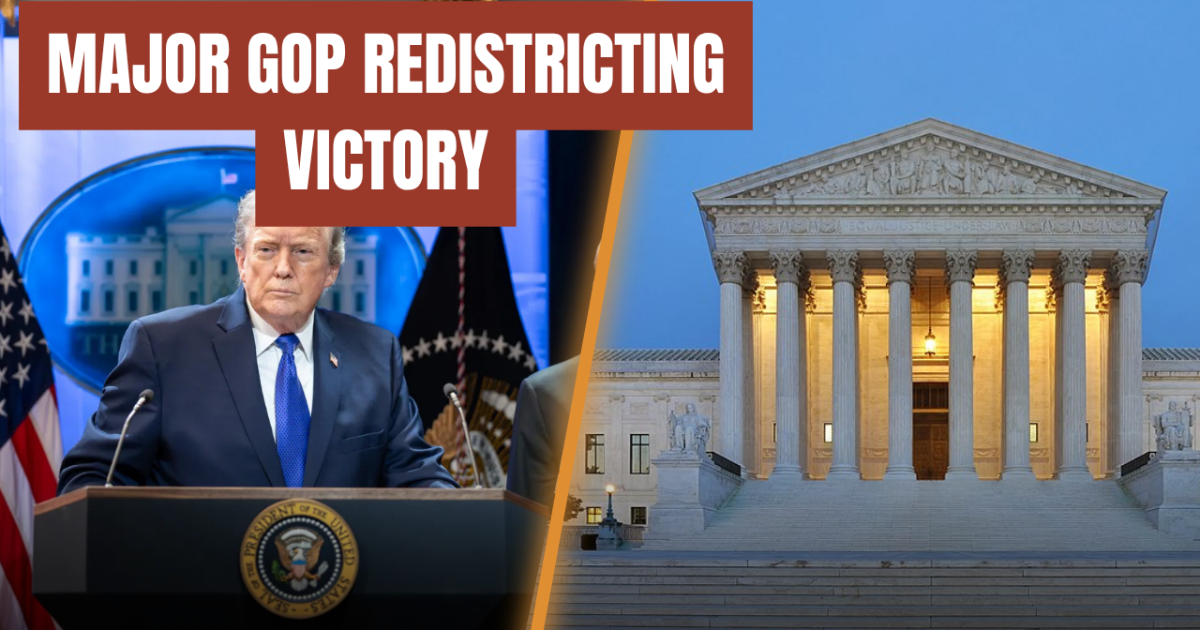
The Supreme Court’s recent decision involving Louisiana’s congressional maps marks a turning point in how race is used in redistricting.
The case did not emerge from abstract legal theory. Rather, came from a specific dispute over whether states can be forced to draw congressional districts primarily on the basis of race under Section 2 of the Voting Rights Act.
Louisiana has six congressional districts. For years, one of those districts was drawn as a majority-Black district, reliably electing a Democrat. That structure was not incidental.
The district was drawn across multiple regions, connecting urban areas a ensure a consistent voting bloc. In recent years, advocacy groups pushed for a second majority-Black district, arguing that additional representation was required under federal law.
Lower courts accepted that argument. Louisiana was ordered to redraw its map to include a second majority-minority district, effectively guaranteeing another Democrat-leaning seat.
The justification relied on Section 2 of the Voting Rights Act, which prohibits voting practices that dilute minority voting power.
The Supreme Court intervened after a separate legal challenge argued that the new map relied too heavily on race without sufficient evidence of discrimination. That distinction became central. The Court did not reject the Voting Rights Act. Instead, it clarified the standard required to invoke it.
The ruling emphasized that race cannot be the dominant factor in drawing districts unless there is clear and demonstrable evidence of intentional discrimination.
General claims of underrepresentation or statistical disparities are not enough. Courts must identify a specific and provable violation, not assume one based on outcomes alone.
That clarification exposes a broader contradiction in how race is used in political arguments.
Many of the same political actors who argue that race should not determine outcomes in education, employment, or law enforcement have defended its use in redistricting when it produces favorable political results.
The Louisiana case placed that contradiction under judicial scrutiny.
The implications extend beyond one state. Similar disputes exist in Alabama, Georgia, South Carolina, and North Carolina, where courts have required districts to be drawn with race as a primary consideration.
The Supreme Court’s decision introduces a stricter threshold that could reshape those maps. If race cannot be used as the primary organizing principle without clear evidence of discrimination, many of those districts may face legal challenges.
The political consequences are measurable. Redrawing districts without race as the dominant factor could shift multiple seats. In closely divided states, even a small number of districts can determine control of the House of Representatives.
Estimates suggest that dozens of seats could change alignment if similar cases follow the Louisiana precedent.
This case also reframes the legal debate. The issue is no longer whether minority representation matters.
The question is whether the Constitution allows race to be used as a default tool in achieving it. The Supreme Court’s answer places limits on that approach.
The Louisiana decision did not eliminate redistricting disputes. It clarified the rules governing them. Those rules now require evidence, not assumptions, and intent, not inference. That standard will shape how future maps are drawn and how courts evaluate them.
The Patriot Perspective has recently switched its main platform from YouTube, and we would greatly appreciate it if you subscribed to us there. [HERE]
Have a question for the show? Like the video and comment your question, and we will be sure to answer it in our next episode’s letters segment. [HERE]
The post The Democrat Party: Condemning Racism While Using It Politically (VIDEO) appeared first on The Gateway Pundit.