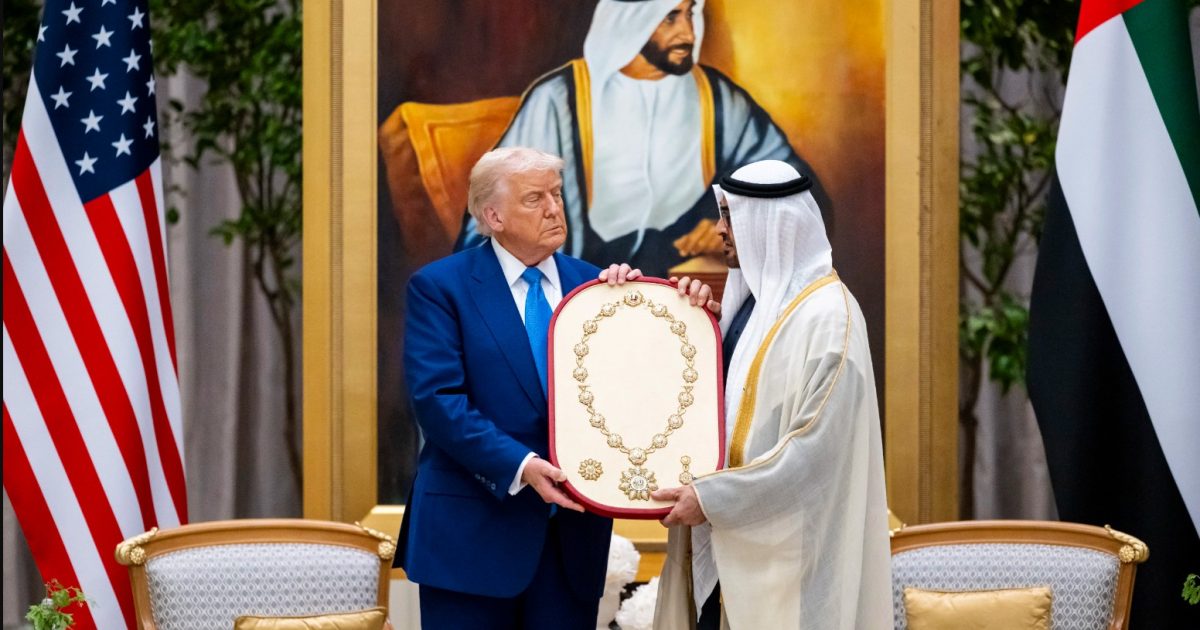
President His Highness Sheikh Mohamed bin Zayed Al Nahyan awarded the Order of Zayed, the UAE’s highest civilian honor granted to heads of state, to U.S. President Donald Trump. Photo courtesy of Mohamed bin Zayed.
On May 1, 2026, the United Arab Emirates’ exit from OPEC took effect. The exit is significant because OPEC produces approximately 35–40% of the world’s oil supply. As a cartel, it dictates production levels and therefore influences prices. The UAE was the third-largest producer in OPEC, behind Saudi Arabia and Iraq, with Abu Dhabi’s membership dating to 1967.
By exiting, the UAE breaks from a cartel that has kept oil prices elevated and stands to unlock roughly one million extra barrels per day. It also controls the Fujairah pipeline, which bypasses the Strait of Hormuz entirely, giving it an export route independent of the waterway Iran has used as a chokepoint.
UAE Energy Minister Suhail Al Mazrouei stated that he chose now to exit because it would have a “minimum impact” on “our friends at OPEC and OPEC+.” The deeper driver is production capacity. Before the Iran war, UAE capacity had grown to 4.8 million bpd, but its OPEC quota held it to 3.2 million bpd. The UAE aims to reach 5 million bpd by 2027 and needs freedom from quota negotiations to pursue that target.
The UAE had been the target of Iranian missile and drone attacks for weeks. Tehran’s closure of the Strait of Hormuz severely constrained UAE oil exports, forcing Abu Dhabi to redirect supply through the Fujairah terminal on the Gulf of Oman, exporting 1.7 million bpd of crude and refined fuels that way. This was enough to survive, but not enough to meet its ambitions.
The exit also reflects a longer-running divergence from Saudi Arabia. Abu Dhabi’s foreign-policy positions on Yemen and other regional matters had progressively isolated it within OPEC. The UAE deepened ties with the United States and Israel through the 2020 Abraham Accords and views those relationships as its primary lever of regional influence.
For the United States, near-term energy costs remain elevated. Brent crude is trading at around $117 a barrel, and the national average U.S. gas price stands at approximately $4.23, a four-year high. Immediate relief at the pump is unlikely while Hormuz remains closed. Once the Strait reopens, the UAE is expected to ramp up supply quickly without OPEC quota negotiations. This potential additional supply would meet 1–2% of daily global oil demand.
U.S. upstream producers, Exxon Mobil, Chevron, Occidental, and EOG, benefit from sustained higher crude prices in the near term, as supply uncertainty drives capital toward U.S. shale. At the same time, airlines, trucking, and freight face continued margin pressure; jet fuel represents roughly 25–30% of airline operating costs.
If the exit triggers further OPEC defections, or a price war follows once the Iran war ends and Gulf producers compete for market share, crude prices could fall sharply. Even if there are no further defections and no price war, oil prices will still fall post-conflict due to the reopening of the Strait of Hormuz, plus the additional oil produced by the UAE.
Furthermore, assuming the U.S. manages to change the regime in Iran and allows Iran to sell oil on the open market, this would bring prices down even further. Even without regime change, permitting Iran to sell oil on world markets would have the same effect. Any and all of these possible outcomes would be good news for U.S. manufacturers and consumers.
The strategic picture for Washington is positive. A UAE outside OPEC but inside the U.S. security and financial orbit is a pro-dollar actor with greater production freedom, allowing Washington to engage Abu Dhabi directly on price and volume rather than through Saudi-led multilateral negotiation.
Security cooperation reinforces this alignment. Israel deployed Iron Dome systems to UAE soil during the Iran war, and the U.S. has deepened its footprint at Al Dhafra Air Base. The dirham has been pegged at 3.6725 to the dollar since 1997, a peg that requires holding dollar reserves. More UAE oil reaching markets without OPEC quota constraints means more dollar-denominated transactions, not fewer. Washington also gains increased leverage over remaining OPEC members such as Venezuela, and potentially over Iran if the regime changes.
The UAE exit fits within a broader pattern of U.S. moves to expand influence over globally traded oil. The U.S. is already the world’s largest producer at roughly 13.6 million bpd. Pressure on Venezuela disrupts a major non-allied producer. Panama Canal pressure limits Chinese logistical leverage over oil transit.
The Iran blockade has curtailed roughly 2.5 million bpd of Iranian output and weakens a key OPEC member. Control of the Strait of Hormuz, if secured on U.S. terms, converts a critical chokepoint from a vulnerability into a controlled asset. Strait of Malacca pressure adds influence over Asian energy supply chains directly relevant to China’s import dependency.
Aggregated, these moves position the United States toward greater influence over a larger share of globally traded oil than at any point since the 1970s. This is a petrodollar consolidation scenario, executed through military positioning, bilateral dealmaking, and deliberate fragmentation of producer cartels that have historically acted against U.S. price preferences.
The post UAE Leaving OPEC: A Win for U.S. Control of Global Oil appeared first on The Gateway Pundit.