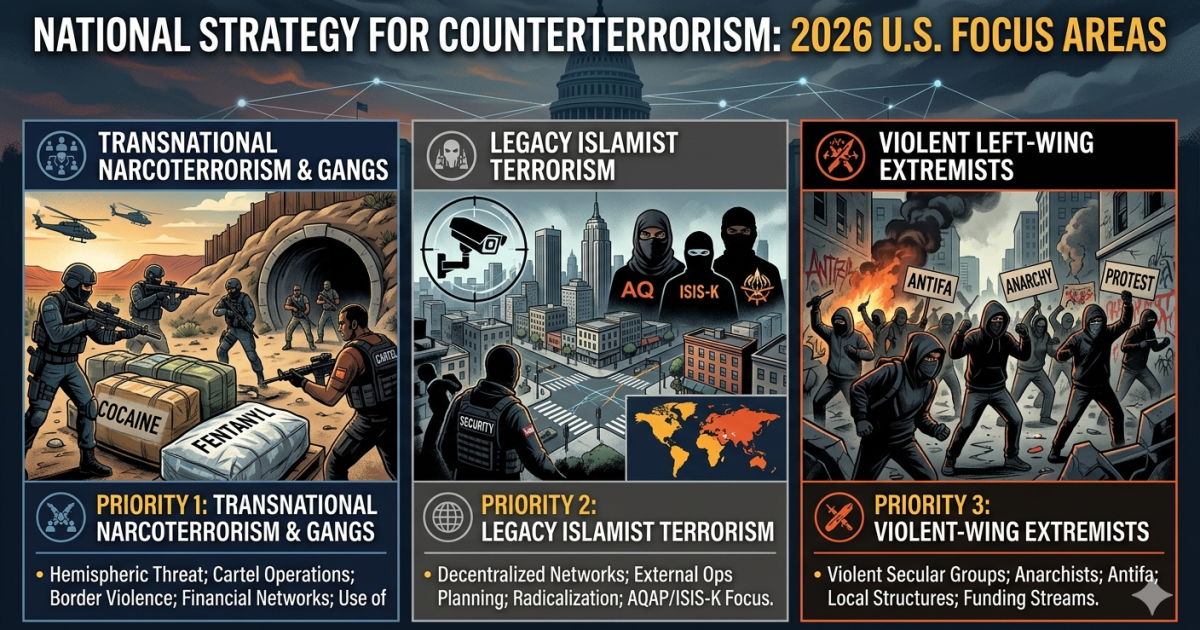
The 2026 United States Counterterrorism Strategy identifies three primary terrorism threat categories: narcoterrorists and transnational gangs, legacy Islamist organizations, and violent left-wing extremists, including anarchists and Antifa. The Biden administration had previously identified white supremacists and anti-government extremists as the primary domestic-terrorism threat. Image by Gemini.
President Trump signed the 2026 United States Counterterrorism Strategy on May 6, setting out the clearest statement yet of his administration’s national security priorities. The 16-page document frames counterterrorism as a core mission centered on protecting Americans from both foreign and domestic threats, and represents a structural reorganization of how the U.S. government identifies, prioritizes, and neutralizes terrorist threats.
“Our new U.S. Counterterrorism Strategy is a return to common sense and Peace through Strength,” Trump wrote in the foreword. “Terrorists of any kind will not be allowed to find safe harbor here at home or attack us from abroad.”
Most importantly, the Trump administration’s strategy focuses on actual threats to the U.S. homeland while prohibiting the weaponization of government resources against citizens, patriots, and Christians whom the Biden administration labeled as white supremacist threats despite what the Trump administration says was a lack of evidence supporting those claims.
Trump’s foreword catalogs the actions his administration regards as proof of concept: the apprehension of the Abbey Gate attack mastermind within 43 days of taking office, the return of 106 American hostages without ransom, the designation of Muslim Brotherhood chapters as terrorist organizations, the capture of Nicolás Maduro, and the strikes on Iran under Operation Midnight Hammer and Operation Epic Fury. “We Will Find You and We Will Kill You,” he wrote, quoting himself from the first days of his second term.
The strategy identifies three primary terrorism threat categories: narcoterrorists and transnational gangs, legacy Islamist organizations, and, for the first time in U.S. history, violent left-wing extremists, including anarchists and Antifa. The document argues that cartels represent an existential threat because of fentanyl trafficking and human smuggling, citing a 12-month period under the Biden administration in which more Americans died from cartel-supplied drugs than all U.S. combat deaths since 1945.
Beyond those three categories, the strategy identifies five evolving dynamics shaping the current counterterrorism environment. These include growing collaboration between nation-states and terrorist or cartel organizations; a “Red-Green” alliance between far-left and Islamist movements; expanding operational cooperation between established groups such as al-Shabaab and the Houthis; the increasing use of drones and advanced technologies by cartels and jihadist groups, allegedly supplied by Iran, China, and Russia; and the threat of terrorists acquiring nuclear, biological, or chemical weapons, which President Trump describes as “the single greatest threat to this world.”
The document also establishes a special category for state-driven terror-like actions, including sabotage, proxy warfare, and assassinations, which some U.S. allies classify as hybrid attacks. The strategy states that the United States will work with its counterterrorism partners to prevent such state-backed operations from reaching the American homeland.
White House counterterrorism director Sebastian Gorka placed hemispheric narcoterrorism at the top of the administration’s priority list, stating that the strategy “first prioritizes the neutralization of hemispheric terror threats by incapacitating cartel operations until these groups are incapable of bringing their drugs, their members and their trafficked victims into the United States.”
The second priority focuses on the five Islamist terrorist organizations deemed capable of conducting external operations against the American homeland, including al-Qaeda, AQAP, ISIS, and ISIS-K, while maintaining continued pressure on the global Muslim Brotherhood network.
The third priority formally designates violent left-wing extremists as a counterterrorism category. The strategy directs the government to map their membership, sever international ties, and cripple them operationally before they can carry out attacks. As evidence of that threat, the document cites the assassination of Charlie Kirk by a radical whom the strategy describes as espousing extreme transgender ideology.
The strategy’s three operational goals are to identify terrorist plots before they occur, sever arms, funding, and recruiting pipelines, and ultimately destroy established threat groups. To accomplish this, the administration plans to use Foreign Terrorist Organization designations to unlock additional intelligence authorities and financial sanctions, authorize unilateral military action when host governments refuse to cooperate, and employ diplomatic, financial, cyber, and covert operations against state sponsors of terrorism.
On weapons of mass destruction, the document directs a policy update beyond NSPM-35 and NSPM-36, the baseline framework established during President Trump’s first term. The strategy argues that technological advances since those directives were issued have significantly altered the threat landscape, particularly regarding the potential terrorist acquisition of nuclear, biological, chemical, and radiological weapons.
The strategy outlines separate regional approaches for the Western Hemisphere, the Middle East, Europe, Africa, and Asia. In Africa, the administration plans to maintain a lighter military footprint while continuing counterterrorism cooperation against ISIS affiliates, al-Qaeda, and al-Shabaab, while specifically highlighting attacks on Christian communities. In the Middle East, the document commits to continued operations against Iranian-backed proxy organizations and the protection of maritime trade routes and strategic waterways.
Across all five regions, the strategy places increased burden-sharing demands on allies. Gorka told Time that “the idea that there is one hyper power in the world, America, and it will protect all from every threat is untenable… we reject the concept of global police officer.”
The document reserves its sharpest language for the Biden administration, accusing senior officials of weaponizing counterterrorism authorities against conservative Catholics attending traditional Latin Mass in Virginia, parents speaking at school board meetings, members of Congress, and Trump and his associates. The strategy commits to prohibiting politically motivated use of intelligence powers and states that those who abused them “must pay the full judicial cost for their crimes against the civil rights of innocent Americans.”
Quoting Trump’s 2025 National Security Strategy, the document states that “departments and agencies of the United States Government have been granted fearsome powers. Those powers must never be abused, whether under the guise of ‘deradicalization,’ ‘protecting our democracy,’ or any other pretext.”
The 2026 strategy represents a sharp departure from Biden-era counterterrorism priorities. Biden’s National Strategy for Countering Domestic Terrorism, released June 15, 2021, made no structured assessment of foreign terrorist threats and established no clear hierarchy among threat categories, directing federal resources primarily toward white supremacist and anti-government militia movements.
The intelligence assessment underpinning that strategy, produced jointly by the NCTC, FBI, DHS, CIA, and DIA, concluded that white supremacists were “the DVE actors with the most persistent and concerning transnational connections” and most likely to conduct mass-casualty attacks. Islamist terrorism and left-wing violence were deprioritized while resources were directed at alleged white supremacist networks.
The Biden administration was able to support this framework by manipulating statistics and redefining terms. The ADL and Biden-era intelligence assessments inflated far-right terrorism statistics by bundling January 6, a political riot directed at a government building with no ethnic or religious target, together with actual hate crimes and racially motivated attacks, producing lopsided figures of 30 far-right incidents versus six Islamist incidents between 2021 and 2023.
What transnational white supremacist activity did exist consisted of shared websites, online propaganda, and occasional travel, not directed attacks, external operations planning, financing of U.S. cells by foreign handlers, or state sponsorship, the operational infrastructure that defines the jihadist threat. The ODNI 2026 Annual Threat Assessment records that in 2025 there were at least three Islamist terrorist attacks inside the United States and law enforcement disrupted at least 15 U.S.-based Islamist plotters, while zero white supremacist organizations directed or claimed a domestic attack in the same period.
Meanwhile the Islamist threat was active and growing under Biden. FBI Director Wray testified that in 2022 Hezbollah was engaged in long-term plotting inside the United States seeking retaliation for the killing of Qassem Soleimani, and that homegrown violent extremists inspired by ISIS and al-Qaeda represent “the greatest, most immediate international terrorism threat to the homeland.”
In June 2024 alone, eight Tajikistani nationals with ISIS ties were arrested in Los Angeles, New York, and Philadelphia after crossing the southern border, with at least one using the CBP One app to gain entry. An Afghan national who entered on a Special Immigrant Visa in September 2021 was later arrested for planning an Election Day attack in the name of ISIS. The New Year’s Day 2025 Bourbon Street attack, in which an ISIS-inspired U.S. citizen killed 14 people, was the deadliest jihadist attack on U.S. soil since the 2016 Pulse nightclub shooting.
By September 2023, Foreign Policy reported that more terrorist groups existed in more countries, controlling more territory, than at any previous point in modern history. The Trump administration argues that this deterioration occurred while the Biden administration focused heavily on what it describes as a manufactured threat posed by white supremacists.
The 2026 strategy reverses that framework, placing cartels, jihadist networks, and violent left-wing extremists at the top of the threat hierarchy.
The post Trump Administration Releases 2026 US Counterterrorism Strategy: “We Will Find You and We Will Kill You” appeared first on The Gateway Pundit.